 Back
Inside the Cell: Structure and Function of Prokaryotic and Eukaryotic Cells
Study Guide - Smart Notes
 Tailored notes based on your materials, expanded with key definitions, examples, and context.
Inside the Cell
Cell Theory and Universal Cell Components
All living organisms are composed of cells, which are the fundamental units of life. Cells share several universal features that are essential for their function and survival.
Proteins: Perform most cellular functions, including catalysis, structure, and signaling.
Nucleic acids: Store, transmit, and process genetic information (DNA and RNA).
Carbohydrates: Provide chemical energy, carbon, structural support, and cellular identity.
Plasma membrane: Acts as a selectively permeable barrier, controlling the movement of substances in and out of the cell.
Cell Types and Domains of Life
Cells are classified based on their morphology and evolutionary history. There are two fundamental cell types and three domains of life.
Eukaryotes: Have a membrane-bound nucleus.
Prokaryotes: Lack a membrane-bound nucleus.
Domains:
Bacteria: Prokaryotic
Archaea: Prokaryotic
Eukarya: Eukaryotic
Bacterial and Archaeal Cell Structures and Their Functions
Prokaryotic Cell Structure
Prokaryotic cells, including bacteria and archaea, possess distinctive structures and functions. Recent advances in microscopy have revealed their complexity.
Chromosome: Usually a single, circular DNA molecule associated with proteins, organized in a region called the nucleoid.
Plasmids: Small, circular, supercoiled DNA molecules that carry genes for specialized functions.
Ribosomes: Macromolecular machines for protein synthesis, composed of RNA and protein; not membrane-bound.
Cytoplasm: All contents within the cell membrane.
Phospholipids: Bacterial phospholipids have fatty acids bound to glycerol; archaeal phospholipids have branched isoprenoid chains bound to glycerol.

DNA Organization and Packaging
Prokaryotic DNA is highly organized and packaged by supercoiling, allowing efficient storage and access to genetic information.
Nucleoid: Region where the chromosome is located.
Supercoiling: DNA is tightly packed to fit within the cell.

Ribosomes and Protein Synthesis
Ribosomes are essential for translating genetic information into proteins. They consist of large and small subunits and are similar in size and function across bacteria and archaea, though their primary structures differ.
Cytoskeleton in Prokaryotes
Bacteria and archaea contain protein filaments that form a cytoskeleton, which is crucial for cell division and maintaining cell shape.
Internal Membrane Complexes in Photosynthetic Species
Some prokaryotes possess internal photosynthetic membranes that convert sunlight into chemical energy. These membranes are infoldings of the plasma membrane and contain enzymes and pigments necessary for photosynthesis.

Organelles in Prokaryotes
Certain bacteria have internal, membrane-bound compartments (organelles) for specialized functions, such as storing ions, holding magnetite crystals, or concentrating enzymes for biosynthesis.
Cell Wall Structure
The cell wall forms a protective exoskeleton around most prokaryotes, providing shape and rigidity. In bacteria, the primary structural component is peptidoglycan, and some have an additional outer membrane made of glycolipids.
External Structures: Flagella and Fimbriae
Many prokaryotes have external structures for movement and attachment:
Flagella: Long filaments that rotate to propel the cell.
Fimbriae: Needlelike projections that promote attachment to surfaces or other cells.

Eukaryotic Cell Structures and Their Functions
Size and Complexity of Eukaryotic Cells
Eukaryotic cells are generally larger and more complex than prokaryotic cells. They include protists, fungi, plants, and animals, and may be unicellular or multicellular.
Benefits of Organelles
Organelles compartmentalize the cell's interior, allowing separation of incompatible reactions and increasing the efficiency of cellular processes.

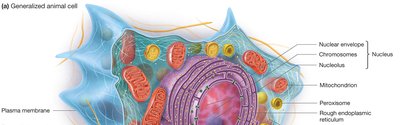
The Nucleus
The nucleus is a large, highly organized, membrane-bound compartment that stores and transmits genetic information. It is surrounded by a double-membrane nuclear envelope with pore-like openings and contains the nucleolus, where ribosomal RNA is synthesized and ribosome subunits are assembled.

Ribosomes
Ribosomes manufacture proteins and are found free in the cytosol or attached to the endoplasmic reticulum. They lack a membrane and are not considered organelles.
Endoplasmic Reticulum (ER)
The ER is an extensive membrane-enclosed factory, continuous with the nuclear envelope. It has two regions:
Rough ER (RER): Studded with ribosomes; synthesizes proteins for shipment, membrane insertion, or secretion.
Smooth ER (SER): Lacks ribosomes; contains enzymes for lipid synthesis and detoxification, and serves as a reservoir for Ca2+ ions.
Golgi Apparatus
The Golgi apparatus processes, sorts, and ships proteins synthesized in the RER. It consists of stacked, flat membranous sacs (cisternae) with distinct cis and trans faces.
Lysosomes
Lysosomes are recycling centers found only in animal cells, containing enzymes specialized for hydrolyzing macromolecules. They are part of the endomembrane system, along with the ER and Golgi apparatus.
Vacuoles
Vacuoles are prominent organelles in plant and fungal cells, serving roles in digestion, recycling, storage, and protection.
Peroxisomes
Peroxisomes are globular organelles that perform reduction–oxidation reactions and detoxify harmful substances, such as hydrogen peroxide.
Mitochondria
Mitochondria supply ATP to cells and have dynamic morphology. They possess their own DNA and ribosomes, and can grow and divide independently.
Chloroplasts
Chloroplasts are found in plant and algal cells and are the site of photosynthesis. They have their own DNA and ribosomes, and their structure includes thylakoids, grana, and stroma.
Cytoskeleton
The cytoskeleton is an extensive system of protein fibers that gives cells shape, structural stability, and facilitates transport and organization of cellular components.
Cell Wall and Extracellular Matrix
Fungi, algae, and plants have a stiff cell wall outside the plasma membrane for structural support. Animal cells lack a cell wall and are supported by the extracellular matrix (ECM).
Summary Table: Eukaryotic Cell Components
Organelle | Main Function | Key Features |
|---|---|---|
Nucleus | Stores genetic information | Double membrane, nucleolus |
Ribosomes | Protein synthesis | Free or bound, no membrane |
Rough ER | Protein synthesis and processing | Studded with ribosomes |
Smooth ER | Lipid synthesis, detoxification | No ribosomes |
Golgi Apparatus | Protein sorting and shipping | Stacked cisternae |
Lysosomes | Macromolecule recycling | Acid hydrolases |
Vacuoles | Storage, digestion | Large in plants |
Peroxisomes | Redox reactions | Enzyme catalase |
Mitochondria | ATP production | Own DNA, double membrane |
Chloroplasts | Photosynthesis | Own DNA, thylakoids |
Cytoskeleton | Structure, transport | Actin, intermediate, microtubules |
Cell Wall/ECM | Support | Cell wall (plants), ECM (animals) |
Putting the Parts into a Whole
Structure-Function Relationship
The structure of each cell component correlates with its function. Variation in organelle content and size reflects the specialized roles of different cell types.
Cell Systems: Nuclear Transport and Endomembrane System
Nuclear Transport
The nucleus is separated from the cytosol by the nuclear envelope, which contains nuclear pore complexes. These complexes regulate the selective import and export of molecules, such as nucleoside triphosphates, proteins, and RNA.
Endomembrane System
The endomembrane system includes the ER, Golgi apparatus, and lysosomes, and is responsible for producing, processing, and transporting proteins, carbohydrates, and lipids. Proteins are directed to their destinations by molecular zip codes and transported in vesicles.
The Dynamic Cytoskeleton
Cytoskeletal Elements
The cytoskeleton consists of three major types of elements:
Actin filaments (microfilaments): Smallest, made of actin; involved in movement and muscle contraction.
Intermediate filaments: Diverse proteins, including keratins; provide structural support.
Microtubules: Largest, made of tubulin dimers; involved in chromosome separation and vesicle transport.
Actin Filament Structure and Function
Actin filaments are fibrous structures made of globular actin subunits, assembled head-to-tail. They have plus and minus ends, with the plus end growing faster. Actin filaments interact with myosin motor proteins to facilitate cellular movements such as cytokinesis, cytoplasmic streaming, and cell crawling.
Intermediate Filaments
Intermediate filaments, such as nuclear lamins, define the shape of the nucleus, stabilize the envelope, and anchor chromosomes.
Microtubules
Microtubules are hollow tubes made of α- and β-tubulin dimers, polymerized in a polar fashion. They originate from the microtubule organizing center (MTOC), called the centrosome in animal cells, and are essential for chromosome separation during mitosis and meiosis.
Vesicle Transport and Motor Proteins
Microtubules serve as tracks for vesicle transport, facilitated by motor proteins such as kinesin, which convert ATP into mechanical energy to move vesicles along microtubules.
Flagella and Cilia
Flagella and cilia are projections from the cell surface that enable movement. Prokaryotic flagella rotate like a propeller, while eukaryotic flagella and cilia whip back and forth. They have a "9 + 2" arrangement of microtubules called the axoneme, originating from the basal body.
Force for Movement
Motor protein dynein uses ATP to move along microtubules, causing bending and swimming motion in cilia and flagella.
Summary Table: Cytoskeletal Filaments
Filament Type | Subunit | Main Function |
|---|---|---|
Actin Filaments | Actin | Cell movement, muscle contraction |
Intermediate Filaments | Keratin, lamins | Structural support, nuclear stability |
Microtubules | α- and β-tubulin | Chromosome separation, vesicle transport |
