 Back
Inside the Cell: Structure and Function of Prokaryotic and Eukaryotic Cells
Study Guide - Smart Notes
 Tailored notes based on your materials, expanded with key definitions, examples, and context.
Inside the Cell
Cell Theory and Universal Cell Components
All living organisms are composed of cells, which are the fundamental units of life. Cells share several universal features that are essential for their function and survival.
Proteins: Perform most cellular functions, including catalysis, structural support, and signaling.
Nucleic acids: Store, transmit, and process genetic information (DNA and RNA).
Carbohydrates: Provide chemical energy, carbon, structural support, and cellular identity.
Plasma membrane: Acts as a selectively permeable barrier, regulating the entry and exit of substances.
Cell Types and Domains of Life
Cells are classified based on their morphology and evolutionary history. There are two fundamental cell types and three domains of life.
Eukaryotes: Possess a membrane-bound nucleus.
Prokaryotes: Lack a membrane-bound nucleus.
Domains:
Bacteria: Prokaryotic
Archaea: Prokaryotic
Eukarya: Eukaryotic
Prokaryotic Cell Structure and Function
Overview of Prokaryotic Cell Components
Prokaryotic cells, including bacteria and archaea, have distinctive structures and functions. Recent advances in microscopy have revealed their complexity.
Chromosome: Usually a single, circular DNA molecule associated with proteins, located in the nucleoid region.
Ribosomes: Macromolecular machines for protein synthesis, composed of RNA and protein.
Phospholipids:
Bacterial phospholipids: Fatty acids bound to glycerol.
Archaeal phospholipids: Branched isoprenoid chains bound to glycerol.
Cytoplasm: All contents within the cell membrane.

Chromosome and Plasmids
The chromosome is the most prominent structure in prokaryotic cells. Many species also contain plasmids, which are small, circular, supercoiled DNA molecules.
Chromosome: Contains essential genetic information.
Plasmids: Carry genes that may confer advantages, such as antibiotic resistance.

Ribosomes
Ribosomes are responsible for protein synthesis. They consist of large and small subunits made of RNA and protein. Bacterial and archaeal ribosomes are similar in size and function but differ in primary structure.
Cytoskeleton
Prokaryotes contain protein filaments that form the cytoskeleton, which is essential for cell division and maintaining cell shape.
Internal Membrane Complexes in Photosynthetic Species
Some prokaryotes have internal photosynthetic membranes that convert sunlight into chemical energy. These membranes are infoldings of the plasma membrane and contain enzymes and pigments necessary for photosynthesis.

Organelles in Prokaryotes
Certain bacteria possess internal, membrane-bound compartments (organelles) for specialized functions, such as storing calcium ions, holding magnetite crystals, or concentrating enzymes.
Cell Wall
The cell wall forms a protective exoskeleton around most prokaryotes. In bacteria, the primary structural component is peptidoglycan, a polysaccharide. Some bacteria also have an outer membrane made of glycolipids.
External Structures: Flagella and Fimbriae
Many prokaryotes have external structures for movement and attachment.
Flagella: Long filaments that rotate to propel the cell.
Fimbriae: Needlelike projections that promote attachment to surfaces or other cells.

Eukaryotic Cell Structure and Function
Overview of Eukaryotic Cells
Eukaryotic cells are larger and more complex than prokaryotic cells. They include protists, fungi, plants, and animals, and may be unicellular or multicellular.
Size: Prokaryotic cells: 1–10 μm diameter; Eukaryotic cells: 5–100 μm diameter.
Organelles: Compartmentalize cellular functions, increasing efficiency and separating incompatible reactions.

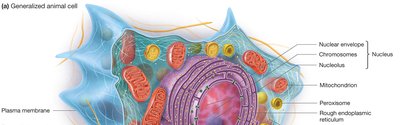
The Nucleus
The nucleus is a large, highly organized, membrane-bound compartment. It is surrounded by a double-membrane nuclear envelope with pore-like openings and contains the nucleolus, where ribosomal RNA is synthesized and ribosome subunits are assembled.

Ribosomes
Ribosomes manufacture proteins and are found free in the cytosol or attached to the endoplasmic reticulum. They lack a membrane and are not considered organelles.
Endoplasmic Reticulum (ER)
The ER is an extensive membrane-enclosed factory, continuous with the nuclear envelope. It has two regions:
Rough ER (RER): Studded with ribosomes; synthesizes proteins for shipment, membrane insertion, or secretion.
Smooth ER (SER): Lacks ribosomes; contains enzymes for lipid synthesis and detoxification; stores Ca2+ ions.
Golgi Apparatus
The Golgi apparatus processes, sorts, and ships proteins synthesized in the RER. It consists of stacked, flat membranous sacs (cisternae) with distinct cis and trans faces.
Lysosomes
Lysosomes are recycling centers found only in animal cells. They contain acid hydrolases that hydrolyze macromolecules and maintain a low internal pH.
Vacuoles
Vacuoles are prominent organelles in plant and fungal cells. They store water, ions, pigments, and may contain compounds for defense.
Peroxisomes
Peroxisomes are globular organelles that perform reduction–oxidation reactions. They contain catalase to detoxify hydrogen peroxide.
Mitochondria
Mitochondria supply ATP to cells and have two membranes. They contain their own DNA and ribosomes, and can grow and divide independently.
Chloroplasts
Chloroplasts are found in plant and algal cells and are the site of photosynthesis. They have three membranes, their own DNA, and ribosomes. The endosymbiosis theory proposes that mitochondria and chloroplasts originated from free-living bacteria.
Cytoskeleton
The cytoskeleton is an extensive system of protein fibers that provides structural stability, transports materials, and organizes cellular components.
Eukaryotic Cell Wall and Extracellular Matrix
Fungi, algae, and plants have a stiff cell wall outside the plasma membrane for structural support. Animal cells lack a cell wall and are supported by the extracellular matrix (ECM).
Summary Table: Eukaryotic Cell Components
Component | Structure | Function |
|---|---|---|
Nucleus | Double membrane, nuclear pores | Stores genetic information, site of RNA synthesis |
Ribosomes | RNA and protein, no membrane | Protein synthesis |
Rough ER | Membrane with ribosomes | Protein synthesis and processing |
Smooth ER | Membrane without ribosomes | Lipid synthesis, detoxification, Ca2+ storage |
Golgi Apparatus | Stacked cisternae | Protein processing, sorting, shipping |
Lysosome | Membrane-bound, enzymes | Macromolecule digestion, recycling |
Vacuole | Large membrane-bound | Storage, digestion, defense |
Peroxisome | Membrane-bound, enzymes | Redox reactions, detoxification |
Mitochondria | Double membrane, own DNA | ATP production |
Chloroplast | Three membranes, own DNA | Photosynthesis |
Cytoskeleton | Protein fibers | Structure, transport, organization |
Cell Wall/ECM | Polysaccharides/proteins | Structural support |
Putting the Parts into a Whole
Structure-Function Relationship
The structure of each cell component correlates with its function. Variation in organelle content reflects the specialized function of different cell types.
Cell Systems: Nuclear Transport
Nuclear Envelope and Transport
The nuclear envelope separates the nucleus from the cytosol and contains nuclear pore complexes for selective transport. Proteins destined for the nucleus contain a nuclear localization signal (NLS) that acts as a molecular zip code.
Cell Systems: The Endomembrane System
Secretory Pathway and Protein Targeting
The endomembrane system includes the ER, Golgi apparatus, and lysosomes. Proteins are synthesized in the RER, processed in the Golgi, and shipped to their destinations via vesicles. The signal hypothesis explains how proteins destined for secretion enter the endomembrane system.
Protein Sorting and Exocytosis
Proteins are tagged for their destination, sorted into vesicles, and transported to organelles or the plasma membrane for secretion (exocytosis).
Lysosomal Recycling Pathways
Cells recycle materials via three pathways: receptor-mediated endocytosis, phagocytosis, and autophagy. Lysosomes digest and recycle macromolecules and damaged organelles.
Cell Systems: The Dynamic Cytoskeleton
Cytoskeletal Elements
The cytoskeleton consists of three major types of elements:
Actin filaments (microfilaments): Smallest, made of actin; involved in movement and structural support.
Intermediate filaments: Diverse proteins (e.g., keratins); provide structural stability.
Microtubules: Largest, made of tubulin dimers; involved in chromosome separation and vesicle transport.
Actin Filament Structure and Function
Actin filaments are fibrous structures that assemble via polymerization. They have plus and minus ends, with the plus end growing faster. Actin-myosin interactions drive cellular movements such as cytokinesis, cytoplasmic streaming, and cell crawling.
Intermediate Filaments
Intermediate filaments, such as nuclear lamins, define the shape of the nucleus and anchor chromosomes.
Microtubules and Centrosomes
Microtubules originate from the microtubule organizing center (MTOC), called the centrosome in animal cells. They serve as tracks for vesicle transport, with motor proteins like kinesin moving vesicles along microtubules.
Flagella and Cilia
Flagella and cilia are projections that move cells. Prokaryotic flagella rotate, while eukaryotic flagella whip back and forth. Cilia are shorter and more numerous. Both have a "9 + 2" arrangement of microtubules called the axoneme, powered by the motor protein dynein.
Summary Table: Cytoskeletal Filaments
Filament Type | Subunit | Function |
|---|---|---|
Actin Filaments | Actin | Cell shape, movement, muscle contraction |
Intermediate Filaments | Keratin, lamins | Structural stability, nuclear envelope support |
Microtubules | α- and β-tubulin | Vesicle transport, chromosome separation, cilia/flagella movement |
Additional info: Academic context was added to clarify cell structure-function relationships, cytoskeletal dynamics, and the endomembrane system. All included images directly reinforce the adjacent explanations and are essential for visualizing cell structure and function.
