 Back
Introduction: Evolution and the Foundations of Biology – Unifying Themes and Scientific Inquiry
Study Guide - Smart Notes
 Tailored notes based on your materials, expanded with key definitions, examples, and context.
Chapter 1: Introduction – Evolution and the Foundations of Biology
Unifying Themes of Biology
The study of biology is organized around several unifying themes that help explain the complexity and diversity of life. These themes provide a framework for understanding how living systems function and interact.
Evolution: The process by which populations of organisms change over generations through variations in genetic information and natural selection. Evolution explains both the unity and diversity of life.
Organization: Biological systems are structured in a hierarchical manner, from molecules and cells to tissues, organs, organisms, populations, and ecosystems. Each level of organization has emergent properties.
Information: Life processes depend on the expression, transmission, and storage of genetic information, primarily in the form of DNA.
Energy and Matter: All living organisms require energy to grow, develop, and maintain homeostasis. Energy flows through ecosystems, while matter cycles between organisms and their environment.
Interactions: Organisms interact with each other and with their environment, forming complex systems that influence survival and reproduction.
Example Table: Applying the Unifying Themes
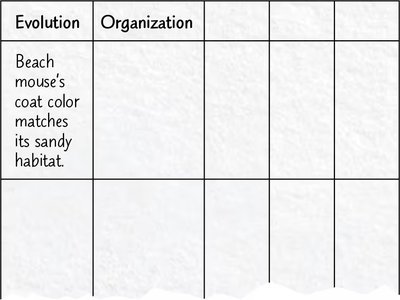
The table below is designed to help you connect each unifying theme to specific examples. One example is provided for the theme of evolution.
Evolution | Organization | Information | Energy & Matter | Interactions |
|---|---|---|---|---|
Beach mouse's coat color matches its sandy habitat. |
The Core Theme: Evolution
Evolution is the central concept in biology, explaining both the similarities and differences among living organisms. Through natural selection, populations adapt to their environments over time, leading to the diversity of life forms observed today.
Natural Selection: Individuals with traits better suited to their environment are more likely to survive and reproduce, passing those traits to the next generation.
Unity and Diversity: All living things share a common ancestry, but evolutionary processes have led to a wide variety of adaptations and species.
Example: The beach mouse (Peromyscus polionotus) has light fur that blends with sandy habitats, while inland populations have darker fur for camouflage in soil and vegetation.
Structure Fits Function
At every level of biological organization, the structure of a component is closely related to its function. This principle helps explain the diversity of forms and adaptations in living organisms.
Example: The fur color of the beach mouse is determined by genetic information and provides camouflage, protecting it from predators.
Levels of Organization: Molecules → Cells → Tissues → Organs → Organisms → Populations → Ecosystems
Information: The Role of DNA
Genetic information encoded in DNA determines the traits of organisms. The transmission and expression of this information are fundamental to growth, development, and reproduction.
Genes: Segments of DNA that code for specific proteins, influencing traits such as fur color in mice.
Inheritance: Genetic information is passed from parents to offspring, ensuring continuity of life.
Energy and Matter
Living organisms require a constant input of energy and the cycling of matter to sustain life. Energy flows through ecosystems, while matter is recycled.
Energy Flow: Energy enters ecosystems as sunlight, is converted by plants through photosynthesis, and then transferred through food webs.
Matter Cycling: Elements such as carbon and nitrogen cycle between organisms and their environment.
Example: A mouse eats a plant to obtain energy, and is itself preyed upon by a hawk, illustrating the flow of energy and cycling of matter.
Interactions Within Systems
Organisms interact with each other and with their environment, forming complex systems. These interactions can be cooperative, competitive, or predatory, and are essential for ecosystem stability.
Example: The interaction between a mouse and its predators, or between plants and herbivores, demonstrates the interconnectedness of living systems.
Scientific Inquiry in Biology
Biology is a science driven by inquiry, observation, and experimentation. Scientists use the scientific method to ask questions, form hypotheses, and test predictions about the natural world.
Hypothesis: A testable explanation for an observation or phenomenon.
Experimentation: The process of testing hypotheses through controlled experiments and data collection.
Collaboration: Scientific progress relies on collaboration and the exchange of diverse viewpoints.
Key Learning Objectives
Use examples to illustrate each unifying theme of biology.
Summarize how evolution accounts for the unity and diversity of life.
Describe the process of scientific inquiry and evaluate the importance of collaboration in science.
