 Back
Introduction: Evolution and the Foundations of Biology – Study Guide
Study Guide - Smart Notes
 Tailored notes based on your materials, expanded with key definitions, examples, and context.
Introduction to Biology
What is Biology?
Biology is the scientific study of life. Biologists investigate questions about how living organisms develop, function, interact, and evolve. The field encompasses a wide range of topics, from the molecular mechanisms inside cells to the interactions of organisms within ecosystems.
Key Questions: How does a single cell develop into an organism? How do different forms of life interact?
Unifying Themes: Organization, Information, Energy and Matter, Interactions, Evolution
Unifying Themes in Biology
Levels of Biological Organization
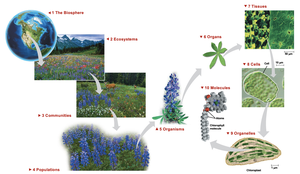
Life is organized into a hierarchy of structural levels, each building on the levels below. This organization allows biologists to study life from the smallest molecules to the entire biosphere.
Biosphere: All life on Earth and all the places where life exists.
Ecosystem: All living things in a particular area, plus nonliving components (soil, water, atmosphere).
Community: All organisms inhabiting a particular ecosystem.
Population: All individuals of a species in a specific area.
Organism: An individual living thing.
Organ/System: Body parts that carry out specific functions.
Tissue: Groups of cells working together.
Cell: The basic unit of life.
Organelle: Functional components within cells.
Molecule: Chemical structure consisting of two or more atoms.
Emergent Properties
Emergent properties arise from the arrangement and interaction of parts as complexity increases. For example, a functioning cell emerges only when all its molecular components interact in the correct way.
Structure and Function
At every level of the biological hierarchy, there is a correlation between structure and function. Understanding the structure of a biological component provides insight into its function (e.g., the wings of a hummingbird are adapted for hovering).
The Cell: The Basic Unit of Life
Cell Types
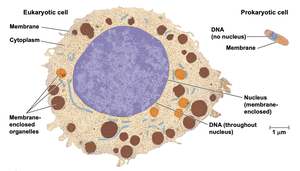
The cell is the smallest unit capable of performing all activities required for life. All cells are enclosed by a membrane and contain genetic material. There are two main types of cells:
Prokaryotic Cells: Lack a nucleus and membrane-bound organelles; generally smaller (e.g., bacteria, archaea).
Eukaryotic Cells: Have a nucleus and membrane-bound organelles; found in plants, animals, fungi, and protists.
Genetic Information and Gene Expression
DNA: The Genetic Material
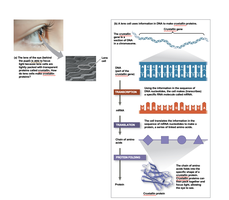
Chromosomes contain DNA (deoxyribonucleic acid), which holds genes—the units of inheritance. Genes encode instructions for building proteins, which carry out most cellular functions.
Gene Expression: The process by which information from a gene is used to synthesize a functional product, usually a protein.
Genomics and Proteomics
Genomics is the study of whole sets of genes and their interactions. Proteomics is the study of the entire set of proteins produced by an organism. Advances in technology and bioinformatics have enabled large-scale analysis of biological data.
Energy and Matter in Living Systems
Energy Flow and Chemical Cycling
Life requires the transfer and transformation of energy and matter. Energy flows through ecosystems, primarily entering as sunlight and exiting as heat, while chemical elements are recycled.
Producers: Organisms (like plants) that convert solar energy into chemical energy via photosynthesis.
Consumers: Organisms that obtain energy by eating other organisms or their remains.
Interactions in Biological Systems
Organismal and Environmental Interactions
Organisms interact with each other and with their physical environment. These interactions can affect both the organisms and their environment, such as plants modifying soil composition.
Human Impact and Climate Change
Human activities have increased atmospheric CO2 levels, contributing to global climate change—a directional change in global climate lasting three decades or more.
Evolution: The Core Theme of Biology
Unity and Diversity of Life
Evolution explains both the unity and diversity of life. Similar traits among species are due to descent from a common ancestor, while differences arise from adaptations to different environments.
Classification of Life
Life is classified into three domains:
Bacteria: Prokaryotic, unicellular organisms.
Archaea: Prokaryotic, often found in extreme environments.
Eukarya: Eukaryotic organisms, including kingdoms Plantae, Fungi, and Animalia.
Charles Darwin and Natural Selection
Charles Darwin proposed that species evolve through natural selection, where individuals with advantageous traits are more likely to survive and reproduce. Over generations, these traits become more common in the population.
Descent with Modification: Species change over time, giving rise to new species while sharing a common ancestor.
The Process of Science
Scientific Inquiry and Hypotheses
Science is a process of inquiry involving observation, hypothesis formation, and testing. A hypothesis is a testable explanation for an observation. Experiments are designed to test hypotheses under controlled conditions.
Variables: The independent variable is manipulated; the dependent variable is measured.
Controls: Used to cancel out unwanted variables.
Data Collection and Analysis
Data can be qualitative (descriptive) or quantitative (numerical). Scientists analyze data to support or refute hypotheses, often using tables and graphs for organization.
Theories in Science
A scientific theory is broader than a hypothesis, generates new hypotheses, and is supported by a large body of evidence.
Science as a Social Process
Science relies on collaboration, peer review, and the accumulation of knowledge. Scientists work in teams and build on the discoveries of others.
