 Back
BackIntroduction to Animals: Evolution, Body Plans, and Diversity
Study Guide - Smart Notes
 Tailored notes based on your materials, expanded with key definitions, examples, and context.
Introduction to Animals
What is an Animal?
Animals are a diverse group of multicellular eukaryotes that form the kingdom Animalia. They are characterized by several key features that distinguish them from other life forms.
Multicellularity: Animals are composed of multiple cells lacking cell walls, instead supported by an extensive extracellular matrix.
Heterotrophy: Animals ingest their food, obtaining energy and organic molecules from other organisms.
Motility: Animals move under their own power at some stage of their life cycle.
Nerve and Muscle Cells: All animals except sponges possess nerve cells (neurons) and muscle cells, enabling rapid response and movement.
Animals are a monophyletic group, meaning they share a single common ancestor. There are an estimated 3 to 10 million extant animal species, with only about 1.4 million described to date.
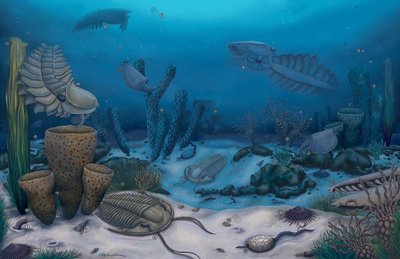
Major Groups of Animals
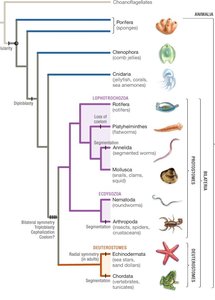
Animals are classified into 30–35 phyla, organized into five major groups:
Non-bilaterian lineages
Protostome groups: Lophotrochozoa and Ecdysozoa
Deuterostome groups: Echinodermata and Chordata
Why Study Animals?
Ecological and Human Importance
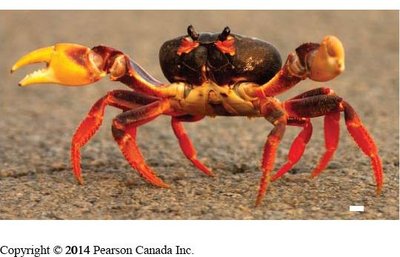
Ecological Roles: Animals are key consumers in ecosystems, acting as chemo-organo-heterotrophs that eat organic matter for energy and building blocks.
Resources: Animals provide food, materials (wool, silk), and other resources essential to human society.
Disease: Some animals act as vectors for diseases (e.g., mosquitoes transmit malaria), while others are parasites themselves (e.g., leeches, tapeworms).
Research: Model organisms such as fruit flies, mice, and zebrafish are used to study genetics and physiology due to homologies with humans.
Evolution of Animals
Choanoflagellates and the Origin of Animals
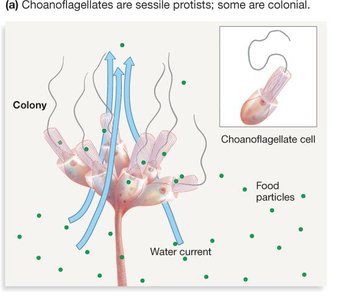
Choanoflagellates are the closest living relatives to animals. They are sessile, colonial protists that feed using flagella. Sponges, the earliest animals in the fossil record (about 700 million years ago), share many features with choanoflagellates, including feeding cells with similar morphology.
Sponges-First Hypothesis
The sponges-first hypothesis proposes that sponges were the first animals, supported by fossil, morphological, and molecular evidence. Sponges possess basic developmental tool-kit genes found in all multicellular animals, including those for cell specialization, adhesion, immunity, and programmed cell death.
Alternative Hypotheses
Recent genomic data suggest that ctenophores (comb jellies) may be the sister group to all other animals, but evidence is not yet sufficient to reject the sponges-first hypothesis.
Evolution of Animal Body Plans
1. Embryonic Tissues and Germ Layers
Animal body plans are defined by the number and type of embryonic tissue layers (germ layers):
Diploblasts: Have two germ layers—ectoderm (skin, nervous system) and endoderm (digestive tract lining).
Triploblasts: Have three germ layers—ectoderm, endoderm, and mesoderm (muscles, circulatory system, organs).
2. Nervous System and Cephalization
Sponges lack neurons and symmetry. Cnidarians and ctenophores have a nerve net and radial symmetry, while all other animals (triploblasts) have bilateral symmetry, a head region (cephalization), and a central nervous system (CNS). Cephalization is associated with directed movement and concentration of sensory organs in the head.
3. Evolution of the Body Cavity (Coelom)
The coelom is a fluid-filled body cavity lined with mesoderm, providing space for organ development and movement. Types include:
Coelomates: True coelom, fully lined with mesoderm.
Acoelomates: No coelom (e.g., flatworms).
Pseudocoelomates: Coelom partially lined with mesoderm (e.g., roundworms, rotifers).
4. Segmentation
Segmentation is the division of the body into repeated segments, seen in annelids, arthropods, and vertebrates. Some segmentation genes are homologous across phyla, but segmentation has also evolved convergently in different groups.
Diversification Themes in Animal Evolution
The Cambrian Explosion
Most animal phyla appeared during the Cambrian explosion (~541 million years ago). Hypotheses for this rapid diversification include higher oxygen levels, evolution of predation, new ecological niches, and the evolution of developmental genes (e.g., Hox genes).
Sensory Organs
Cephalization led to the concentration of sensory organs in the head. Most animals have senses such as sight, hearing, taste, smell, and touch, with some able to detect magnetic or electric fields.
Feeding Strategies
Animals exhibit diverse feeding strategies, classified by how and what they eat:
How: Suspension feeders, deposit feeders, fluid feeders, mass feeders.
What: Herbivores (plants/algae), carnivores (animals), detritivores (dead matter).
Predators: Kill prey quickly; Parasites: Harvest nutrients without killing host (endo- or ectoparasites).
Movement and Limbs
Locomotion is essential for finding food, mates, and escaping predators. Limbs, which may be unjointed or jointed, are a key innovation in animal movement. Evidence suggests all animal limbs may be homologous, with similar developmental genes involved.
Reproduction and Life Cycles
Animals reproduce sexually and/or asexually. Sexual reproduction involves sperm and eggs, with fertilization being internal or external. Animals are grouped by where embryos develop:
Viviparous: Live-bearing
Oviparous: Egg-laying
Ovoviviparous: Eggs hatch inside the mother
Most animals have diploid-dominant life cycles, and many undergo metamorphosis, allowing specialization at different life stages.
Non-Bilaterian Animals
Key Lineages
Porifera (Sponges): Specialized cell types, some epithelial tissue, mostly asymmetrical, suspension feeders, benthic, mostly asexual reproduction.
Cnidaria (Jellyfish, Corals, Anemones, Hydroids): Radially symmetric diploblasts, possess cnidocytes for prey capture, life cycle includes polyp and medusa forms, important reef builders.
Ctenophora (Comb Jellies): Transparent, ciliated diploblasts, move by beating rows of cilia, planktonic predators, use adhesive cells to trap prey.
Summary Table: Major Non-Bilaterian Animal Groups
Taxa | Morphology/Synapomorphies | Ecology/Importance |
|---|---|---|
Porifera | Specialized cells, some epithelial tissue, asymmetrical, system of tubes and pores | Benthic, suspension feeders, mostly asexual reproduction, ~7000 species |
Cnidaria | Radial symmetry, diploblasts, cnidocytes, mesoglea | Marine, filter feeders/predators, reef builders, polyp and medusa forms |
Ctenophora | Transparent, ciliated, gelatinous diploblasts | Marine, planktonic predators, adhesive cells for prey capture, ~100 species |
