 Back
Introduction to Animals: Structure, Classification, and Development
Study Guide - Smart Notes
 Tailored notes based on your materials, expanded with key definitions, examples, and context.
Introduction to Animals
Defining Characteristics of Animals
Animals, also known as Metazoans, are a diverse group of multicellular eukaryotic organisms. They are distinguished by several unique characteristics that set them apart from other life forms.
Multicellularity: Animals are composed of multiple cells that differentiate into specialized types.
Heterotrophy: Animals obtain energy by consuming other organisms.
No Cell Walls: Unlike plants and fungi, animal cells lack rigid cell walls.
Dominant Consumers: Animals play a major role as consumers in both aquatic and terrestrial ecosystems.
Movement: All animals move at some stage of their life cycle.
Neurons and Muscle Cells: All animals except sponges possess nerve and muscle cells, enabling rapid response and movement.
Specific Developmental Stages: Animals undergo characteristic stages during embryonic development.
Animal Diversity and Classification
Animal Phyla and Evolutionary Relationships
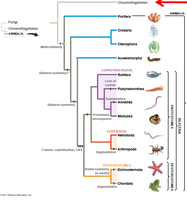
The animal kingdom is highly diverse, with approximately 34 recognized major phyla. Animals are a monophyletic group, meaning they share a single common ancestor. Recent phylogenetic analyses have revealed three fundamental evolutionary splits, resulting in four broad groups. The most ancient extant animal group is the sponges, and the closest living relatives to animals are the choanoflagellates (a group of protists).
Body Plans and Developmental Features
Key Features Defining Animal Body Plans
Four main features are used to classify animal body plans:
Number of Tissue Types in Embryos: Animals can be diploblastic (two germ layers) or triploblastic (three germ layers).
Type of Body Symmetry: Animals may exhibit asymmetry, radial symmetry, or bilateral symmetry.
Presence or Absence of a Coelom: The coelom is a fluid-filled body cavity lined with mesoderm.
Embryonic Development Patterns: Early developmental events, such as cleavage and gastrulation, differ among major groups.
Evolution of Tissues
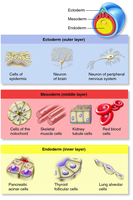
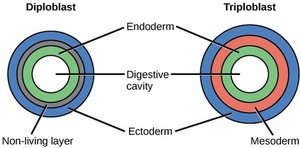
All animals except sponges possess true tissues—integrated groups of cells with a common structure and function. Diploblasts have two germ layers (ectoderm and endoderm), while triploblasts have three (ectoderm, mesoderm, and endoderm). These germ layers give rise to distinct adult tissues and organs.
Evolution of Symmetry
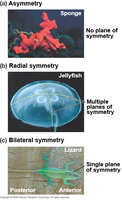
Symmetry refers to the arrangement of body structures. Animals may be:
Asymmetrical: No plane of symmetry (e.g., sponges).
Radially Symmetrical: Multiple planes of symmetry around a central axis (e.g., jellyfish).
Bilateral Symmetry: A single plane divides the body into mirror-image halves (e.g., lizards). Bilateral symmetry is associated with cephalization—the development of a head region where sensory and feeding structures are concentrated.
Evolution of Body Cavities
The coelom is an internal, fluid-filled body cavity that forms within the mesoderm. Animals can be classified based on the presence and type of coelom:
Acoelomates: Lack a body cavity.
Pseudocoelomates: Have a body cavity partially lined with mesoderm.
Coelomates: Have a body cavity completely lined with mesoderm.
With the exception of echinoderms (which have secondary radial symmetry), all coelomates are bilaterally symmetrical and triploblastic. This group, called Bilateria, is subdivided into protostomes and deuterostomes. Acoelomates are also part of Bilateria and are considered protostomes.
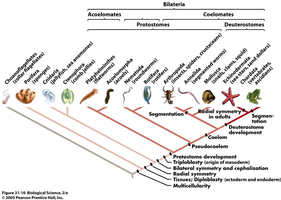
Protostomes vs. Deuterostomes
Key Differences in Embryonic Development
Protostomes and deuterostomes differ in four major embryonic events:
Cleavage: Protostomes exhibit spiral cleavage (cells form at angles), while deuterostomes exhibit radial cleavage (cells stack directly on top of each other).
Developmental Fate of Cells: Protostomes have determinate development (cell fate set early), while deuterostomes have indeterminate development (cell fate set later).
Gastrulation: In protostomes, the blastopore becomes the mouth; in deuterostomes, it becomes the anus.
Coelom Formation: The method by which the coelom forms differs between the two groups.
These developmental differences are critical for the diversification and classification of animals.
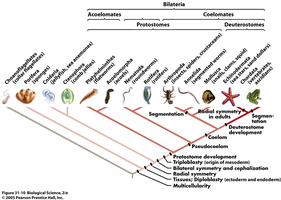
Genetic Regulation of Animal Development
Hox Genes and Body Plan Specification
Hox (homeobox) genes are a cluster of genes that play a crucial role in determining the general body plan of an organism. They control the number and placement of body segments, appendages, and head-tail directionality. Hox genes are homologous among all animals, with invertebrates typically having one set and vertebrates having four sets. Mutations in Hox genes can lead to significant developmental abnormalities.
Regulatory Cascade: Hox genes act as master regulators, influencing the expression of other genes in a hierarchical manner. This cascade provides positional information to cells, guiding their proliferation, differentiation, movement, and interactions during development.
Hox genes are also found in plants, indicating their ancient evolutionary origin and fundamental role in multicellular development.
Summary Table: Key Differences Between Protostomes and Deuterostomes
Feature | Protostomes | Deuterostomes |
|---|---|---|
Cleavage Pattern | Spiral | Radial |
Developmental Fate of Cells | Determinate | Indeterminate |
Fate of Blastopore | Mouth develops first | Anus develops first |
Coelom Formation | Solid masses of mesoderm split to form coelom | Folds of archenteron form coelom |
Knowledge Check: True or False
Endoderm, ectoderm, and mesoderm can be found in triploblasts. True
All animals have bilateral symmetry. False
Pseudocoelomates have a body cavity partially lined with mesoderm. True
All protostomes have bilateral symmetry. True
Endoderm, ectoderm, and mesoderm germ layers develop into distinct adult tissues. True
Knowledge Check: Protostomes vs. Deuterostomes
Characteristic | Group |
|---|---|
Cell fate is determined early | Protostomes |
Radial cleavage | Deuterostomes |
Groups of cells pouch off to form the coelom | Deuterostomes |
Spiral cleavage | Protostomes |
Cells with NO cell wall | Both |
Gastrulation forms the anus first | Deuterostomes |
Multicellular | Both |
