 Back
Introduction to Biology and Scientific Inquiry: Mini-Textbook Study Notes
Study Guide - Smart Notes
 Tailored notes based on your materials, expanded with key definitions, examples, and context.
Introduction to Biology
What is Biology?
Biology is the scientific study of life, encompassing a wide range of questions about living organisms and their interactions. Biologists seek to understand how life functions at all levels, from molecules to ecosystems.
Key Point 1: Biology investigates questions such as how a single cell develops into an organism, how the human mind works, and how living things interact in communities.
Key Point 2: The study of biology is essential for understanding the natural world and solving real-world problems.
Example: Studying camouflage in animals helps us understand adaptation and survival strategies.

Levels of Biological Organization
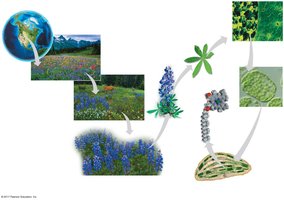
Biology examines life at multiple levels of organization, from the biosphere down to molecules. Each level builds upon the previous, creating a hierarchy of complexity.
Biosphere: The global ecosystem, including all living organisms and their environments.
Ecosystems: Communities of organisms interacting with their physical environment.
Communities: Different populations of species living together.
Populations: Groups of individuals of the same species.
Organisms: Individual living entities.
Organs and Tissues: Structures within organisms that perform specific functions.
Cells: The basic unit of life.
Organelles: Specialized structures within cells.
Molecules: Chemical components that make up cells.
Cell Components
What is a Cell?
The cell is the fundamental unit of structure and function in living organisms. All cells are surrounded by a membrane that regulates the passage of materials.
Key Point 1: Cells are the smallest units capable of performing all activities required for life.
Key Point 2: Every cell is enclosed by a membrane, which maintains internal conditions distinct from the external environment.
Types of Cells: Prokaryotic vs. Eukaryotic
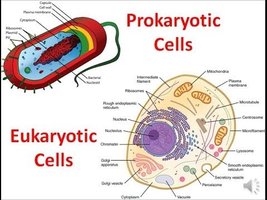
Cells are classified into two main types: prokaryotic and eukaryotic. These types differ in their internal structure and complexity.
Prokaryotic Cells: Simpler, usually smaller, lack a nucleus and membrane-bound organelles.
Eukaryotic Cells: More complex, contain a nucleus and various membrane-bound organelles.
Example: Bacteria are prokaryotes; plants and animals are eukaryotes.
Scientific Inquiry and the Scientific Method
The Scientific Process
Science is a systematic approach to understanding the natural world. The scientific method involves making observations, forming hypotheses, testing predictions, and drawing conclusions.
Observation: Gathering information about phenomena.
Hypothesis: A tentative explanation based on observations and assumptions, leading to testable predictions.
Experiment: A controlled test to evaluate hypotheses.
Conclusion: Interpretation of results to support or refute the hypothesis.
Forming and Testing Hypotheses
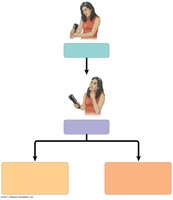
A hypothesis must be testable and falsifiable. Experiments are designed to test predictions derived from hypotheses.
Key Point 1: Hypotheses lead to predictions that can be tested by observation or experimentation.
Key Point 2: Experiments must include controls to ensure valid interpretation of results.
Example: Testing why a flashlight does not work by hypothesizing about dead batteries or a burnt-out bulb.
Experimental Variables and Controls
Controlled experiments compare an experimental group to a control group, differing in only one variable. Variables are classified as independent (manipulated) and dependent (measured).
Independent Variable: The factor manipulated by researchers (e.g., mouse color).
Dependent Variable: The factor measured in response (e.g., predation rate).
Control Group: The group that receives no experimental treatment or receives standard treatment.
Experimental Group: The group that receives the treatment or variable being tested.
Data Collection and Analysis
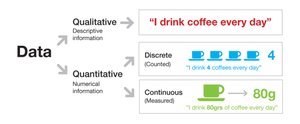
Data are recorded observations from experiments. They can be qualitative (descriptive) or quantitative (numerical), and are often organized into tables and graphs for analysis.
Qualitative Data: Descriptive information (e.g., color, shape).
Quantitative Data: Numerical measurements (e.g., length, weight).
Example: Recording the number of mice attacked in different habitats.
Case Study: Scientific Inquiry in Mouse Populations
Investigating Coat Coloration in Mouse Populations
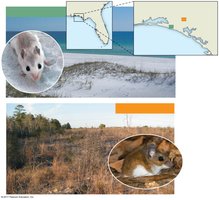
Scientists use case studies to apply the scientific method to real-world problems. In this example, researchers investigated why two populations of mice have different fur colors.
Key Point 1: The beach mouse lives on white sand dunes, while the inland mouse lives on darker soil.
Key Point 2: The coloration matches the habitat, suggesting adaptation for camouflage.
Example: Predators are visual hunters, so camouflage increases survival.
Experimental Design and Results
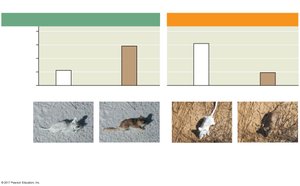
Researchers hypothesized that mice not matching their habitat would be preyed upon more heavily. They tested this by placing model mice in both habitats and recording predation rates.
Key Point 1: Models matching the habitat were attacked less frequently.
Key Point 2: The experiment demonstrated the selective advantage of camouflage.
Example: Data showed higher predation rates for non-camouflaged models.
Theories in Science
Scientific Theories vs. Hypotheses
A scientific theory is broader in scope than a hypothesis, general enough to lead to new testable hypotheses, and supported by a large body of evidence.
Key Point 1: Theories explain a wide range of phenomena and are fundamental to scientific progress.
Key Point 2: Hypotheses are specific, testable statements; theories are overarching explanations.
Example: The theory of evolution explains the diversity of life and leads to hypotheses about adaptation.
