 Back
BackIntroduction to Biology and the Scientific Method: Study Guide
Study Guide - Smart Notes
 Tailored notes based on your materials, expanded with key definitions, examples, and context.
Introduction to Biology
What is Life?
Biology is the scientific study of life. Life is characterized by several key properties that distinguish living organisms from non-living matter.
Membrane delimited: All living things are bounded by membranes that separate their internal environment from the external environment.
Information storage and transmission: Life stores and transmits instructions, primarily through genetic material such as DNA.
Energy transformation and use: Living organisms store, transform, and utilize energy to maintain their functions.
Response to environment: Organisms control their functions and respond to environmental changes.
Self-replication: Life is capable of reproducing itself.
Evolution: Populations of living organisms evolve over time.
Biomolecules: The properties of life are facilitated by complex biomolecules such as proteins, nucleic acids, lipids, and carbohydrates.
The cell: The cell is the smallest unit of life, capable of performing all life functions.
Example: A bacterium is a single cell that can grow, reproduce, respond to its environment, and evolve.
Fundamental Concepts in Biology
Building Knowledge
Biology builds upon fundamental concepts, and understanding these basics is essential for success in advanced topics. Consistent study habits and seeking help early are recommended for mastering the material.
Develop a study schedule and stick to it.
Engage in group study and attend office hours for collaborative learning.
Use active learning techniques such as drawing, concept mapping, and self-testing.
This foundational course prepares students for advanced studies and standardized exams (e.g., MCAT, DAT, GRE).

Effective Study Practices
How to Study Biology Effectively
Research shows that we forget more than 50% of what we learn within one hour. Effective study practices can help retain information and improve performance.
Set clear goals and develop a consistent study schedule.
Form study groups and utilize available resources such as office hours and learning assistants (LAs).
Use active learning strategies: draw diagrams, create concept maps, and use flashcards.
Test yourself regularly to reinforce learning and identify gaps in understanding.
Data Interpretation and Graphs
Understanding Variables and Graphs
Biologists often use graphs to present data and analyze relationships between variables.
Independent variable (x-axis): The factor that is manipulated or categorized, not dependent on other variables (e.g., time).
Dependent variable (y-axis): The factor that is measured or observed, dependent on the independent variable (e.g., growth).
Graphs can be used to compare groups, show trends, and illustrate experimental results.
Experimental Variable (Independent Variable) | Responding Variable (Dependent Variable) |
|---|---|
Factor of the experiment being tested | Result or change that occurs due to the experimental variable |
The Scientific Method
Steps of the Scientific Method
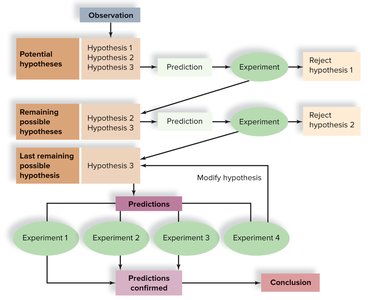
The scientific method is a systematic approach used to investigate natural phenomena and answer scientific questions.
Observation: Gathering information about a phenomenon or problem.
Hypothesis: Formulating a testable explanation or prediction based on observations.
Prediction: Making specific predictions that can be tested by experiments.
Experiment: Conducting controlled tests to evaluate the hypothesis.
Control group: A group that does not receive the experimental treatment, serving as a baseline for comparison.
Analysis and Conclusion: Interpreting results to accept, reject, or modify the hypothesis.
Example: Tomato Plant Experiment
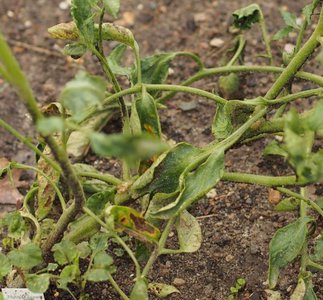
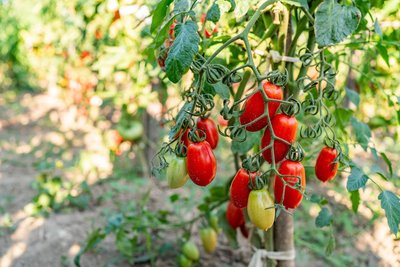
Suppose you observe that your neighbor's tomato plants are healthier than yours. You hypothesize that a specific factor (e.g., amount of sunlight or water) is responsible. You design an experiment with a control group to test your hypothesis.
Observation: Neighbor's tomato plants are thriving; yours are not.
Hypothesis: Tomato plants grow better with more sunlight.
Prediction: If I increase sunlight exposure, my tomato plants will grow better.
Experiment: Grow two groups of tomato plants, one with increased sunlight (experimental group) and one with normal conditions (control group).
Control group: Plants grown under normal sunlight conditions.
Importance of Controls in Experiments
A control group is essential for determining whether the experimental variable is responsible for observed changes. For example, in a baking experiment, the control would be the cake recipe without the added variable (e.g., baking powder).
Example: To test if baking powder makes a cake airy, the control is the cake made without baking powder.
Summary Table: Scientific Method Steps
Step | Description | Example (Tomato Plants) |
|---|---|---|
Observation | Notice a phenomenon | Neighbor's plants are healthier |
Hypothesis | Propose explanation | Sunlight affects growth |
Prediction | Make testable prediction | More sunlight = better growth |
Experiment | Test prediction with control | Grow plants with/without extra sunlight |
Analysis | Interpret results | Compare plant health |
Conclusion | Accept/reject hypothesis | Sunlight is/is not the cause |
Conclusion
Understanding the properties of life, effective study habits, and the scientific method are foundational for success in biology. Mastery of these concepts will support further study in all areas of biological science.
