 Back
Introduction to Biology: Evolution, Themes, and Scientific Inquiry
Study Guide - Smart Notes
 Tailored notes based on your materials, expanded with key definitions, examples, and context.
Chapter 1: Evolution, the Themes of Biology, and Scientific Inquiry
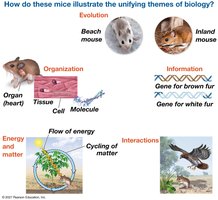
Unifying Themes in Biology
Biology is the scientific study of life, characterized by several unifying themes that help organize and explain the diversity and complexity of living organisms. These themes provide a framework for understanding the structure, function, and evolution of life on Earth.
Organization: Life is structured in a hierarchical manner, from molecules to the biosphere.
Information: Genetic information is stored and transmitted through DNA.
Energy and Matter: Life depends on the transfer and transformation of energy and matter.
Interactions: Living systems interact at all levels, from molecules to ecosystems.
Evolution: Evolution explains both the unity and diversity of life.
Properties of Life
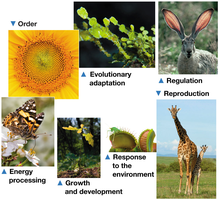
Living organisms share several key properties that distinguish them from non-living matter. These properties are essential for the maintenance and perpetuation of life.
Order: Highly ordered structure is a hallmark of life.
Evolutionary Adaptation: Organisms adapt to their environment over generations.
Regulation: Homeostatic mechanisms maintain internal balance.
Reproduction: Organisms reproduce their own kind.
Response to the Environment: Organisms respond to environmental stimuli.
Growth and Development: Organisms grow and develop according to inherited instructions.
Energy Processing: Organisms obtain and use energy to power activities.
Levels of Biological Organization
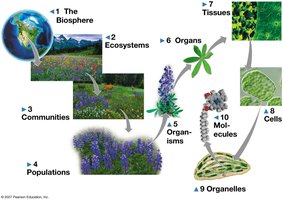
Biological organization is structured in a hierarchy, with each level building on the one below it. This hierarchy ranges from the smallest chemical building blocks to the entire biosphere.
The Biosphere
Ecosystems
Communities
Populations
Organisms
Organs and Organ Systems
Tissues
Cells
Organelles
Molecules
Structure and Function
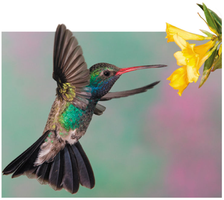
At every level of biological organization, there is a close relationship between structure and function. Understanding the structure of a biological component provides insight into its function, and vice versa.
Example: The shape of a bird's wing is adapted for flight, and the structure of enzymes allows them to catalyze specific chemical reactions.
The Cell: The Basic Unit of Life
Cell Theory and Types of Cells
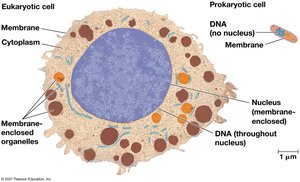
The cell is the fundamental unit of structure and function in living organisms. According to cell theory, all living things are composed of cells, and all cells arise from pre-existing cells. Cells are classified as either prokaryotic or eukaryotic.
Prokaryotic Cells: Lack a nucleus and membrane-bound organelles; found in Bacteria and Archaea.
Eukaryotic Cells: Have a nucleus and membrane-bound organelles; found in plants, animals, fungi, and protists.
Genetic Information and DNA
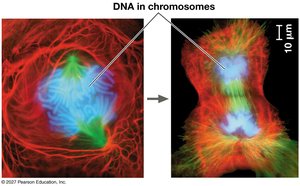
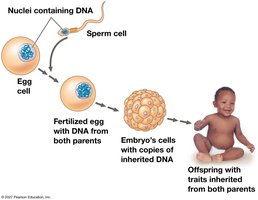
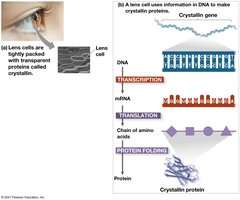
Genetic information is stored in the form of DNA (deoxyribonucleic acid) within chromosomes. DNA contains the instructions for building and maintaining an organism.
Genes: Units of inheritance that encode information for building proteins and other molecules.
Chromosomes: Structures within cells that contain DNA.
Molecular Structure of DNA
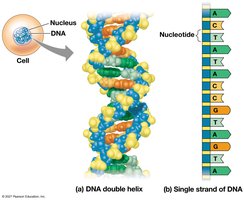
The double helix structure of DNA enables it to store genetic information efficiently. DNA is composed of four types of nucleotides: adenine (A), guanine (G), cytosine (C), and thymine (T).
Double Helix: Two strands of nucleotides wound around each other.
Base Pairing: A pairs with T, and G pairs with C.
Gene Expression
Gene expression is the process by which information from a gene is used to synthesize a functional product, typically a protein. This involves two main steps: transcription and translation.
Transcription: DNA is transcribed into messenger RNA (mRNA).
Translation: mRNA is translated into a chain of amino acids, forming a protein.
Energy and Matter in Living Systems
Energy Flow and Chemical Cycling
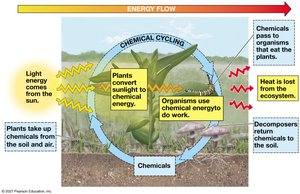
Life depends on the transfer and transformation of energy and matter. Energy flows through ecosystems, primarily entering as sunlight and exiting as heat, while chemicals are recycled within ecosystems.
Producers: Organisms (such as plants) that convert sunlight into chemical energy.
Consumers: Organisms that obtain energy by eating other organisms.
Decomposers: Organisms that break down dead matter, returning nutrients to the environment.
Regulation and Feedback Mechanisms
Feedback Regulation
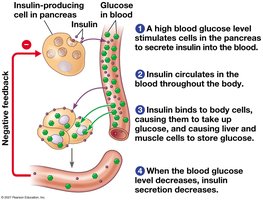
Biological systems use feedback mechanisms to maintain homeostasis. The two main types are negative feedback and positive feedback.
Negative Feedback: The response reduces the initial stimulus (e.g., regulation of blood glucose levels).
Positive Feedback: The response amplifies the initial stimulus (less common in biology).
Evolution: The Core Theme of Biology
Unity and Diversity of Life
Evolution is the central concept that explains both the unity and diversity of life. All living organisms are related through descent from common ancestors, but have diversified through adaptation to different environments.
Unity: Shared characteristics due to common ancestry.
Diversity: Adaptations to different environments and lifestyles.
Domains and Kingdoms of Life
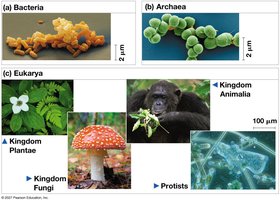
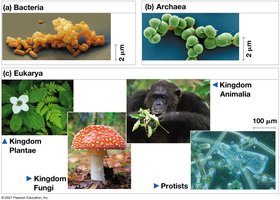
All life is classified into three domains: Bacteria, Archaea, and Eukarya. Eukarya is further divided into four main groups: Plants, Fungi, Animals, and Protists.
Domain | Characteristics | Examples |
|---|---|---|
Bacteria | Prokaryotic, unicellular | Escherichia coli |
Archaea | Prokaryotic, unicellular, often extremophiles | Halobacterium |
Eukarya | Eukaryotic, unicellular or multicellular | Plants, Fungi, Animals, Protists |
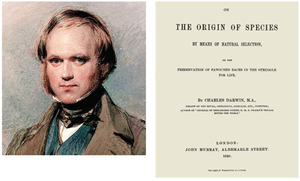
Charles Darwin and Natural Selection
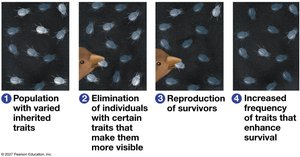
Charles Darwin proposed the theory of evolution by natural selection, which explains how species adapt and change over time. Natural selection is the process by which individuals with advantageous traits are more likely to survive and reproduce, passing those traits to the next generation.
Variation: Individuals in a population vary in their traits.
Inheritance: Many traits are heritable.
Overproduction: More offspring are produced than can survive.
Differential Survival: Individuals with traits best suited to the environment are more likely to survive and reproduce.
Tree of Life and Adaptive Radiation
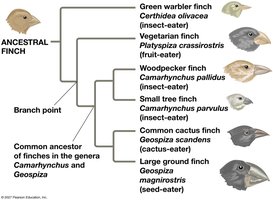
Evolutionary relationships among species are often depicted as tree-like diagrams, illustrating common ancestry and divergence. Adaptive radiation is the process by which one species gives rise to multiple species adapted to different environments, as seen in Darwin's finches of the Galápagos Islands.
Example: The diversification of finch species from a common ancestor, each adapted to different food sources.
Additional info: These notes provide a foundational overview of the major themes and concepts in introductory biology, including the structure and function of cells, the role of DNA, the flow of energy and matter, regulatory mechanisms, and the principles of evolution and classification.
