 Back
BackIntroduction to Biology: Evolution, Themes, and Scientific Inquiry
Study Guide - Smart Notes
 Tailored notes based on your materials, expanded with key definitions, examples, and context.
Introduction to Biology
What is Biology?
Biology is the scientific study of life, encompassing the structure, function, growth, origin, evolution, and distribution of living organisms. Life is defined by a set of properties and processes that distinguish living things from non-living matter.
Order: Living things exhibit complex but ordered organization.
Evolutionary adaptation: Organisms adapt to their environment through evolution.
Regulation: Living things regulate internal conditions (homeostasis).
Reproduction: Organisms reproduce, passing genetic information to offspring.
Energy processing: Living things obtain and use energy.
Growth and development: Organisms grow and develop according to inherited instructions.
Response to the environment: Living things respond to environmental stimuli.
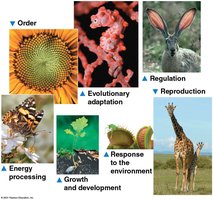
Themes of Biology
Unifying Themes
The study of life reveals five unifying themes that help organize biological knowledge:
Organization: Biological systems are structured hierarchically, from molecules to the biosphere.
Information (Genetics): Genetic information is stored, transmitted, and expressed in living organisms.
Energy and Matter: Life requires the transfer and transformation of energy and matter.
Interactions: Components of biological systems interact at all levels.
Evolution: Evolution explains the unity and diversity of life.
Levels of Biological Organization
Biological organization ranges from the most inclusive to the least:
Biosphere: All life and places where life exists on Earth.
Ecosystem: Communities of living organisms and their non-living environment.
Communities: All organisms inhabiting a particular ecosystem.
Population: Individuals of a species in a specific area.
Organism: Individual living things.
Organ and Organ System: Structures that carry out specific functions.
Tissues: Groups of cells performing specific functions.
Cells: Fundamental unit of structure and function.
Organelles: Functional components within cells.
Molecules: Chemical structures consisting of atoms.
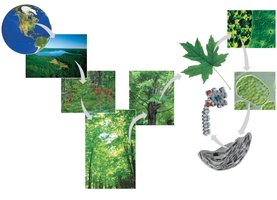
Emergent Properties: Novel properties arise at each level due to arrangement and interaction of parts.
Structure and Function: Analyzing biological structure provides clues about function (e.g., leaf structure).
The Cell: Basic Unit of Life
All living things are composed of cells, which are the smallest units capable of all life activities. Cells vary in structure and function, reflecting their roles in organisms.
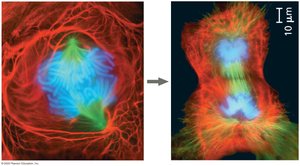
Genetic Information and Gene Expression
DNA: The Genetic Material
Chromosomes contain genetic material in the form of DNA (deoxynucleic acid). DNA holds genes, which are units of inheritance transmitting information from parents to offspring.
Gene Expression: The process by which information from a gene is used to synthesize functional proteins.
Genome: The entire set of genetic instructions in an organism.
Proteome: The complete set of proteins expressed by a cell, tissue, or organism.
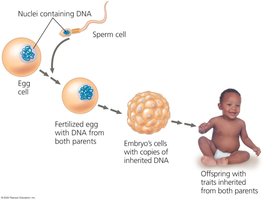
Energy Flow and Chemical Cycling
Energy and Matter in Biological Systems
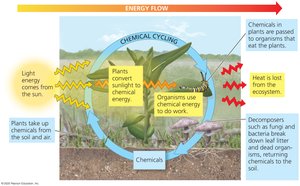
Life requires the transfer and transformation of energy and matter. Energy flows through ecosystems, while chemicals cycle within them.
Energy Flow: Light energy from the sun is converted to chemical energy by plants, used by organisms, and lost as heat.
Chemical Cycling: Chemicals are recycled between organisms and the environment.
Interactions in Biological Systems
Interactions from Molecules to Ecosystems
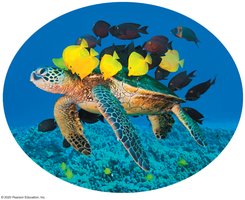
Interactions among components—organs, tissues, cells, and molecules—are crucial for smooth operation. Biological processes often self-regulate through feedback mechanisms.
Negative Feedback: The response reduces the initial stimulus (most common).
Positive Feedback: The end product speeds up its own production (less common).
Classifying the Diversity of Life
Domains of Life
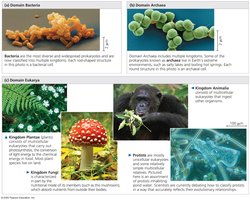
Life is classified into three domains:
Bacteria: Prokaryotic, unicellular organisms.
Archaea: Prokaryotic, often found in extreme environments.
Eukarya: Eukaryotic organisms, including four kingdoms: Plantae, Fungi, Animalia, and Protists.
Scientific Inquiry and the Scientific Method
What is Scientific Inquiry?
Scientific inquiry is the search for information and explanation of natural phenomena. Science relies on empirical research, systematic observation, and experimentation.
Validity: Research is relevant to the question.
Reliability: Research is repeatable and consistent.
The Scientific Method
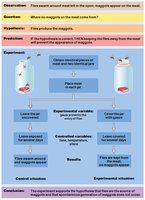
The scientific method is a flexible process of inquiry involving several steps:
Observation: Noticing a phenomenon.
Question: Asking why or how.
Hypothesis: Proposing a testable explanation.
Experiment: Testing the hypothesis under controlled conditions.
Results: Collecting and analyzing data.
Conclusion: Accepting or rejecting the hypothesis.
Types of Data
Qualitative Data: Descriptions rather than measurements.
Quantitative Data: Recorded measurements, often organized into tables and graphs.
Reasoning in Science
Inductive Reasoning: Drawing generalizations from specific observations.
Deductive Reasoning: Making predictions based on general principles.
Forming and Testing Hypotheses
A hypothesis is a testable and falsifiable explanation based on observations. It must lead to predictions that can be tested with experiments or additional observations.
Controlled Experiments
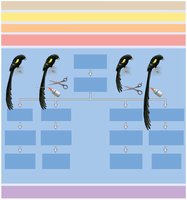
Control Group: Not exposed to the experimental treatment; serves as a comparison.
Experimental Group: Exposed to the experimental treatment.
Independent Variable: Manipulated by the researcher.
Dependent Variable: Measured in the experiment.
Constant Variables: Factors kept the same to ensure validity.
Scientific Theories
A scientific theory is a well-supported explanation for a wide range of phenomena, broader in scope than a hypothesis, and supported by a large body of evidence.
Theory vs Hypothesis: Theories are broader, generate new hypotheses, and are supported by more evidence.
The Flexibility of the Scientific Process
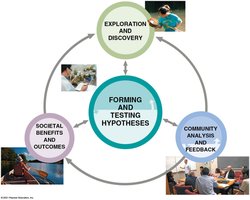
The scientific method is not always linear; backtracking, repetition, and feedback are common. Science is a social process, benefiting from diversity and collaboration.
Science and Technology
Science aims to understand natural phenomena, while technology applies scientific knowledge for specific purposes. Both have dramatic effects on society and are interdependent.
Ethics: Debates about technology often focus on "should we do it" rather than "can we do it."
----------------------------------------
