 Back
Introduction to Biology: Exploring Life and Scientific Inquiry
Study Guide - Smart Notes
 Tailored notes based on your materials, expanded with key definitions, examples, and context.
Ch. 1 - Evolution, the Themes of Biology, and Scientific Inquiry
What Does It Mean to Be Alive?
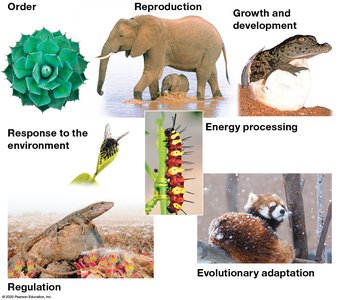
Biology is the scientific study of life. To understand what it means to be alive, biologists identify several key characteristics shared by all living organisms. These characteristics distinguish living things from non-living matter and form the foundation for biological study.
Order: Living things exhibit complex organization, from molecules to entire organisms.
Reproduction: Organisms reproduce, ensuring the continuation of their species.
Growth and Development: Organisms grow and develop according to inherited genetic instructions.
Energy Processing: Living things obtain and use energy to power their activities.
Response to the Environment: Organisms respond to environmental stimuli.
Regulation: Internal conditions are regulated to maintain stability (homeostasis).
Evolutionary Adaptation: Populations evolve over generations, adapting to their environments.
Living Things are Organized into Three Domains
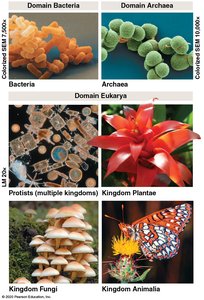
All life on Earth is classified into three major domains based on cellular structure and genetic differences. These domains are further divided into kingdoms and other taxonomic groups.
Domain Bacteria: Prokaryotic, unicellular organisms with simple cell structure.
Domain Archaea: Prokaryotic, unicellular organisms often found in extreme environments; genetically distinct from bacteria.
Domain Eukarya: Eukaryotic organisms with complex cells; includes protists, plants, fungi, and animals.
Within Domain Eukarya, organisms are classified into multiple kingdoms:
Kingdom Protista: Diverse group of mostly unicellular eukaryotes.
Kingdom Plantae: Multicellular, photosynthetic organisms.
Kingdom Fungi: Multicellular (or unicellular), decomposers.
Kingdom Animalia: Multicellular, heterotrophic organisms.
Hierarchy of Biological Organization
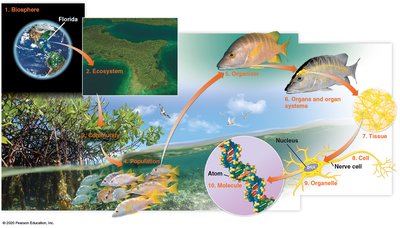
Biological systems are organized in a hierarchy, from the smallest chemical units to the entire biosphere. Understanding this hierarchy helps biologists study life at different levels of complexity.
Biosphere: All life and environments on Earth.
Ecosystem: All living and nonliving components in a particular area.
Community: All organisms in an ecosystem.
Population: Individuals of the same species in a given area.
Organism: Individual living entity.
Organ and Organ System: Body parts with specific functions.
Tissue: Groups of cells with a common function.
Cell: Basic unit of life.
Organelle: Functional components within cells.
Molecule: Chemical structure consisting of two or more atoms.
Atom: Smallest unit of matter.
Scientific Inquiry: How Do We Conduct Science?
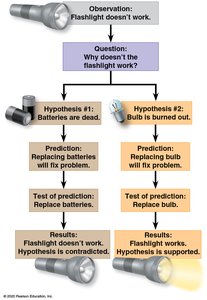
Scientific inquiry is a systematic process used to investigate natural phenomena. It involves making observations, forming hypotheses, testing predictions, and analyzing results. This process helps scientists build reliable knowledge about the natural world.
Observation: Noticing and describing phenomena.
Question: Asking why or how something occurs.
Hypothesis: Proposing a testable explanation.
Prediction: Forecasting what will happen if the hypothesis is correct.
Test: Experimenting or gathering data to check the prediction.
Result: Analyzing whether the prediction was supported or contradicted.
Example: If a flashlight doesn't work, possible hypotheses include dead batteries or a burned-out bulb. Testing each hypothesis by replacing batteries or the bulb helps determine the cause.
Additional info:
The chapter numbers listed in the original file correspond to standard General Biology topics, confirming the relevance of these notes.
Images included directly reinforce the explanations of the characteristics of life, domains of life, biological hierarchy, and scientific inquiry.
