 Back
Introduction to Biology: Fundamental Concepts and Methods
Study Guide - Smart Notes
 Tailored notes based on your materials, expanded with key definitions, examples, and context.
Introduction to Biology
What is Biology?
Biology is the scientific study of life and living organisms. It encompasses a wide range of fields and applications, from understanding microscopic bacteria to complex multicellular animals and plants.
Science: An organized way of using evidence to learn about the natural world.
Biogenesis Theory: All life comes from pre-existing life.
Technology: The practical application of scientific knowledge.
Examples of living things: Bacteria, plants, insects, animals.
Branches of Biology
Biology is divided into specialized branches, each focusing on different aspects of life.
Zoology: Study of animals.
Botany: Study of plants.
Taxonomy: Classification of organisms.
Anatomy: Study of organism structure.
Ecology: Study of interactions between organisms and their environment.
Domains and Kingdoms of Life
Classification of Life
Organisms are classified based on structural complexity. Eukaryotes are the most complex, and life is organized into domains and kingdoms.
Domains: Broadest classification; includes Eukaryotes and Prokaryotes.
Kingdoms: Animalia, Plantae, Fungi, Protista.
Measurement in Biology
Metric System
The metric system is the universal system of measurement in science, based on units scaled by powers of ten.
Length: Meter (m)
Mass: Gram (g)
Volume: Liter (L)
Time: Second (s)
Current: Ampere (A)
Amount of substance: Mole (mol)
Temperature: Kelvin (K), Celsius (°C)
Metric Prefixes and Conversions
Metric prefixes indicate multiples or fractions of base units.
Kilo (103): 1,000
Hecto (102): 100
Deca (101): 10
Deci (10-1): 1/10
Centi (10-2): 1/100
Milli (10-3): 1/1,000
Problem Solving in Measurements
To solve metric conversion problems:
Write the starting unit.
Place known units on the bottom, desired units on top.
Use conversion factors (10, 100, 1000).
Cross-multiply and cancel units.
Scientific Method
How Scientists Work
The scientific method is a universal process for conducting experiments and research.
Observation: Recognize a problem using the senses.
Research: Gather information to explain observations.
Hypothesis: Formulate a possible explanation or prediction.
Experiment: Set up controlled experiments with control and experimental groups.
Data Collection: Record quantitative (numerical) and qualitative (descriptive) data.
Analysis: Find trends using graphs and equations.
Conclusion: Accept or reject the hypothesis based on analysis.
Publish/Repeat: Share results in scientific journals or repeat experiments.
Graphing and Interpreting Data
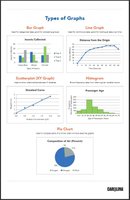
Graphs are essential tools for visualizing and interpreting scientific data. Common types include bar graphs, line graphs, scatterplots, histograms, and pie charts.
Characteristics of Life
RAREHOG: Fundamental Traits
All living things share certain characteristics, summarized by the acronym RAREHOG:
Reproduce: Ability to produce new organisms.
Adapts: Evolution and change over time.
Responds to Stimuli: Reacts to environmental signals.
Energy: Metabolism and energy use.
Homeostasis: Maintains stable internal conditions.
Organization: Composed of cells, increasing in complexity.
Growth and Development: Increase in size and specialization.
Reproduction
Reproduction is the process of producing new organisms, either asexually or sexually.
Asexual: One parent, identical offspring (e.g., bacteria, mitosis).
Sexual: Two parents, genetically diverse offspring (e.g., humans, frogs).
Adaptation and Evolution
Organisms change over time in response to their environment, a process known as adaptation. Evolution is the cumulative change in populations over generations.
Response to Stimulus
Organisms respond to environmental signals (stimuli) such as temperature, light, and hunger. For example, plants grow toward light (phototropism).
Energy and Metabolism
Metabolism is the sum of all chemical reactions in the body. Organisms obtain energy in two main ways:
Autotrophs: Make their own food using sunlight (e.g., plants).
Heterotrophs: Obtain energy by consuming other organisms (e.g., humans).
Homeostasis
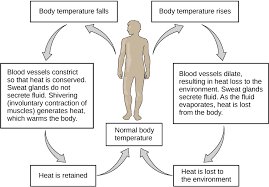
Homeostasis is the maintenance of stable internal conditions, often regulated by negative feedback loops. Examples include body temperature and blood glucose regulation.
Organization of Life
Cellular Organization
Cells are the basic unit of structure and function in living organisms.
Unicellular: Single-celled organisms (e.g., bacteria).
Multicellular: Organisms with many cells (e.g., plants, animals).
Levels of Biological Organization
Life is organized in a hierarchy:
Molecular: Atoms form organelles.
Organelles: Specialized cell parts.
Cell: Basic unit of life.
Tissue: Group of cells with a specific function.
Organ: Two or more tissues working together.
Organ System: Multiple organs for a common purpose.
Organism: All organ systems functioning together.
Species: Genetically similar organisms.
Population: Members of one species in an area.
Community: Different populations in the same area.
Ecosystem: Communities and their environment.
Biosphere: All ecosystems on Earth.
Biodiversity: Variety and number of species in an ecosystem.
Genetic Material
DeoxyriboNucleic Acid (DNA)
DNA is the universal genetic code, present in every cell. It carries genetic information from parent to offspring and is essential for growth and development.
Taxonomy and Classification
Binomial Taxonomy
Organisms are classified using a binomial system (genus and species). For example, the domestic cat is Felis catus.
Taxonomists: Scientists who classify organisms.
Subcategories: Subspecies are below species level.
Growth and Development
Cell Growth and Differentiation
Growth is an increase in cell size, while development involves cell division and differentiation, leading to specialized cells (e.g., bone, muscle).
Microscopy
Microscopes
Microscopes are instruments that produce enlarged images of objects, essential for studying cells and microorganisms.
Magnification: Increase in apparent size; calculated by multiplying eyepiece and objective lens.
Resolution: Ability to show details clearly; higher resolution means better image quality.
Types of Microscopes
Light Microscope: Uses light to view specimens; most common in biology.
Electron Microscope: Uses electron beams for high magnification; includes Transmission (TEM) and Scanning (SEM) types. Cannot view living specimens.
Organ Systems
Major Organ Systems
Organ systems perform vital functions in multicellular organisms. Examples include:
Cardiovascular: Circulates blood and delivers nutrients.
Integumentary: Protects the body (skin, hair, nails).
Digestive: Breaks down food and absorbs nutrients.
Muscular: Enables movement.
Lymphatic: Defends against infection and maintains fluid balance.
Graphing in Biology
Types of Graphs
Graphs are used to represent data visually in biology. Common types include:
Bar Graph: Compares quantities across categories.
Line Graph: Shows trends over time or continuous data.
Scatterplot: Displays relationships between variables.
Histogram: Shows frequency distribution.
Pie Chart: Represents proportions of a whole.
Interpreting Biological Data
Graphs help analyze trends, relationships, and distributions in biological data. For example, a graph may show the relationship between light intensity and photosynthetic rate.
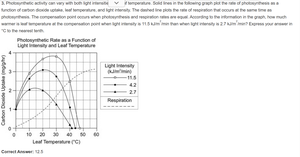
Additional info: The photosynthetic rate graph demonstrates how environmental factors affect biological processes, a key concept in biology.
