 Back
Introduction to Biology: Properties, Themes, Organization, and Scientific Method
Study Guide - Smart Notes
 Tailored notes based on your materials, expanded with key definitions, examples, and context.
Properties of Living Things
Characteristics of Life
Living organisms share several fundamental properties that distinguish them from nonliving matter. These properties are essential for the survival and continuation of life.
Cellular Organization: All living things are composed of cells, which are the basic units of life. Organisms may be unicellular (e.g., bacteria) or multicellular (e.g., humans, plants).
Energy Use: Organisms require energy to grow, move, repair, and carry out life processes. Plants obtain energy via photosynthesis, while animals acquire energy by consuming food.
Growth and Development: Living things increase in size and undergo changes as they mature. This includes both physical growth and functional development.
Response to Environment: Organisms can react to environmental changes, such as moving away from danger or growing toward light.
Reproduction: Living things produce new organisms through sexual or asexual reproduction, ensuring the continuation of their species.
Homeostasis: Organisms maintain stable internal conditions despite external changes (e.g., humans sweat to regulate body temperature).
Adaptation and Evolution: Over generations, populations evolve as individuals with advantageous traits survive and reproduce.
Example: Humans maintain homeostasis by regulating body temperature, and plants respond to light by growing toward it.
Unifying Themes of Life
Five Major Themes
Biology is unified by several key themes that apply to all living organisms:
Energy and Matter: All organisms require energy and matter, which are obtained and recycled in various ways (e.g., photosynthesis in plants, consumption in animals).
Information: Genetic information is stored in DNA and passed from parents to offspring, guiding development and function.
Interactions: Organisms interact with each other and their environment, affecting survival and reproduction (e.g., pollination, competition).
Structure and Function: The form of biological structures is closely related to their function (e.g., bird wings for flight, plant roots for absorption).
Evolution: Evolution explains the diversity and adaptation of organisms through changes over generations.
Example: The structure of a bird's wing enables flight, illustrating the relationship between structure and function.
Levels of Biological Organization
Ten Levels from Atom to Biosphere
Biological organization ranges from the smallest chemical units to the entire biosphere:
Atom: Smallest unit of an element (e.g., carbon atom).
Molecule: Two or more atoms bonded (e.g., water, H2O).
Organelle: Specialized cell structures (e.g., mitochondria).
Cell: Basic unit of life (e.g., red blood cell).
Tissue: Group of similar cells (e.g., muscle tissue).
Organ: Structure made of tissues (e.g., heart).
Organ System: Group of organs (e.g., digestive system).
Organism: Individual living thing (e.g., human, tree).
Population: Group of same species in an area (e.g., deer population).
Ecosystem/Biosphere: All living and nonliving things in an area; biosphere includes all life on Earth.
Example: The heart is an organ composed of muscle tissue, which consists of muscle cells.
Darwin’s Theory of Natural Selection
Development and Principles
Charles Darwin proposed natural selection as the mechanism for evolution. He observed that individuals vary in traits, and some traits enhance survival and reproduction. Because resources are limited, organisms compete, and those with advantageous traits are more likely to survive and reproduce. Over generations, these traits become more common.
Variation: Individuals within a species differ in traits.
Competition: More offspring are produced than can survive, leading to competition for resources.
Survival and Reproduction: Traits that improve survival are passed to offspring.
Adaptation: Over time, populations become better suited to their environment.
Example: Darwin’s study of finches on the Galápagos Islands showed beak variations related to food sources.
Three Domains of Life
Classification and Examples
Organisms are classified into three domains based on cell structure and genetics:
Bacteria: Prokaryotic cells without a nucleus (e.g., E. coli).
Archaea: Prokaryotic, genetically distinct from bacteria, often in extreme environments (e.g., Halobacterium).
Eukarya: Eukaryotic cells with a nucleus; includes animals, plants, fungi, protists (e.g., humans, oak trees).
Example: Mushrooms belong to the Eukarya domain.
The Scientific Method
Steps and Hypothesis
The scientific method is a systematic approach to investigation:
Observation: Noticing a phenomenon.
Question: Asking about the observation.
Research: Gathering information.
Hypothesis: Formulating a testable explanation or prediction.
Experiment: Testing the hypothesis.
Data Collection: Recording results.
Analysis: Interpreting data.
Conclusion: Drawing conclusions based on evidence.
Example: "If the plant receives more sunlight, then it will grow taller." is a testable hypothesis.
Reasoning in Science
Deductive vs. Inductive Reasoning
Reasoning methods help scientists draw conclusions:
Deductive Reasoning: Starts with a general principle and applies it to a specific case (e.g., all mammals have lungs; a dog is a mammal; therefore, a dog has lungs).
Inductive Reasoning: Begins with specific observations and forms a general conclusion (e.g., observing several dogs have lungs and concluding all dogs have lungs).
Comparison: Deductive moves from general to specific; inductive moves from specific to general.
Experimental Design
Groups and Variables
Experiments use control and experimental groups to test hypotheses:
Control Group: Does not receive the treatment; used for comparison.
Experimental Group: Receives the treatment or change.
Independent Variable: The factor changed by the researcher (e.g., amount of sunlight).
Dependent Variable: The factor measured (e.g., plant height).
Example: Testing plant growth with different sunlight levels; sunlight is independent, plant height is dependent.
Interpreting Graphs
Drawing Conclusions from Data
Graphs visually represent data and help identify patterns and trends. To interpret a graph:
Examine the title, axes, labels, and units.
Identify patterns or trends in the data.
Draw conclusions based on evidence shown.
Avoid unsupported assumptions.
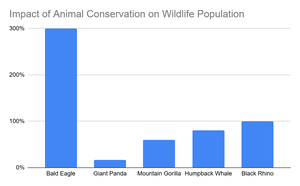
Example: The bar graph below shows the impact of animal conservation on wildlife populations. The Bald Eagle population increased by nearly 300%, while other species showed smaller increases.
Scientific Theory
Definition and Importance
A scientific theory is a well-supported explanation of natural phenomena, tested repeatedly and supported by extensive evidence. Theories are not guesses; they are foundational to scientific understanding and may be revised with new evidence.
Example: The theory of evolution explains how populations change over time.
Additional info: Scientific theories differ from hypotheses in that they are broader, have more evidence, and are widely accepted by the scientific community.
