 Back
Introduction to Biology: The Study of Life
Study Guide - Smart Notes
 Tailored notes based on your materials, expanded with key definitions, examples, and context.
Introduction to Biology
Definition and Characteristics of Life
Biology is the scientific study of life and living organisms. To be considered alive, an entity must exhibit several key characteristics that distinguish living things from non-living matter.
Replication (with high fidelity): Living organisms can reproduce, passing on their genetic information to offspring with high accuracy.
Cells (borders): All living things are composed of cells, which are membrane-bound units that separate the internal environment from the external environment.
Information (flow): Organisms process hereditary information encoded in genes as well as information from the environment.
Energy (flow): Life requires the acquisition and use of energy to power cellular processes.
Evolution: Populations of organisms evolve over time through changes in their genetic material.
Example: A bacterium divides to produce two identical daughter cells, demonstrating replication, cellular structure, information flow, energy use, and the potential for evolutionary change.
Vocabulary and Key Terms
Central dogma (of biology): The flow of genetic information from DNA to RNA to protein.
ATP (adenosine triphosphate): The primary energy currency of the cell.
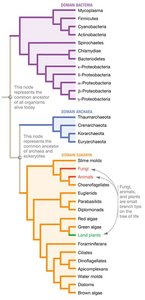
Phylogenetic tree: A diagram showing evolutionary relationships among species.
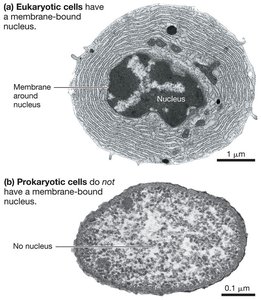
Eukaryotic cell: A cell with a membrane-bound nucleus.
Prokaryotic cell: A cell lacking a membrane-bound nucleus.
The Cell Theory
Discovery and Principles
The cell theory is a fundamental concept in biology, stating that all living organisms are composed of cells and that all cells arise from preexisting cells. This theory was developed based on observations by early scientists such as Robert Hooke and Anton van Leeuwenhoek.
Cells are highly organized compartments separated from their environment by a membrane barrier.
All organisms are made up of cells.
All cells come from preexisting cells.


Cell Theory vs. Spontaneous Generation
Cell theory challenged the idea of spontaneous generation, which posited that living organisms could arise from non-living matter. Louis Pasteur's experiments provided evidence that cells only arise from preexisting cells, not spontaneously.
All-cells-from-cells hypothesis: Cells are produced when pre-existing cells grow and divide.
Spontaneous generation hypothesis: Organisms could arise spontaneously under certain conditions (disproven by Pasteur).


Types of Cells and Domains of Life
Eukaryotic vs. Prokaryotic Cells
Cells are classified into two main types based on their internal structure: eukaryotic and prokaryotic.
Eukaryotic cells: Have a membrane-bound nucleus and various organelles.
Prokaryotic cells: Lack a membrane-bound nucleus; DNA is located in the nucleoid region.

The Three Domains of Life
All cellular life is classified into three domains based on genetic and biochemical differences:
Bacteria
Archaea
Eukarya
This classification was not discovered until the 1970s and is often depicted as a phylogenetic tree.
Genetic Information and the Central Dogma
Flow of Genetic Information
The central dogma of molecular biology describes the flow of genetic information within a biological system:
DNA is transcribed into messenger RNA (mRNA).
mRNA is translated into protein.
Proteins determine the physical traits of organisms.

DNA Replication and Mutation
DNA is copied with high accuracy during cell division, but occasional mistakes (mutations) can occur. These mutations may alter proteins and result in heritable variations, which are the raw material for evolution.
Heritable variations underlie the diversity of life and drive evolutionary change.
Energy and Life
Energy Flow in Living Systems
All living organisms require energy to drive the chemical reactions necessary for life. The main energy currency in cells is ATP (adenosine triphosphate).
Organisms acquire chemical energy in the form of ATP.
They also need molecules to build DNA, RNA, proteins, and other cellular components.
How organisms acquire energy is central to the diversification of life (e.g., photosynthesis in plants, consumption of organic molecules in animals).
Energy Acquisition in Plants and Bacteria
Plants and some bacteria can produce sugars using energy from sunlight (photosynthesis). These sugars are used to make ATP or stored for later use. Other organisms absorb molecules from their environment as food.

Evolution and Natural Selection
Principles of Evolution
Evolution is the change in the characteristics of a population over time. Charles Darwin and Alfred Russel Wallace proposed that species are related by common ancestry and that species can change over generations—a process called "descent with modification."

Natural Selection
Natural selection is the mechanism by which evolution occurs. For natural selection to operate, two conditions must be met:
Individuals in a population must vary in heritable characteristics.
Certain heritable traits must help individuals survive and reproduce more successfully than others in a particular environment.
Over time, these advantageous traits become more common in the population.


Fitness and Adaptation
Fitness is the ability of an individual to produce surviving offspring. Adaptation is a trait that increases an individual's fitness in a particular environment.

Phylogenetic Trees and the Tree of Life
Phylogenetic trees are diagrams that depict evolutionary relationships among species based on genetic or morphological data. The "tree of life" illustrates how all organisms are related through common ancestry.

Summary Table: Key Differences Between Eukaryotic and Prokaryotic Cells
Feature | Eukaryotic Cells | Prokaryotic Cells |
|---|---|---|
Nucleus | Present (membrane-bound) | Absent |
Size | Generally larger | Generally smaller |
Organelles | Membrane-bound organelles present | Few or none |
Domains | Eukarya | Bacteria, Archaea |
