 Back
Introduction to Biology: The Study of Life
Study Guide - Smart Notes
 Tailored notes based on your materials, expanded with key definitions, examples, and context.
Biology: The Study of Life
Introduction to Biology
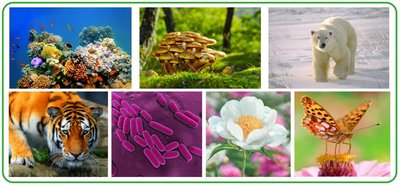
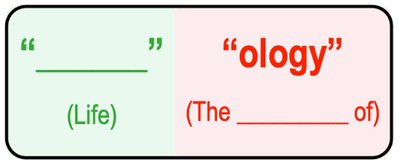
Biology is the scientific study of life, encompassing the structure, function, growth, origin, evolution, and distribution of living organisms. The term 'biology' is derived from the Greek words 'bios' (life) and 'logy' (the study of). Life on Earth is incredibly diverse, ranging from microscopic organisms to large plants and animals, but most life forms are too small to be seen without magnification.
Basic Units of Life
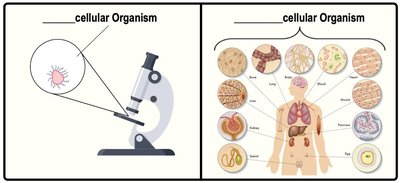
Cell: The smallest, most basic unit of life. All living things are composed of cells.
Organism: Any individual form of life, which can be unicellular or multicellular.
Unicellular vs. Multicellular Organisms
Living organisms can be classified based on the number of cells they possess:
Unicellular organisms: Consist of a single cell (e.g., bacteria, some protists).
Multicellular organisms: Composed of multiple cells (e.g., plants, animals, fungi).
Characteristics of Life
Defining Features of Living Organisms
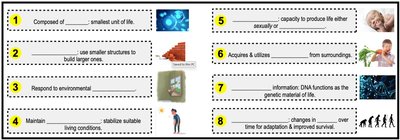
All living organisms share several key characteristics that distinguish them from nonliving things:
Cellular Organization: Composed of one or more cells, the smallest unit of life.
Order: Use smaller structures to build larger, more complex ones.
Response to Stimuli: Ability to respond to environmental changes.
Homeostasis: Maintain stable internal conditions.
Reproduction: Capacity to produce new life, either sexually or asexually.
Energy Utilization: Acquire and utilize energy from the environment.
Genetic Information: DNA functions as the genetic material of life.
Evolution: Populations change over time for adaptation and improved survival.
Note: Viruses are not considered alive because they do not meet all these criteria independently.
Life’s Organizational Hierarchy
Levels of Biological Organization
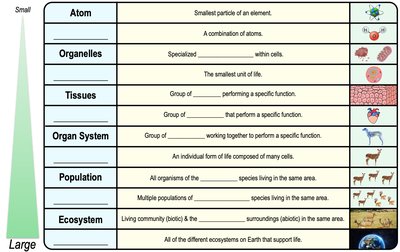
Life is organized into a hierarchical structure, from the smallest to the largest scale:
Level | Description |
|---|---|
Atom | Smallest particle of an element |
Organelle | Specialized structures within cells |
Cell | The smallest unit of life |
Tissue | Group of cells performing a specific function |
Organ | Group of tissues working together to perform a specific function |
Organ System | Group of organs working together |
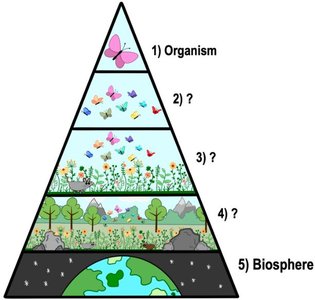
Organism | An individual form of life composed of many cells |
Population | All organisms of the same species living in the same area |
Community | Multiple populations of different species living in the same area |
Ecosystem | Living community (biotic) & nonliving surroundings (abiotic) in the same area |
Biosphere | All ecosystems on Earth that support life |
Emergent Properties
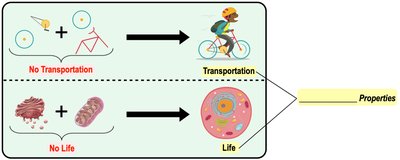
Emergent properties are characteristics that arise when smaller parts combine to form more complex structures, and these properties are not present in the individual parts alone. At each new level of the hierarchy, the whole is greater than the sum of its parts.
Natural Selection & Evolution
Adaptation and Fitness
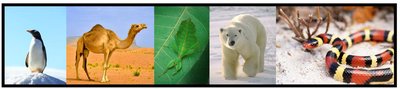
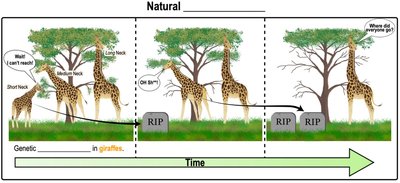
Living organisms are well suited to their environments due to adaptation, which improves their fitness. Adaptation is the process that enables organisms to survive and reproduce in their environments. Fitness refers to an organism’s ability to survive and reproduce.
Natural Selection
Natural selection, described by Charles Darwin, is the process by which the natural environment selects for organisms in a population that are more 'fit.' This process is often summarized as 'survival of the fittest.' Natural selection requires:
Genetic variation in a population
Selective pressure for heritable traits affecting fitness
Evolution
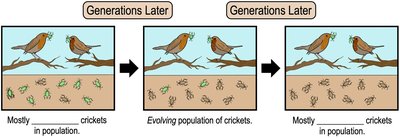
Evolution is the change in the genetic makeup of a population over multiple generations. Evolution can occur in several ways, but natural selection is a primary mechanism. Evolution is responsible for the diversity of life on Earth.
Introduction to Taxonomy
Classification of Life
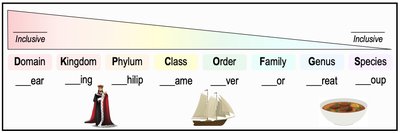
Taxonomy is the branch of science that classifies, identifies, and names organisms. Life is classified into hierarchical categories, from the most inclusive (domain) to the least inclusive (species):
Level | Mnemonic |
|---|---|
Domain | Dear |
Kingdom | King |
Phylum | Philip |
Class | Came |
Order | Over |
Family | For |
Genus | Great |
Species | Soup |
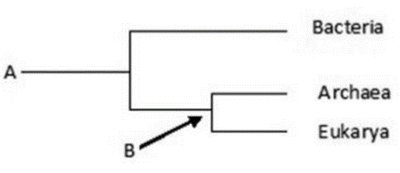
The Three Domains of Life
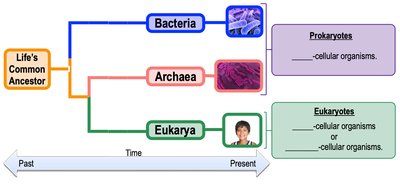
Bacteria: Prokaryotic cells (lack a nucleus), usually unicellular.
Archaea: Prokaryotic cells (lack a nucleus), usually unicellular, often found in extreme environments.
Eukarya: Eukaryotic cells (contain a nucleus), can be unicellular or multicellular.
Kingdoms of the Eukarya Domain
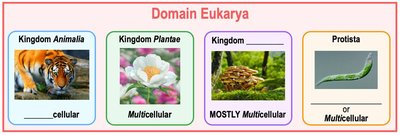
Domain Eukarya is further subdivided into four kingdoms:
Kingdom Animalia: Multicellular animals
Kingdom Plantae: Multicellular plants
Kingdom Fungi: Mostly multicellular fungi
Kingdom Protista: Unicellular or multicellular protists
Categorizing Life by Energy Acquisition
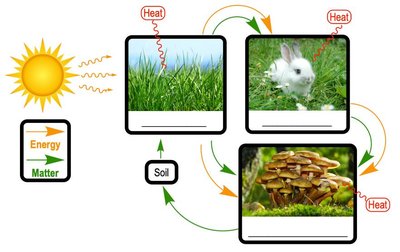
Organisms are categorized based on how they acquire energy:
Producers (Autotrophs): Make their own food (e.g., plants, algae).
Consumers (Heterotrophs): Obtain energy by eating other organisms (e.g., animals).
Decomposers: Obtain energy from wastes and dead organisms (e.g., fungi, bacteria).
Most energy utilized by life originates from the sun, and with every transfer of energy, some is lost as heat.
The Scientific Method
Overview of the Scientific Method
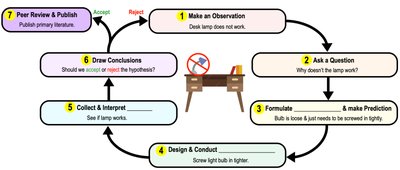
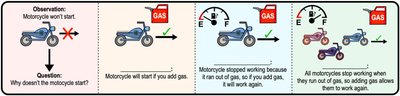
The scientific method is a systematic procedure used to answer questions, test ideas, and gain scientific knowledge. It begins with an observation and a question, followed by hypothesis formation, experimentation, data collection, and analysis.
Predictions, Hypotheses, and Theories
Prediction: An expected outcome of an event, answering 'what will happen?'
Hypothesis: A proposed and testable explanation for an observation, answering 'what will happen?' and 'why will it happen?'
Theory: A testable and broad hypothesis supported by a large body of evidence.
Basic Theories of Biology
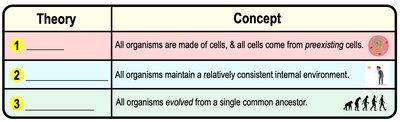
There are three basic theories of biology:
Theory | Concept |
|---|---|
Cell Theory | All organisms are made of cells, and all cells come from preexisting cells. |
Homeostasis Theory | All organisms maintain a relatively consistent internal environment. |
Evolution Theory | All organisms evolved from a single common ancestor. |
Experimental Design
Variables in Experiments
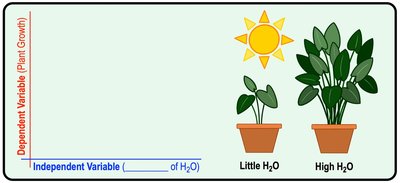
Experiments are designed to test the validity of a hypothesis or theory. Variables are changeable elements in an experiment. Scientists investigate the relationship between two main types of variables:
Variable Type | Definition | Example |
|---|---|---|
Independent Variable | Variable controlled by the researcher | Age, Time/Exposure, Amount, etc. |
Dependent Variable | Variable measured by the researcher | Growth of plant, Drug effectiveness, etc. |

Controls in Experiments
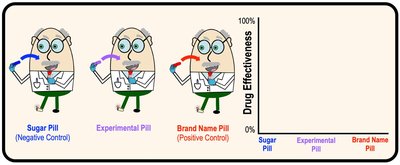
Well-designed experiments contain control groups to prevent false positives and negatives:
False Positive: Outcome that falsely indicates the presence of a result (e.g., a pregnancy test says you are pregnant when you are not).
False Negative: Outcome that falsely indicates the absence of a result (e.g., a pregnancy test says you are not pregnant when you are).
There are two main types of controls:
Control Type | Definition | Purpose |
|---|---|---|
Negative Control | Control group where no response is expected (e.g., placebo) | Prevents false positives |
Positive Control | Control group where a response is expected | Prevents false negatives |

Additional info: These foundational concepts in biology provide the framework for understanding more advanced topics in cellular biology, genetics, evolution, and ecology.
