 Back
BackIntroduction to Biology: The Study of Life and the Process of Science
Study Guide - Smart Notes
 Tailored notes based on your materials, expanded with key definitions, examples, and context.
Biology: The Study of Life
What is Biology?
Biology is the scientific study of life and living organisms. It encompasses a wide range of topics, from the molecular mechanisms inside cells to the interactions of organisms within ecosystems.
Biology investigates the structure, function, growth, origin, evolution, and distribution of living things.
It seeks to answer fundamental questions about how life works and how living things interact with each other and their environment.

The Process of Science
Scientific Inquiry
Science is an approach to understanding the natural world through inquiry—a search for information, evidence, explanations, and answers to specific questions.
Scientists seek natural causes for natural phenomena.
They focus on structures and processes that can be observed and measured.
Recorded observations are called data, which serve as the evidence for scientific inquiry.
The Scientific Method
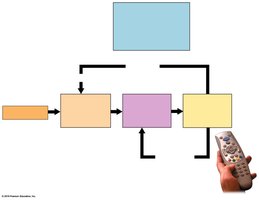
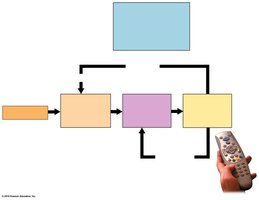
The scientific method is a systematic approach to investigation that involves several key steps:
Exploration: Making observations, asking questions, and seeking information.
Hypothesis Formation: Proposing a testable explanation for a set of observations.
Prediction: Making predictions based on the hypothesis.
Experimentation: Running experiments to test the predictions.
Data Collection: Gathering and interpreting data from experiments.
Conclusion: Drawing conclusions based on the results, which may support or refute the hypothesis.
Testing Hypotheses
A hypothesis is a proposed explanation for a set of observations that can be tested through experimentation.
Experiments are designed to test hypotheses by manipulating variables and observing outcomes.
The independent variable is what the researcher manipulates.
The dependent variable is the response or effect measured in the experiment.
Well-designed experiments test only one independent variable at a time.
Controlled Experiments
Controlled experiments compare two or more groups that differ only in one variable being tested.
The control group does not receive the experimental treatment.
The experimental group receives the treatment.
A placebo is an inert treatment used as a control in medical studies.
In a double-blind experiment, neither the participants nor the researchers know who is in the control or experimental group, reducing bias.

Outcomes and Communication in Science
The results of scientific inquiry lead to building knowledge, solving problems, developing new technologies, and benefiting society. Communication is essential for scientific progress.
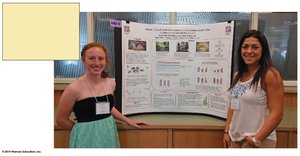
Scientists share data, obtain feedback, publish papers, replicate findings, and build consensus.
Peer review improves the reliability of scientific papers by subjecting them to evaluation by impartial experts.
Theories and Facts
A theory is a comprehensive and well-substantiated explanation, broader than a hypothesis, and supported by a large body of evidence. Theories are refined or abandoned if new evidence contradicts them.
Fact: An observation that has been repeatedly confirmed.
Theory: A broad explanation for a wide range of phenomena.
Hypothesis: A testable explanation for a specific observation.
Science vs. Pseudoscience
Pseudoscience is any field falsely presented as having a scientific basis. Recognizing pseudoscience is crucial for evaluating scientific claims.
Science adheres to the scientific method, is open to review, and relies on repeatable results.
Pseudoscience relies on anecdotal evidence, untestable claims, and rejects external review.
Features of Science | Features of Pseudoscience |
|---|---|
Adheres to scientific method | Does not adhere to accepted processes |
Repeatable results | Results cannot be duplicated |
Testable, disprovable claims | Unprovable or untestable claims |
Open to outside review | Rejects external review |
Multiple lines of evidence | Relies on anecdotal evidence |

Evaluating Scientific Claims
To evaluate scientific claims, consider the reliability of the source. Peer review, author qualifications, and reproducibility are key factors.
Is the information current and primary?
Are the authors qualified and unbiased?
Are references cited and experiments reproducible?
Was the information peer reviewed?

Properties and Themes of Life
Characteristics of Life
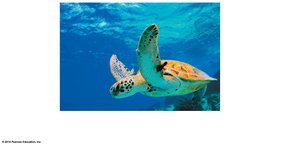
An object is considered alive if it displays all of the following characteristics simultaneously:
Order
Cells
Growth and development
Energy processing
Regulation
Evolution
Reproduction
Response to the environment
Major Themes in Biology
Five unifying themes recur throughout biology:
Structure and Function: The relationship between the form of biological structures and their functions.
Information Flow: The transfer and use of information within and among organisms.
Pathways That Transform Energy and Matter: The flow of energy and cycling of matter through living systems.
Evolution: The process that drives the diversity and unity of life.
Interactions Within Biological Systems: The complex interactions at all levels of biological organization.

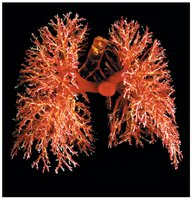
The Relationship of Structure to Function
Structure and function are correlated at all levels of biological organization, from molecules to ecosystems. For example, the branching structure of lungs increases surface area for gas exchange.
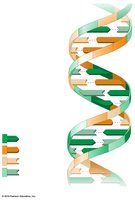
Information Flow
Information must be received, transmitted, and used for life’s functions to proceed in an orderly manner. Genes, composed of DNA, are the hereditary units that store and transmit information.
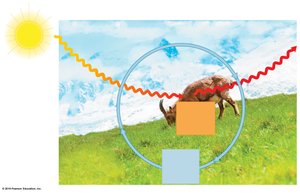
Pathways That Transform Energy and Matter
All living things require energy to perform work. Energy flows through ecosystems, entering as sunlight and exiting as heat, while matter is recycled.
Producers (plants) capture sunlight and convert it to chemical energy.
Consumers (animals) obtain energy by eating producers or other consumers.
Decomposers recycle nutrients back into the ecosystem.
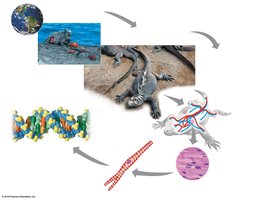
Levels of Biological Organization
Biology studies life from the molecular level to the biosphere. Each level exhibits emergent properties not present at lower levels.
Biosphere
Ecosystems
Communities
Populations
Organisms
Organ systems and organs
Tissues
Cells
Organelles
Molecules and atoms
Evolution: The Core Theme of Biology
Evolution explains both the unity and diversity of life. All living organisms share common features due to descent from a common ancestor, but have diversified through evolutionary processes.
Natural selection is the mechanism by which individuals with advantageous traits are more likely to survive and reproduce.
Evolutionary adaptations are inherited traits that enhance survival and reproduction in specific environments.
Evolutionary Relationships
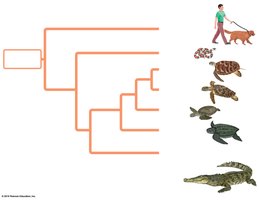
Comparing DNA sequences among species reveals evolutionary relationships and helps construct evolutionary trees. Each species represents a twig on the tree of life, tracing back to common ancestors.
Additional info: This guide covers foundational concepts from Chapter 1 of a college biology course, including the nature of science, the scientific method, properties of life, major themes in biology, and the basics of evolution.
