Back
Introduction to Biology: Themes and Organization
Study Guide - Smart Notes
 Tailored notes based on your materials, expanded with key definitions, examples, and context.
What is Biology?
Definition and Scope
Biology is the scientific study of life and living organisms. It seeks to understand what living things are made of, how they function, how they grow and change, and how they interact with each other and their environments. Biology covers a vast range of topics, from the molecular level to entire ecosystems.
Major Themes in Biology
Overview of Themes
Organization: Biological systems are structured in hierarchical levels, from molecules to the biosphere.
Information: Life processes depend on the storage, transmission, and use of information, primarily in the form of genetic material (DNA).
Energy and Matter: Living systems require energy and matter to grow, develop, and maintain organization.
Interactions: Organisms interact with each other and their environment at all levels of organization.
Evolution: Populations of organisms change over generations, leading to the diversity of life.
Organization in Biology
Levels of Biological Organization
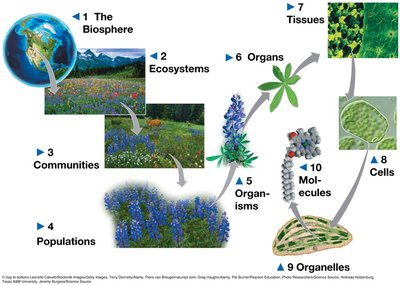
Biological systems are organized into a hierarchy of levels, each with emergent properties that arise from the interactions of their parts.
Molecules: Chemical building blocks of life (e.g., DNA, proteins, lipids, carbohydrates).
Organelles: Specialized structures within cells (e.g., mitochondria, nucleus).
Cells: The basic unit of life; can be unicellular or multicellular.
Tissues: Groups of similar cells performing a specific function.
Organs: Structures composed of different tissues working together.
Organ Systems: Groups of organs that perform major body functions.
Organisms: Individual living beings.
Populations: Groups of organisms of the same species in an area.
Communities: Groups of populations of different species in an area.
Ecosystems: Communities interacting with their physical environment.
Biosphere: All ecosystems on Earth.
Emergent Properties
At each higher level of organization, new properties emerge that are not present at the lower level. These emergent properties result from the interactions and arrangement of parts within a system.
Example 1: A single heart cell can contract, but the heart as an organ can pump blood due to the coordinated action of many cells.
Example 2: An ecosystem exhibits nutrient cycling and energy flow, which are not properties of individual organisms alone.
Structure and Function
There is a close relationship between the structure of a biological component and its function. Analyzing structure can provide insights into how something works.
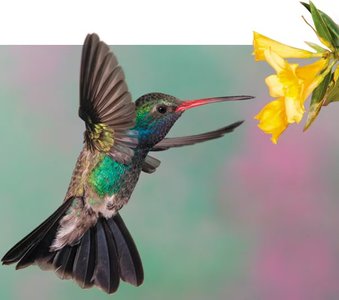
Example: The long, slender beak of a hummingbird is adapted for feeding on nectar deep within flowers.
Example: The biconcave shape of red blood cells increases surface area for gas exchange and allows them to move through narrow vessels.
Information in Biology
Genetic Information
Genetic information is stored in DNA and provides the instructions for building, functioning, and maintaining life. During cell division, this information is copied and passed to new cells, ensuring continuity of life.
DNA (deoxyribonucleic acid) contains genes, which are specific sequences that code for proteins.
Genetic information is inherited from one generation to the next, allowing for growth, development, and reproduction.

Energy and Matter
Energy Flow
All living organisms require energy to power processes such as growth, repair, and movement. Energy enters ecosystems (usually as sunlight), is captured by producers (like plants), and flows through food chains. Eventually, energy is lost as heat and does not get recycled.
Producers (e.g., plants) convert sunlight into chemical energy via photosynthesis.
Consumers (e.g., animals) obtain energy by eating other organisms.
Decomposers (e.g., fungi, bacteria) break down dead matter, returning nutrients to the environment.

Matter Cycling
Unlike energy, matter (such as carbon, nitrogen, and oxygen) cycles between living organisms and the environment. These cycles ensure that essential elements are reused and recycled within ecosystems.
Carbon Cycle: Movement of carbon among the atmosphere, organisms, and the Earth.
Nitrogen Cycle: Conversion of nitrogen between different chemical forms, making it available to living things.

Interactions in Biology
Interactions at All Levels
Life involves interactions at every level of organization. These interactions can occur between molecules, cells, organs, organisms, and with the physical environment.
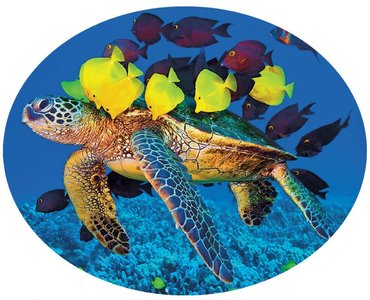
Mutualism: Both species benefit (e.g., bees and flowers).
Parasitism: One species benefits, the other is harmed (e.g., tapeworms in mammals).
Predation: One organism kills and eats another (e.g., lions and zebras).
Competition: Both species are negatively affected by sharing a limited resource (e.g., plants competing for sunlight).
Evolution
Evolution and Common Ancestry
Evolution is the process by which populations change over generations through the inheritance of traits. Over long periods, evolutionary changes can lead to both similarities and differences among organisms, explaining the diversity of life.
All living organisms are connected through common ancestry.
Species with a more recent common ancestor are more closely related.
Shared ancestry explains similarities among different organisms.

Evolution and Divergence
Populations can accumulate changes independently, leading to divergence. Over many generations, this process results in the formation of new species and contributes to the vast diversity of life on Earth.
Evolutionary divergence explains why different species have unique adaptations.
Natural selection, genetic drift, and other mechanisms drive evolutionary change.