 Back
Introduction to Biology: Unifying Themes, Organization, and Evolution
Study Guide - Smart Notes
 Tailored notes based on your materials, expanded with key definitions, examples, and context.
Unifying Themes in Biology
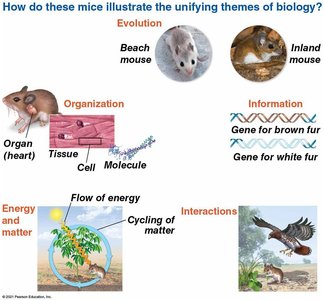
Overview of the Five Unifying Themes
Biology is organized around five unifying themes that help explain the complexity and diversity of life. These themes provide a framework for understanding biological processes at all levels of organization.
Organization: Life is structured in a hierarchical manner, from molecules to the biosphere.
Information: Living organisms store, transmit, and respond to genetic information.
Energy and Matter: Life requires the transfer and transformation of energy and matter.
Interactions: Organisms interact with each other and their environment.
Evolution: The process by which populations of organisms change over generations, leading to diversity and adaptation.
Properties of Life
Characteristics Shared by All Living Things
All living organisms share a set of fundamental properties that distinguish them from non-living matter.
Cellular Organization: Composed of one or more cells, the basic unit of life.
Metabolism: Use raw materials to extract and utilize energy.
Homeostasis: Maintain stable internal conditions.
Growth and Development: Increase in size and complexity over time.
Reproduction: Ability to produce new individuals.
Response to Stimuli: React to environmental changes.
Evolutionary Adaptation: Populations evolve and possess adaptive traits.
Levels of Biological Organization
Hierarchy from Molecules to the Biosphere
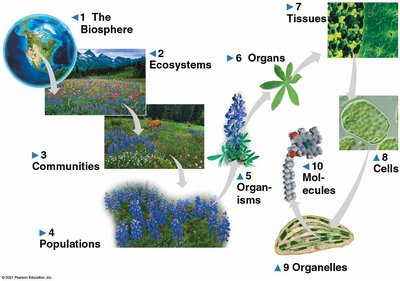
Biological systems are organized into a hierarchy of structural levels, each building on the levels below it. This organization allows for emergent properties at each level.
Molecules → Organelles → Cells → Tissues → Organs → Organisms → Populations → Communities → Ecosystems → Biosphere
Cells: The Basic Unit of Life
Prokaryotic vs. Eukaryotic Cells
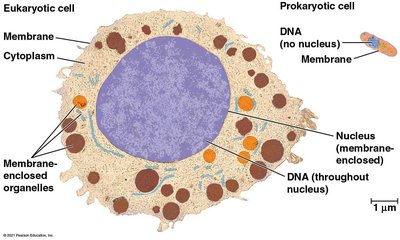
Cells are the fundamental units of life. There are two main types of cells:
Prokaryotic Cells: Lack a nucleus and membrane-bound organelles (e.g., Bacteria and Archaea).
Eukaryotic Cells: Have a nucleus and membrane-bound organelles (e.g., plants, animals, fungi, protists).
Genetic Information and Gene Expression
DNA, Genes, and Genomes
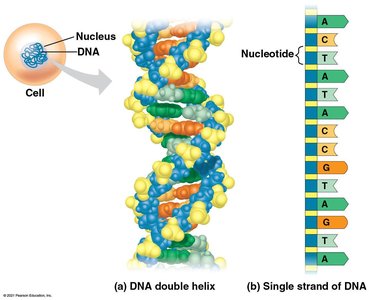
Genetic information is stored in DNA, which encodes instructions for building and maintaining an organism. The flow of genetic information is central to biology.
DNA (Deoxyribonucleic Acid): The molecule that stores genetic information.
Gene: A segment of DNA that encodes a functional product, usually a protein.
Genome: The complete set of genetic material in an organism.
Gene Expression: The process by which information from a gene is used to synthesize a functional gene product (protein or RNA).
Inheritance and Variation
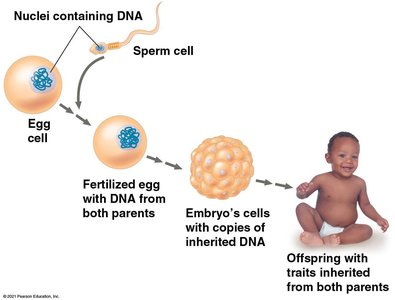
Genetic information is passed from parents to offspring, resulting in inherited traits. Variation arises from mutations and sexual reproduction.
Genomics and Proteomics
Large-Scale Analysis of Biological Molecules
Modern biology uses large-scale approaches to study genes (genomics) and proteins (proteomics).
Genomics: Study of whole sets of genes and their interactions within and between species.
Proteomics: Study of the entire set of proteins (proteome) expressed by a cell, tissue, or organism.
Energy Flow and Chemical Cycling
How Energy and Matter Move Through Ecosystems
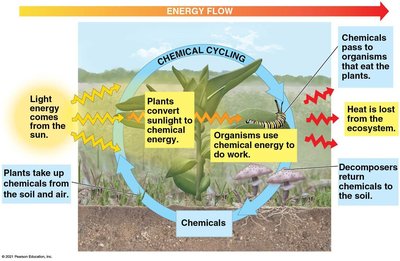
All living organisms require energy, which flows through ecosystems, while matter cycles between living and nonliving components.
Energy Flow: Sunlight is converted to chemical energy by producers (e.g., plants), which is then used by consumers and decomposers.
Chemical Cycling: Elements such as carbon and nitrogen are recycled through the ecosystem.
Evolution: The Core Theme of Biology
Darwin's Theory of Natural Selection
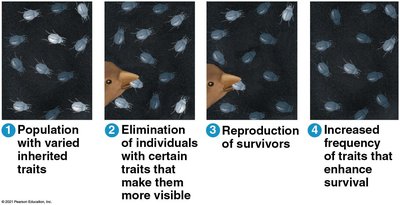
Evolution explains both the unity and diversity of life. Charles Darwin proposed that natural selection is the mechanism by which evolution occurs.
Natural Selection: Individuals with advantageous traits are more likely to survive and reproduce, passing those traits to the next generation.
Adaptation: Over time, populations become better suited to their environments.
Unity and Diversity of Life
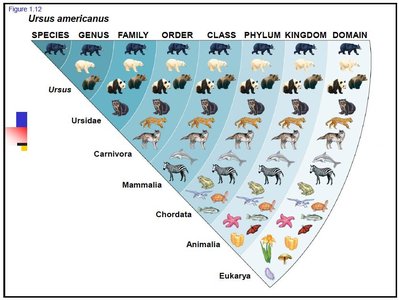
Despite the diversity of life, all organisms share a common ancestry and many fundamental characteristics. Classification systems organize this diversity.
Taxonomy: The science of naming and classifying organisms.
Hierarchical Classification: Species are grouped into increasingly broad categories: genus, family, order, class, phylum, kingdom, domain.
Three Domains of Life
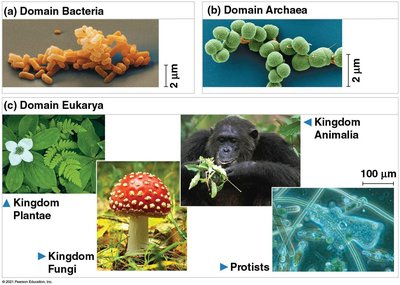
All life is classified into three domains: Bacteria, Archaea, and Eukarya. Each domain contains unique and diverse forms of life.
Bacteria: Prokaryotic, unicellular organisms.
Archaea: Prokaryotic, often found in extreme environments.
Eukarya: Eukaryotic organisms, including plants, animals, fungi, and protists.
Scientific Inquiry and Reasoning in Biology
Approaches to Understanding Biological Systems
Biologists use various methods to study life, including:
Systems Biology: Analysis of interactions among the parts of biological systems.
Reductionism: Breaking down complex systems into simpler components.
Inductive Reasoning: Drawing general conclusions from specific observations.
Example: Studying gene expression in a cell to understand how traits are inherited and regulated.
Summary Table: Key Terms and Definitions
Term | Definition |
|---|---|
Genome | The complete set of genetic material in an organism |
Gene | A segment of DNA that encodes a functional product |
Proteome | The entire set of proteins expressed by a cell, tissue, or organism |
Natural Selection | The process by which advantageous traits become more common in a population |
Homeostasis | The maintenance of stable internal conditions |
Additional info: These notes provide foundational concepts for introductory biology, covering the first chapter's major themes, organization, and the role of evolution in shaping life.
