Back
BackIntroduction to Biotechnology: Concepts, History, and Applications
Study Guide - Smart Notes
 Tailored notes based on your materials, expanded with key definitions, examples, and context.
Biotechnology: Definition and Scope
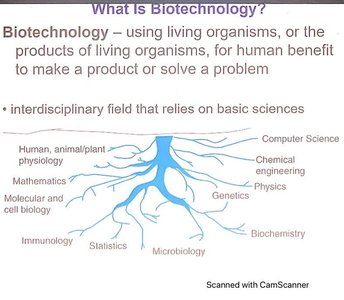
What is Biotechnology?
Biotechnology is the use of living organisms, or the products of living organisms, for human benefit to make a product or solve a problem. It is an interdisciplinary field that relies on basic sciences such as genetics, microbiology, biochemistry, molecular and cell biology, immunology, statistics, mathematics, computer science, chemical engineering, and physics.
Definition: The application of biological systems or organisms to technical and industrial processes.
Interdisciplinary Nature: Integrates knowledge from various scientific disciplines to innovate and solve problems.
Everyday Experiences with Biotechnology
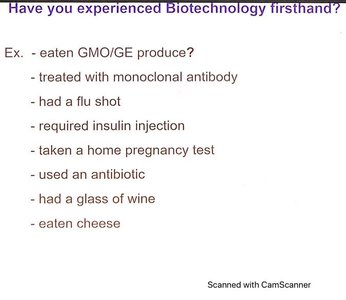
Many people encounter biotechnology in their daily lives, often without realizing it. Common examples include:
Consumption of GMO/GE produce
Treatment with monoclonal antibodies
Receiving a flu shot
Insulin injections for diabetes
Home pregnancy tests
Use of antibiotics
Consumption of wine or cheese
Historical Examples of Biotechnology
Early Biotechnology Practices
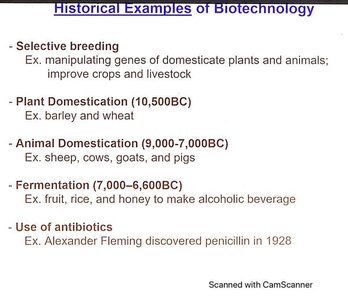
Selective Breeding: Manipulating genes of domesticated plants and animals to improve crops and livestock.
Plant Domestication (10,500 BC): Early cultivation of barley and wheat.
Animal Domestication (9,000–7,000 BC): Domestication of sheep, cows, goats, and pigs.
Fermentation (7,000–6,000 BC): Use of fruit, rice, and honey to make alcoholic beverages.
Use of Antibiotics: Discovery of penicillin by Alexander Fleming in 1928.
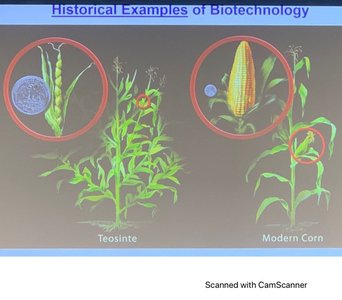
Plant Domestication: Teosinte to Modern Corn
Selective breeding transformed wild teosinte into modern corn, demonstrating the power of biotechnology in agriculture.
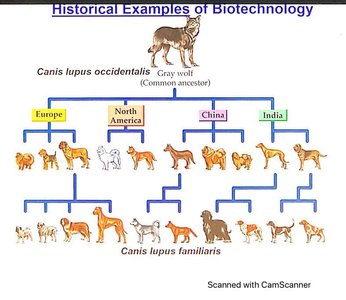
Animal Domestication: Evolution of Dogs
Domestication of the gray wolf (Canis lupus occidentalis) led to the development of various dog breeds (Canis lupus familiaris).
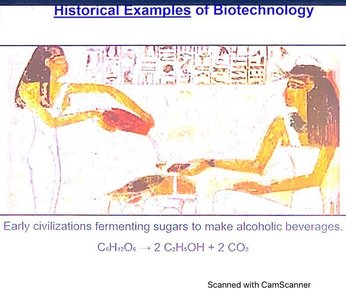
Fermentation in Early Civilizations
Early civilizations used fermentation to convert sugars into alcoholic beverages. The chemical equation for alcoholic fermentation is:
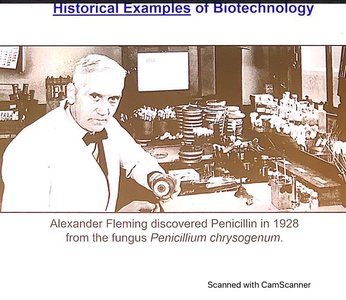
Discovery of Antibiotics
Alexander Fleming discovered penicillin in 1928 from the fungus Penicillium chrysogenum, revolutionizing medicine by enabling the treatment of bacterial infections.
Modern Examples of Biotechnology
Key Technologies and Milestones
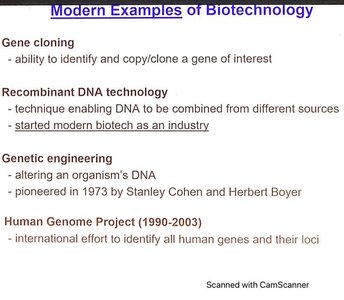
Gene Cloning: Identifying and copying a gene of interest.
Recombinant DNA Technology: Combining DNA from different sources; foundational for the biotech industry.
Genetic Engineering: Altering an organism's DNA; pioneered by Stanley Cohen and Herbert Boyer in 1973.
Human Genome Project (1990–2003): International effort to identify all human genes and their loci.
Applications of Modern Biotechnology
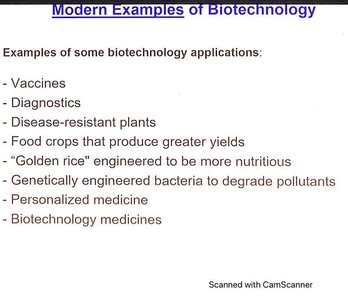
Vaccines
Diagnostics
Disease-resistant plants
Food crops with greater yields
"Golden rice" engineered for improved nutrition
Genetically engineered bacteria for pollutant degradation
Personalized medicine
Biotechnology medicines
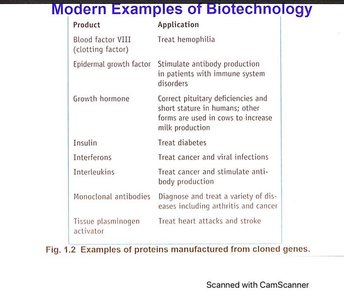
Examples of Proteins Manufactured from Cloned Genes
The following table summarizes important proteins produced using biotechnology and their medical applications:
Product | Application |
|---|---|
Blood factor VIII (clotting factor) | Treat hemophilia |
Epidermal growth factor | Stimulate antibody production in patients with immune system disorders |
Growth hormone | Correct pituitary deficiencies and short stature in humans; increase milk production in cows |
Insulin | Treat diabetes |
Interferons | Treat cancer and viral infections |
Interleukins | Treat cancer and stimulate antibody production |
Monoclonal antibodies | Diagnose and treat various diseases, including arthritis and cancer |
Tissue plasminogen activator | Treat heart attacks and stroke |
Types of Biotechnology
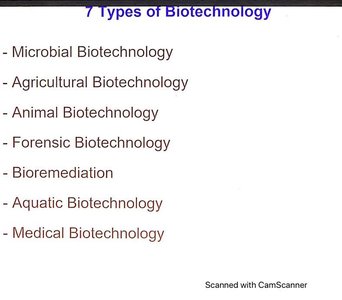
Major Branches
Microbial Biotechnology
Agricultural Biotechnology
Animal Biotechnology
Forensic Biotechnology
Bioremediation
Aquatic Biotechnology
Medical Biotechnology
Microbial Biotechnology
Applications and Importance
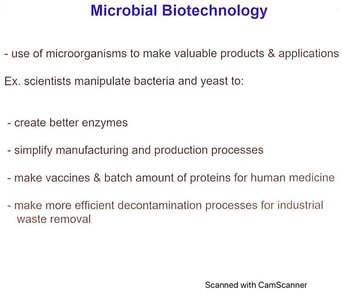
Microbial biotechnology involves the use of microorganisms to create valuable products and applications. Scientists manipulate bacteria and yeast to:
Create better enzymes
Simplify manufacturing and production processes
Produce vaccines and proteins for human medicine
Develop efficient decontamination processes for industrial waste removal
Production of Recombinant Proteins
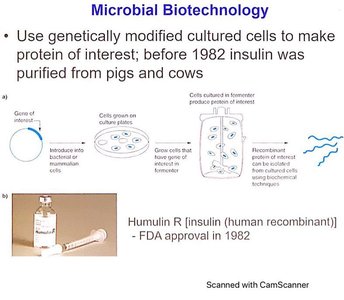
Genetically modified cultured cells are used to produce proteins of interest. Before 1982, insulin was purified from pigs and cows; now, recombinant human insulin (Humulin R) is produced using genetically engineered bacteria.
Agricultural Biotechnology
Genetic Engineering of Plants
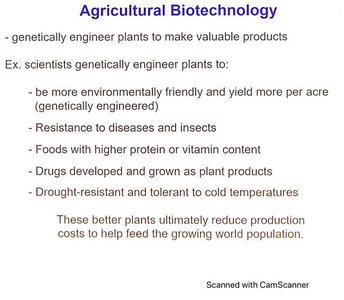
Agricultural biotechnology focuses on genetically engineering plants to make valuable products. Scientists engineer plants to:
Be more environmentally friendly and yield more per acre
Resist diseases and insects
Have higher protein or vitamin content
Produce drugs as plant products
Be drought-resistant and tolerant to cold
These improvements help reduce production costs and support the growing world population.
Global Food Production Challenge
The United Nations predicts that by 2050, the world population will reach 9.1 billion, requiring a 70% increase in food production. Agricultural biotechnology is essential to meet this demand.
Animal Biotechnology
Genetic Engineering of Animals
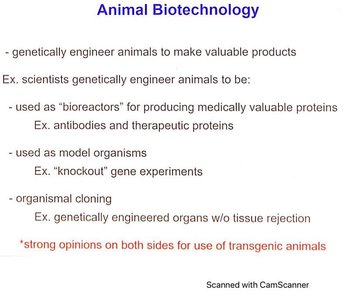
Animal biotechnology involves genetically engineering animals to produce valuable products. Applications include:
Using animals as "bioreactors" for producing medically valuable proteins (e.g., antibodies, therapeutic proteins)
Using animals as model organisms (e.g., "knockout" gene experiments)
Organismal cloning (e.g., genetically engineered organs without tissue rejection)
Note: There are strong opinions on both sides regarding the use of transgenic animals.
Transgenic Animals
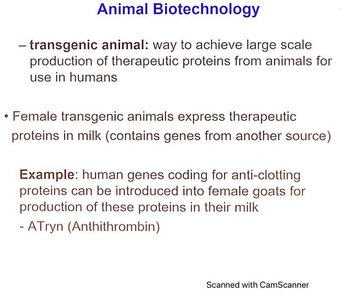
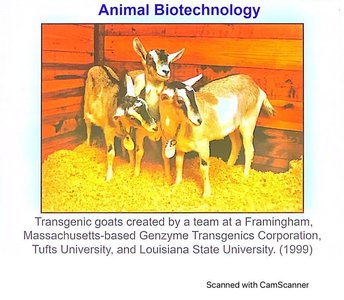
A transgenic animal is one that carries genes from another species. Female transgenic animals can express therapeutic proteins in their milk, such as human anti-clotting proteins produced in goats (e.g., ATryn, or antithrombin).
Gene Knockout Studies
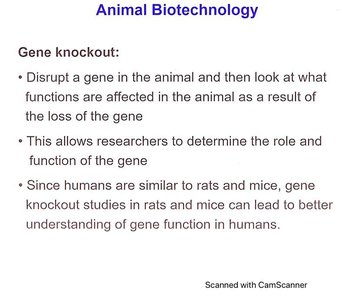
Gene knockout involves disrupting a gene in an animal to study the resulting effects. This helps researchers determine gene function. Since humans are genetically similar to rats and mice, knockout studies in these animals can improve understanding of human gene function.
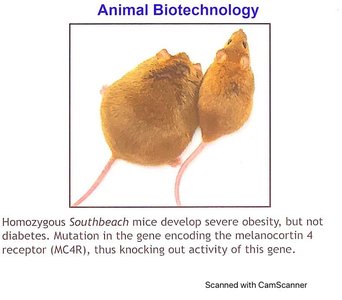
Example: Southbeach Mice
Homozygous Southbeach mice develop severe obesity due to a mutation in the melanocortin 4 receptor (MC4R) gene, demonstrating the impact of gene knockout on phenotype.
Forensic Biotechnology
Applications in Law and Medicine
Forensic biotechnology involves the analysis and application of biological evidence, such as DNA sequence data, to detect an organism's unique DNA pattern. Applications include:
Solving crimes
Determining paternity
Identifying human remains
Tracking and confirming organisms that spread disease
Determining the identity of unknown biological samples
DNA Profiling
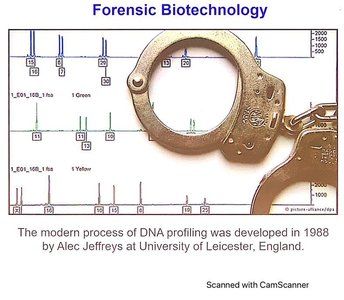
The modern process of DNA profiling was developed in 1988 by Alec Jeffreys at the University of Leicester, England. DNA fingerprinting is a powerful tool for identification in forensic science.
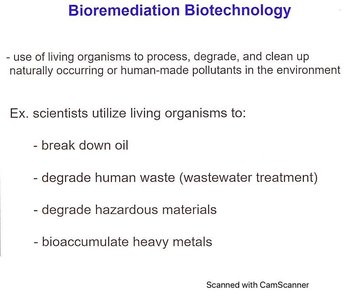
Bioremediation Biotechnology
Environmental Applications
Bioremediation uses living organisms to process, degrade, and clean up pollutants in the environment. Scientists utilize organisms to:
Break down oil
Degrade human waste (wastewater treatment)
Degrade hazardous materials
Bioaccumulate heavy metals