 Back
BackIntroduction to Cell and Molecular Biology: Evolution, Classification, and Scientific Inquiry
Study Guide - Smart Notes
 Tailored notes based on your materials, expanded with key definitions, examples, and context.
Introduction to Cell and Molecular Biology
Characteristics of Life
Biologists define life by a set of common characteristics shared by all living organisms. Understanding these characteristics helps distinguish living things from non-living matter.
Order: Living organisms exhibit complex but ordered organization of cells and structures.
Evolutionary Adaptation: Populations of organisms change over generations through adaptations that enhance survival and reproduction.
Response to the Environment: Organisms detect and respond to environmental stimuli.
Reproduction: Living things reproduce, passing genetic information to offspring.
Growth and Development: Organisms grow and develop according to inherited instructions.
Energy Processing: Life requires energy, which organisms obtain and use to power activities.
Regulation: Organisms maintain stable internal conditions (homeostasis) despite external changes.
Levels of Classification: The Three Domains of Life
All life on Earth is classified into three domains based on cellular structure and genetics:
Bacteria: Single-celled prokaryotes with unique cell wall structures and biochemistry.
Archaea: Single-celled prokaryotes, often found in extreme environments, with distinct molecular characteristics.
Eukarya: Organisms with eukaryotic cells, including protists, fungi, plants, and animals.
Nomenclature Rules: Scientific names are assigned using binomial nomenclature (Genus species), ensuring clarity and consistency in classification.
Evolution and Natural Selection
Mechanisms of Evolution
Populations change over generations through observable, testable mechanisms. The most significant mechanism is natural selection, as proposed by Charles Darwin.
Natural Selection: The process by which individuals with advantageous traits survive and reproduce more successfully, leading to adaptation and diversification of lineages.
Adaptation: Traits that enhance survival and reproduction become more common in a population over time.
Population vs. Individual Change: Evolution occurs at the population level, not within individuals.
Darwin proposed that natural selection could cause an ancestral species to give rise to two or more descendant species.
Variation in traits
Inheritance of traits
Overproduction of offspring
Differential survival and reproduction
Possible reasons for diverse traits among individuals: Genetic variation, mutations, sexual reproduction, and environmental influences.
Evolutionary Relationships
Evolutionary relationships are often illustrated with phylogenetic (treelike) diagrams that show ancestors and their descendants. These diagrams help clarify how species are related through common ancestry.
Example: Green warbler finches and woodpecker finches share a common ancestor but did not evolve directly from one another.
The Scientific Process in Biology
Scientific Inquiry
Biology relies on the scientific method, which involves making observations, forming hypotheses, and testing predictions.
Inductive Reasoning: Drawing general conclusions from specific observations (e.g., observing many cells and concluding all living things are made of cells).
Deductive Reasoning: Making specific predictions based on general principles (e.g., if all organisms are made of cells, then any new organism discovered will be made of cells).
Hypothesis: An explanation based on observations and assumptions that leads to a testable prediction. Often structured as "If..., then..." statements.
Experimental Design: Case Study of Mouse Coat Coloration
Scientific experiments use controls and variables to test hypotheses. The classic study of mouse coat coloration demonstrates the process of scientific inquiry in biology.
Initial Observations: Mice living on light-colored beaches tend to have light coats, while those on dark inland soils have dark coats.
Data Collection: Measure predation rates on model mice with different coat colors in different habitats.
Hypotheses:
Coat color matching the environment reduces predation (camouflage hypothesis).
Coat color does not affect predation rates (null hypothesis).
Experimental Controls: Models with coat colors matching the native habitat (camouflaged).
Independent Variable: Coat color of the mouse models (light or dark).
Dependent Variable: Percentage of models attacked by predators.
Conclusion: The data support the hypothesis that camouflage reduces predation, but other factors may also influence survival.
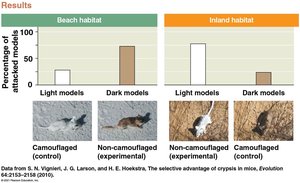
Does this data set prove that coat color is driven by predation alone? No; while the experiment supports the role of predation, other ecological factors may also contribute to the evolution of coat color.
Summary Table: Key Concepts in Evolution and Scientific Inquiry
Concept | Definition | Example/Application |
|---|---|---|
Natural Selection | Process by which individuals with advantageous traits survive and reproduce more successfully | Camouflaged mice survive better in matching habitats |
Hypothesis | Testable explanation for an observation | If mouse color matches habitat, then predation will decrease |
Control | Standard for comparison in an experiment | Camouflaged mouse models |
Independent Variable | Variable manipulated by the experimenter | Coat color of mouse models |
Dependent Variable | Variable measured in the experiment | Percentage of models attacked |
Additional info: The mouse coat color experiment is a classic example of hypothesis-driven science and illustrates how natural selection can be studied in real populations.
