 Back
BackIntroduction to Ecology and Behavioural Ecology: Study Guide
Study Guide - Smart Notes
 Tailored notes based on your materials, expanded with key definitions, examples, and context.
Introduction to Ecology
What is Ecology?
Ecology is the scientific study of how organisms interact with each other and with their environment. The primary goals of ecology are to understand the distribution and abundance of organisms and to identify the impacts humans have on the environment. Ecology is closely linked with evolution, as evolutionary processes shape ecological interactions and vice versa.
Distribution: Where organisms are found geographically.
Abundance: How many individuals of a species are present in a given area.
Human Impact: Human activities can alter ecological systems, sometimes with unintended consequences.
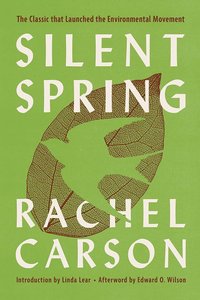
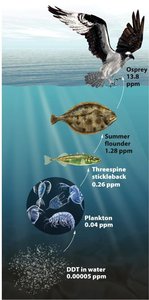
Example: The publication of Silent Spring by Rachel Carson in 1962 highlighted the ecological consequences of DDT pesticide use, which led to declines in bird populations due to bioaccumulation and biomagnification.
Levels of Ecological Study
Ecological Scales
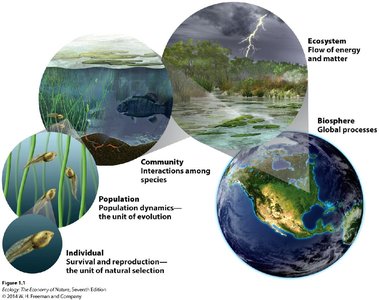
Ecology can be studied at multiple biological scales, each focusing on different aspects of the interactions between organisms and their environment:
Biosphere: Global processes and patterns, such as climate and ocean currents, that affect life on Earth.
Ecosystem: The flow of energy and matter between living (biotic) and non-living (abiotic) components.
Community: Interactions among different species living in the same area.
Population: Dynamics of a single species, including changes in size, density, and structure over time and space.
Individual: How the morphology, physiology, and behavior of an organism allow it to survive and reproduce in its environment.
Determinants of Distribution and Abundance
Biogeography and Limiting Factors
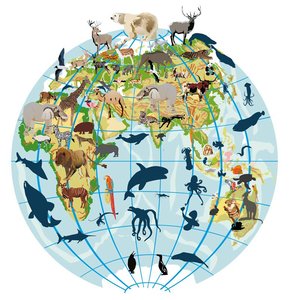
Biogeography is the study of how organisms are distributed geographically. The distribution and abundance of species are influenced by both abiotic (non-living) and biotic (living) factors.
Abiotic Factors: Climate (temperature and moisture), soil, light, and nutrients.
Biotic Factors: Interactions with other species, such as competition, predation, mutualism, and parasitism.
Niche Models: These models show the range of environmental conditions a species can tolerate. Some species have broad tolerances (generalists), while others are more specialized (specialists).
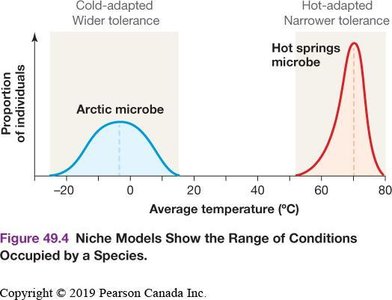
Climate and Its Effects on Ecology
Latitudinal and Seasonal Variation
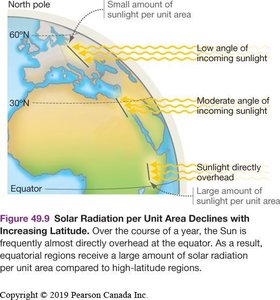
Climate, defined by long-term patterns of temperature and precipitation, is a major determinant of species distribution. Solar radiation per unit area declines with increasing latitude, making the tropics warmer and the poles colder.
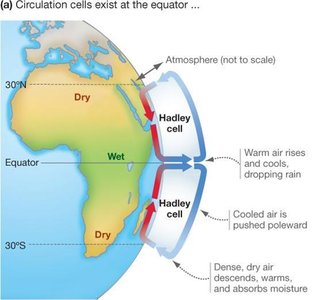
Global air circulation patterns, such as Hadley cells, create moist tropics and dry subtropical regions.
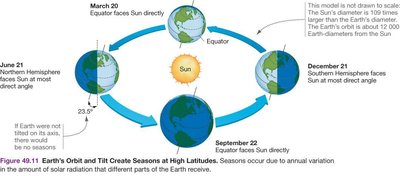
Seasonality is caused by the Earth's 23.5° tilt on its axis, resulting in varying solar input throughout the year.
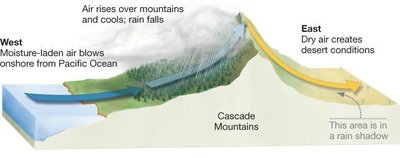
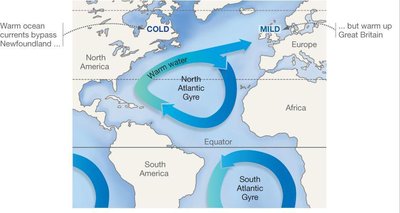
Regional effects, such as rain shadows created by mountains and oceanic moderation of climate, further influence local climates.
Terrestrial Biomes
Major Biome Types
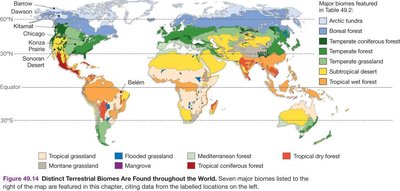
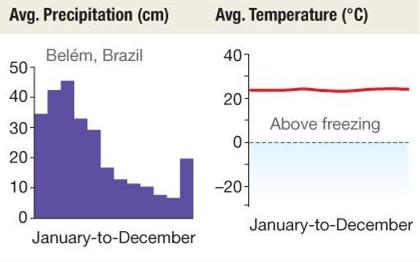
Terrestrial biomes are major groupings of plant and animal communities defined by dominant vegetation and governed by average temperature and precipitation.
Biome | Climate | Key Features |
|---|---|---|
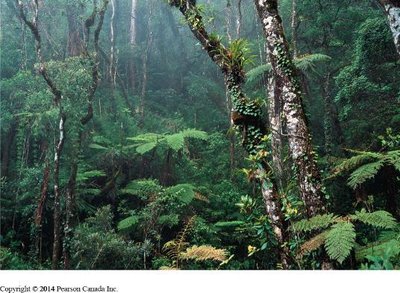
Tropical Wet Forest | Warm, high moisture | High diversity, high productivity |
Subtropical Desert | Extreme temperatures, low moisture | Low diversity, adaptations for drought |
Temperate Grassland | Moderate temp, low-moderate moisture | Fertile soil, fire regimes, dense growth |
Temperate Forest | Moderate temp, moderate moisture | Deciduous trees, seasonal photosynthesis |
Temperate Coniferous Forest | Mild winters, high moisture | Conifer canopy, diverse understory |
Boreal Forest (Taiga) | Low temp, low moisture | Cold-tolerant conifers, low diversity |
Arctic Tundra | Very low temp, very low moisture | Low productivity, permafrost |
Aquatic Biomes
Physical Factors Affecting Aquatic Life
About 70% of Earth's surface is covered by water. The distribution and abundance of aquatic organisms are influenced by four main physical factors:
Salinity: The concentration of dissolved solutes; affects osmoregulation in organisms.
Water Flow: Movement of water presents physical challenges and affects dispersal.
Nutrient Availability: Essential for productivity; affected by processes like lake turnover.
Water Depth: Dictates light penetration and thus photosynthetic activity.
Example: Lake turnover redistributes nutrients and oxygen, supporting aquatic life.
Introduction to Behavioural Ecology
Behaviour and Adaptation
Behavioural ecology studies how behavioural adaptations evolve in response to ecological selection pressures, affecting an organism's fitness. Behaviour is defined as an action in response to a stimulus and can be analyzed at two levels:
Proximate (Mechanistic) Causation: Explains how actions occur (e.g., genetic, neurological, hormonal mechanisms).
Ultimate (Evolutionary) Causation: Explains why actions occur (e.g., evolutionary history, fitness benefits).
Example: Male starlings sing in spring due to hormonal changes (proximate) and to attract mates (ultimate).
Common Questions in Behavioural Ecology
What should I eat?
Where should I live?
Whom should I mate with?
How should I communicate?
When should I cooperate?
Foraging Behaviour
Foraging behaviour is influenced by genetic variation and fitness trade-offs. For example, in Drosophila larvae, "rovers" and "sitters" exhibit different foraging strategies based on population density, controlled by the for gene.
Optimal Foraging Theory: Predicts that animals maximize benefits and minimize costs when foraging.
Habitat Selection and Navigation
Animals select habitats based on quality, population density, and competition. Navigation strategies include:
Piloting: Using landmarks.
Compass Orientation: Using the sun, stars, or Earth's magnetic field.
True Navigation: Locating a specific place on Earth.
Migration is a costly behaviour but may increase survival and reproductive success by tracking seasonal resources.
