 Back
Back1.1 Introduction to Ecology: Concepts, Scales, and Methods
Study Guide - Smart Notes
 Tailored notes based on your materials, expanded with key definitions, examples, and context.
Ecology: Definitions and Scope
What is Ecology?
Ecology is the scientific study of the interactions between organisms and their environment. It seeks to understand the distribution and abundance of organisms, as well as the processes that drive these patterns. The term derives from the Greek words oikos ("house") and logos ("study"), reflecting the concept of studying our natural "house" or environment.
Definition (Cain textbook): The scientific study of interactions between organisms and their environment.
Definition (Krebs Ecology): The scientific study of the interactions that determine the distribution and abundance of organisms.

Ecology vs. Related Fields
Ecology is distinct from several related disciplines:
Environmental Science: An interdisciplinary field focusing on human interactions with the environment.
Conservation Biology: The scientific study of threats to biodiversity and strategies to mitigate them.
Environmentalism: A social ideology aimed at preventing environmental degradation by humans.
Scales in Ecology
Levels of Ecological Organization
Ecology examines biological interactions at multiple scales, from individuals to the entire biosphere:
Individual
Population
Community
Ecosystem
Landscape
Global (Biosphere)
At each scale, ecologists focus on:
Pattern: Observation of natural phenomena (e.g., species distribution).
Process: Mechanisms explaining observed patterns (e.g., competition, predation).
How Do We Study Ecology?
Scientific Methods in Ecology
Ecologists use a combination of surveys, experiments, and modeling to investigate ecological questions. The scientific method involves:
Ask a question
Form a hypothesis
Test the hypothesis
Analyze results
Report results

Field Surveys
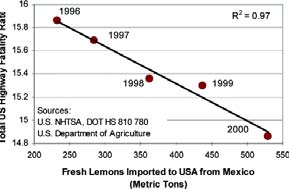
Field surveys are observational studies conducted in natural environments. They are useful for identifying patterns across all ecological scales but cannot establish causation.
Strength: Broad applicability; good for pattern recognition.
Limitation: Cannot determine underlying processes (correlation does not imply causation).


Experiments
Experiments are designed to identify ecological processes by manipulating variables and observing outcomes. Key features include manipulation, replication, and randomization.
Strength: Best for identifying causal mechanisms.
Requirements: Manipulation of variables, replication of treatments, and randomization to avoid bias.
Example: Marine Reserve Experiment
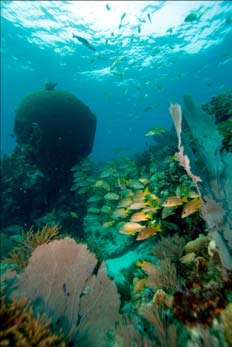
Implementation of marine reserves increases the density of large piscivorous fishes.
This leads to higher predation pressure on juvenile fish, potentially decreasing their recruitment success.
Selective mortality may occur, where only fish with certain traits survive.
Mesocosm Experiments
Mesocosms are controlled outdoor experiments that simulate natural conditions. They allow for manipulation, replication, and randomization in a semi-natural setting.
Example treatments: Reserve density, non-reserve density, and control (no predators).
Experimental steps: Acclimation, transplantation of juveniles, introduction of predators, and monitoring survivorship.



Ecological Modeling
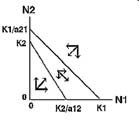
Ecological models use mathematical and computational tools to predict patterns based on processes, or vice versa. Models require assumptions and are most powerful when combined with empirical data from experiments.
Strength: Predictive power; can integrate complex interactions.
Limitation: Dependent on the validity of underlying assumptions.
Major Ecological Concepts
Foundational Principles
1. Everything is connected: Organisms interact in complex ways; no organism acts in isolation.
2. Matter cycles: Materials are transformed and recycled in ecosystems; nothing disappears.
3. Population limits: No population can grow indefinitely; limiting factors always exist.
4. Species interactions: Life depends on interactions such as predation, competition, and mutualism.
5. Resource limitation: Resources are finite; trade-offs are inevitable.
6. Evolution matters: Species change over time, affecting ecological dynamics.
7. Time matters: Ecosystems change over time due to succession and disturbance.
8. Space matters: Environmental conditions vary across space, influencing ecological patterns.
Why Study Ecology?
Importance of Ecology
Practical reasons: Human well-being depends on sustainable use of environmental services and resources. Understanding ecology can guide innovations and inform policy.
Personal reasons: Studying ecology fosters appreciation of nature and a sense of responsibility to future generations.
