 Back
Introduction to Ecology: Levels, Climate, and Biomes
Study Guide - Smart Notes
 Tailored notes based on your materials, expanded with key definitions, examples, and context.
Introduction to Ecology
Definition and Scope
Ecology is the scientific study of how organisms interact with their biotic (living) and abiotic (non-living) environments. Ecologists seek to understand the distribution and abundance of organisms, the dynamics of populations, and the structure and function of communities and ecosystems.
Biotic environment: Includes all living organisms that interact with each other.
Abiotic environment: Includes physical factors such as temperature, water, sunlight, and soil.
Key questions: Why are species found in certain habitats? How do species composition and abundance change over time?
Levels of Ecological Study
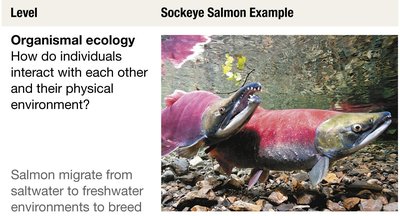
Organismal Ecology
Organismal ecology focuses on how individual organisms interact with their environment, including physiological and behavioral adaptations.
Physiological ecology: Examines how organisms respond to environmental conditions.
Behavioral ecology: Studies how behavior contributes to survival and reproduction.
Example: Salmon migrate from saltwater to freshwater environments to breed.
Population Ecology
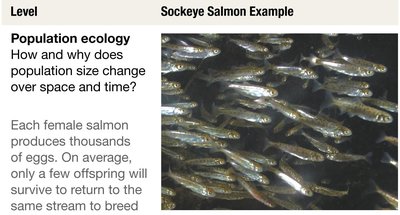
Population ecology investigates the factors that affect population size and dynamics over space and time within a single species.
Population size: Influenced by birth rates, death rates, immigration, and emigration.
Example: Each female salmon produces thousands of eggs, but only a few offspring survive to return to the same stream to breed.
Community Ecology
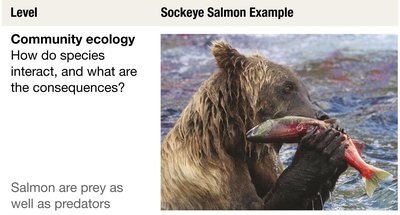
Community ecology examines interactions among different species and the consequences of these interactions for community structure and function.
Species interactions: Includes predation, competition, mutualism, and more.
Example: Salmon are prey for bears and other predators, affecting both salmon and predator populations.
Ecosystem Ecology
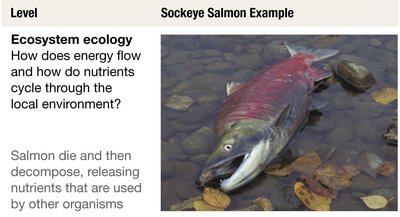
Ecosystem ecology studies how energy flows and nutrients cycle through the biotic and abiotic components of the environment.
Energy flow: Movement of energy through food webs.
Nutrient cycling: Decomposition and recycling of nutrients.
Example: Salmon die and decompose, releasing nutrients used by other organisms.
Abiotic and Biotic Factors Affecting Distribution
Key Abiotic Factors in Terrestrial Environments
Temperature and rainfall are major determinants of the geographic distribution and abundance of organisms. Both average values and variability are important.
Tropical regions: High temperatures, low variability.
Temperate regions: Moderate temperatures, moderate variability.
Arctic/subarctic regions: Low temperatures, high variability.
Global Temperature Patterns
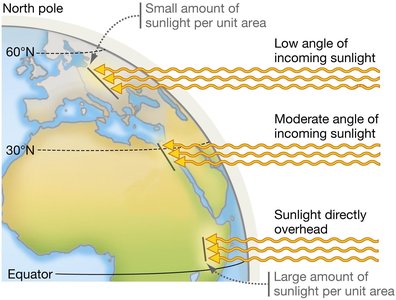
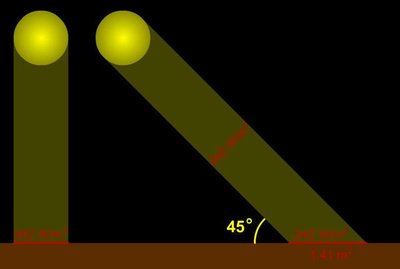
Temperature decreases with increasing latitude due to the angle of incoming sunlight and atmospheric effects.
Sun angle: Higher latitudes receive sunlight at a lower angle, spreading energy over a larger area.
Atmospheric absorbance: More atmosphere to pass through at higher latitudes, reducing energy.
Annual Temperature Variability
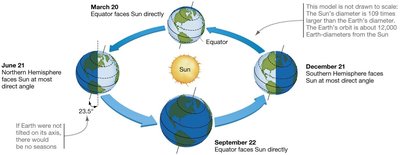
Earth's axial tilt causes seasonal changes in temperature, affecting the angle of sunlight throughout the year.
Axial tilt: 23.5° tilt causes variation in sunlight received at different latitudes.
Seasonal changes: Northern and southern hemispheres alternate facing the sun directly.
Global Rainfall Patterns
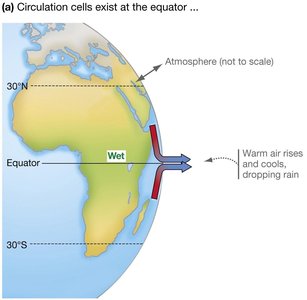
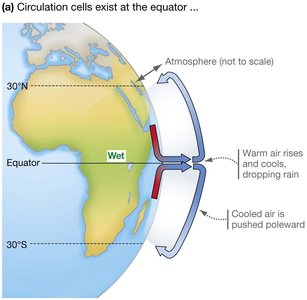
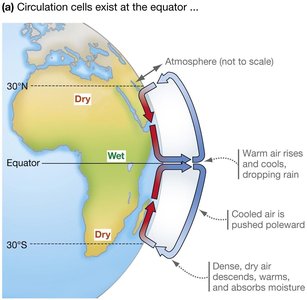
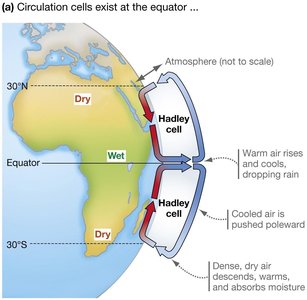
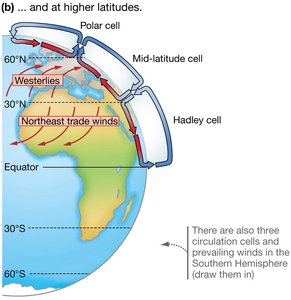
Rainfall varies with latitude, influenced by atmospheric circulation cells such as Hadley cells.
High rainfall: Equator and 60° N/S latitude.
Low rainfall: 30° N/S latitude and poles.
Hadley cell: Warm air rises at the equator, cools, and drops rain; dry air descends at 30° N/S.
Regional Rainfall Patterns: Rain Shadow Effect
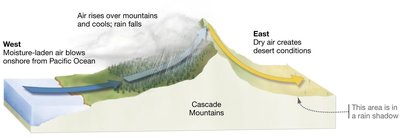
Mountain ranges can create rain shadows, where moist air rises and cools, dropping rain on one side, while dry air descends and creates arid conditions on the other side.
Rain shadow: Area of reduced rainfall on the leeward side of a mountain range.
Terrestrial Biomes
Biome Classification
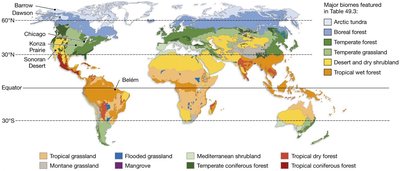
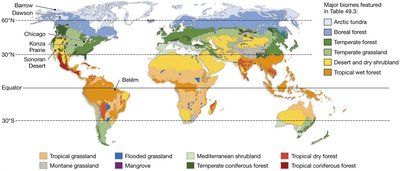
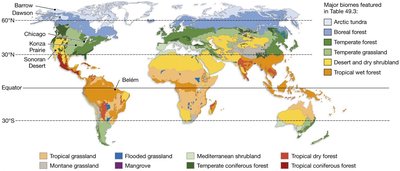
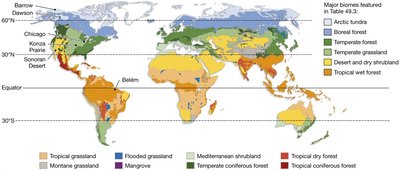
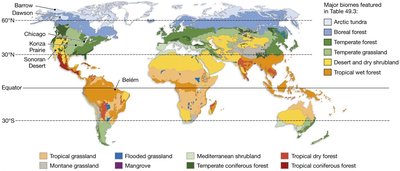
Biomes are large ecological regions defined by their climate, dominant vegetation, and characteristic organisms. Temperature and rainfall patterns determine biome distribution.
Major biomes: Arctic tundra, boreal forest, temperate forest, temperate grassland, desert, tropical rainforest.
Arctic Tundra
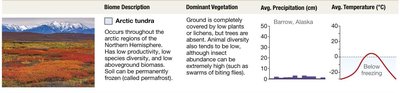
The arctic tundra is characterized by low productivity, low species diversity, and permafrost. Vegetation is dominated by low plants and lichens.
Location: Northern Hemisphere.
Climate: Cold temperatures, low precipitation.
Boreal Forest (Taiga)
Boreal forests are dominated by cold-tolerant conifers and have low species diversity and low precipitation.
Location: Canada, Alaska, Russia, northern Europe.
Climate: Cold temperatures, low precipitation.
Temperate Forest
Temperate forests occur in regions with moderate temperatures and precipitation, supporting diverse plant and animal life.
Location: Eastern North America, Europe, eastern Asia.
Climate: Moderate temperatures, moderate precipitation.
Temperate Grassland
Temperate grasslands are dominated by grasses due to dry conditions and frequent fires. Soils are often fertile.
Location: North America, Eurasia.
Climate: Moderate temperatures, low precipitation.
Desert and Dry Shrubland
Deserts are characterized by extreme temperatures, low moisture, and low productivity. Vegetation is adapted to conserve water.
Location: 30° latitude north and south.
Climate: High temperatures, very low precipitation.
Aquatic Biomes
Key Factors in Aquatic Environments
Light, nutrient, and oxygen availability are critical in aquatic biomes. Light decreases with depth, affecting photosynthesis. Nutrients and oxygen are distributed unevenly.
Light: Decreases with depth; affects photosynthetic organisms.
Nutrients: Upwellings increase nutrient availability in coastal regions.
Oxygen: Higher in surface waters; temperature affects water density and mixing.
Major Aquatic Biomes
Marine biomes: Oceans, estuaries.
Freshwater biomes: Lakes, ponds, rivers, streams, wetlands.
Wetlands and Rivers
Wetlands are areas where water covers the soil, supporting unique plant and animal communities. Rivers and streams are flowing freshwater systems, while estuaries are transition zones between river and ocean environments.
Wetlands: High productivity, important for nutrient cycling.
Rivers: Support diverse aquatic life.
Estuaries: Mix of salt and freshwater, high biological diversity.
Summary Table: Major Terrestrial Biomes
Biome | Dominant Vegetation | Climate | Productivity |
|---|---|---|---|
Arctic tundra | Low plants, lichens | Cold, low precipitation | Low |
Boreal forest | Conifers | Cold, low precipitation | Low |
Temperate forest | Deciduous trees | Moderate temp, moderate precipitation | Moderate |
Temperate grassland | Grasses | Moderate temp, low precipitation | Moderate |
Desert | Cacti, shrubs | High temp, very low precipitation | Low |
Tropical rainforest | Diverse trees | High temp, high precipitation | High |
Additional info: Biomes are shaped by long-term climate patterns, and their boundaries may shift with global climate change.
