 Back
BackIntroduction to Ecology: Levels of Study, Climate, and Biomes
Study Guide - Smart Notes
 Tailored notes based on your materials, expanded with key definitions, examples, and context.
Introduction to Ecology
Definition and Scope of Ecology
Ecology is the scientific study of interactions between organisms and their environment, focusing on the distribution and abundance of organisms. The term derives from the Greek words oikos (home) and ology (study of). Ecologists examine both biotic (living) and abiotic (non-living) factors that influence life on Earth.
Biotic factors: Living components such as plants, animals, fungi, and microorganisms.
Abiotic factors: Non-living components such as temperature, water, sunlight, soil, and climate.
Ecology is organized into six hierarchical levels of study, each focusing on different scales of biological organization and environmental interaction.
Levels of Ecological Study
1. Global Ecology
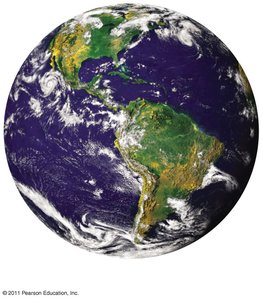
Global ecology examines the effects of regional exchanges of energy and materials on the biosphere—the sum of all Earth's ecosystems, including the atmosphere, land, and oceans. This level addresses large-scale processes that influence life across the planet.
Biosphere: The global ecosystem; all regions of Earth where life exists, from the atmosphere to the ocean depths.
2. Landscape Ecology
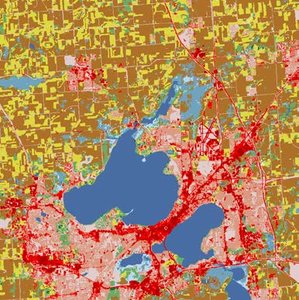
Landscape ecology studies the interactions between the structure and function of physical, biological, and cultural components across multiple ecosystems within a landscape. It focuses on how spatial arrangement affects ecological processes.
Landscape: A mosaic of connected ecosystems, such as forests, lakes, and urban areas.
Examines human impacts (e.g., urbanization, agriculture) on ecological patterns and processes.
3. Ecosystem Ecology
Ecosystem ecology investigates the community of organisms in an area and their interactions with the physical environment. It emphasizes the flow of energy and the cycling of nutrients between biotic and abiotic components.
Ecosystem: All organisms in a given area plus the non-living factors with which they interact.
Major focus: Resource cycling (e.g., carbon, nitrogen) and energy flow (e.g., food webs).
4. Community Ecology
Community ecology focuses on the interactions among populations of different species living together in a specific area. It analyzes biotic interactions such as predation, competition, and symbiosis.
Community: Multiple populations of different species living in the same area.
Examples of interactions: Predator-prey relationships, competition for resources, mutualism.
5. Population Ecology
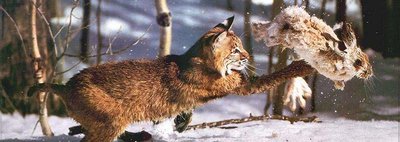
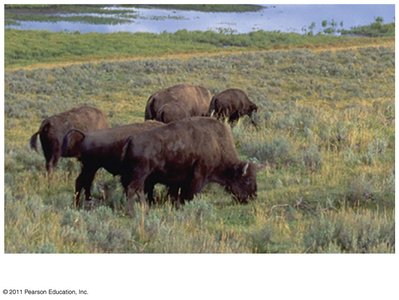
Population ecology studies groups of individuals of the same species living in a particular area. It measures population density, growth, and the factors that regulate population size over time.
Population: A group of individuals of the same species in a defined area.
Key topics: Birth and death rates, immigration and emigration, population regulation.
6. Organismal Ecology
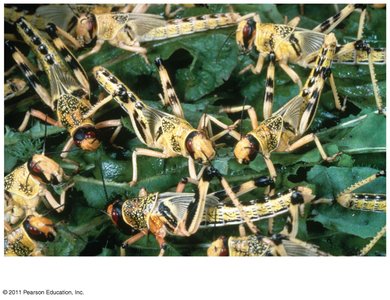
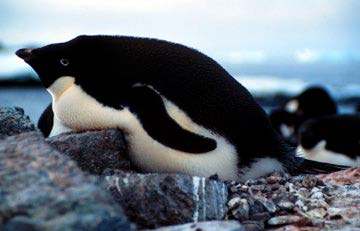
Organismal ecology explores how the physiological and behavioral adaptations of individual organisms enable them to survive and reproduce in their environments. This includes studies of temperature regulation, foraging behavior, and reproductive strategies.
Physiological ecology: How organisms' bodies function in response to environmental conditions.
Behavioral ecology: How behavior contributes to survival and reproductive success.
Climate and Its Influence on Ecology
Definition and Scales of Climate
Climate is the long-term pattern of temperature and precipitation in a region, and it is the most significant factor determining the distribution of organisms. Climate operates at two main scales:
Macroclimate: Large-scale patterns at the global, regional, or landscape level.
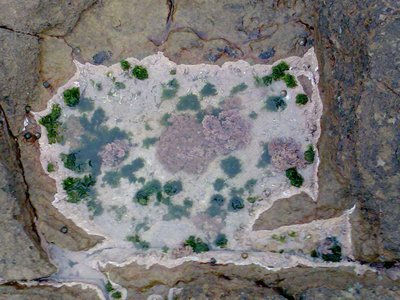
Microclimate: Very localized climate patterns, such as those under a log or in a tide pool.


Latitudinal Variation in Sunlight Intensity
The intensity of sunlight varies with latitude, affecting temperature and climate. The tropics (between 23.5°N and 23.5°S) receive the most direct sunlight, resulting in warmer temperatures, while higher latitudes receive sunlight at a lower angle, spreading energy over a larger area and resulting in cooler climates.

Global Climate Patterns
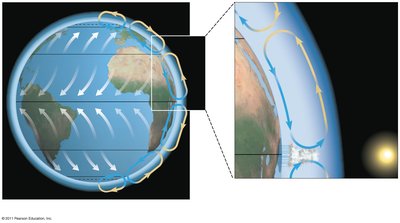
Global climate patterns are shaped by the unequal heating of Earth's surface, the planet's rotation, and the movement of air and water. These patterns create distinct climate zones and influence the distribution of biomes.
Air circulation: Warm air rises at the equator, cools, and descends at higher latitudes, creating wind and precipitation patterns.
Precipitation: Ascending moist air releases moisture as rain, while descending dry air absorbs moisture, forming deserts.
Seasonality and Earth's Tilt
Earth's axis is tilted at 23.5°, causing seasonal variation in temperature and day length as the planet orbits the sun. This tilt results in different regions experiencing varying intensities of sunlight throughout the year.
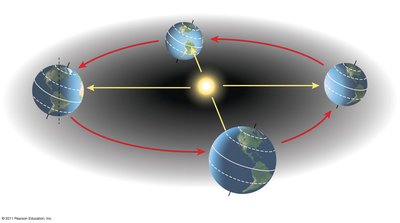
Influence of Water Bodies and Mountains
Large bodies of water and mountain ranges significantly influence local and regional climates. Water moderates temperature, while mountains affect rainfall patterns through the rain shadow effect.
Rain shadow effect: Moist air rises over mountains, cools, and releases precipitation on the windward side; dry air descends on the leeward side, creating arid conditions.
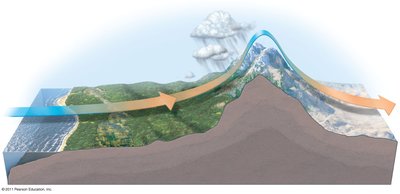
Biomes: Major Ecological Communities
Definition and Types of Biomes
A biome is a large ecological community defined primarily by its climate, vegetation, and the adaptations of its organisms. Biomes are classified as terrestrial (land-based) or aquatic (water-based).
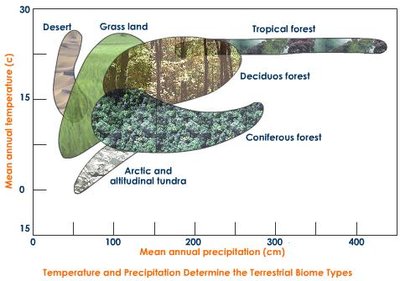
Terrestrial biomes: Determined mainly by temperature and precipitation.
Aquatic biomes: Determined primarily by salinity, depth, and water movement.
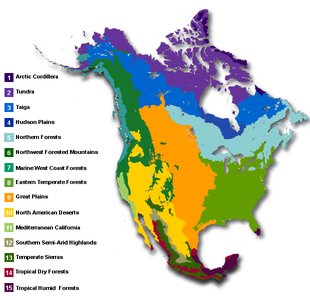
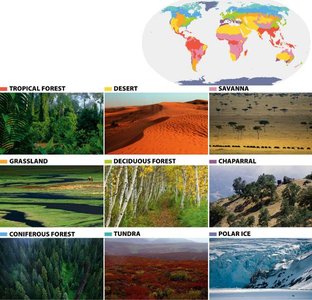
Climate and Biome Distribution
The distribution of terrestrial biomes is closely linked to patterns of temperature and precipitation. Each biome supports characteristic plant and animal communities adapted to its climate.
Tropical forests: High temperature and precipitation; high biodiversity.
Deserts: Low precipitation; plants and animals adapted to conserve water.
Grasslands: Moderate precipitation; dominated by grasses.
Coniferous forests: Cooler temperatures; dominated by cone-bearing trees.
Tundra: Low temperature and precipitation; permafrost present.
Additional info: Aquatic biomes, such as freshwater lakes, rivers, and marine environments, are primarily influenced by factors like salinity, depth, and water flow, which were not covered in detail in the provided material but are important for a comprehensive understanding of global ecology.
