 Back
Introduction to Ecology: Structure, Interactions, and Levels of Organization
Study Guide - Smart Notes
 Tailored notes based on your materials, expanded with key definitions, examples, and context.
Introduction to Ecology
Definition and Scope
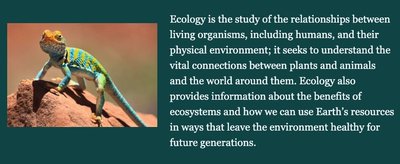
Ecology is the scientific study of the interactions between organisms and their environment, encompassing both living (biotic) and non-living (abiotic) components. Understanding these relationships helps explain patterns and processes in natural systems, and informs conservation and resource management.
Ecology: The study of how organisms interact with their environment.
Environment: Everything that affects an organism during its lifetime, including biotic and abiotic factors.
Applications: Ecology provides insights into biodiversity, natural resources, and human impacts on ecosystems.
The Role of Ecology in Our Lives
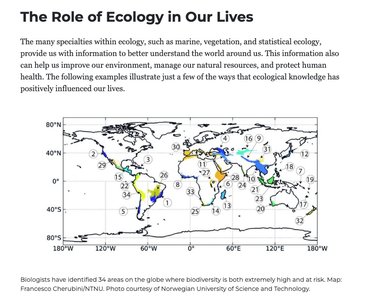
Ecological knowledge is essential for managing natural resources, protecting human health, and maintaining environmental quality. It helps us understand the vital connections between plants, animals, and the world around us.
Biodiversity: The variety of life forms in an ecosystem, including differences within and between species.
Natural Resources: Renewable and non-renewable resources managed through ecological principles.
Human Impact: Ecology informs sustainable practices to keep environments healthy for future generations.
Components of the Environment
Biotic and Abiotic Factors
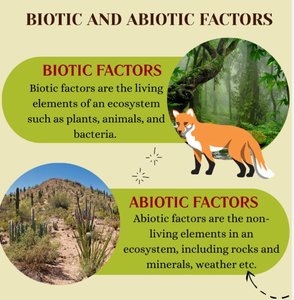
The environment consists of biotic (living) and abiotic (non-living) factors. Both influence the survival, growth, and reproduction of organisms.
Biotic Factors: Living elements such as plants, animals, fungi, and bacteria.
Abiotic Factors: Non-living elements including rocks, minerals, water, temperature, and weather.
Biodiversity and Environment
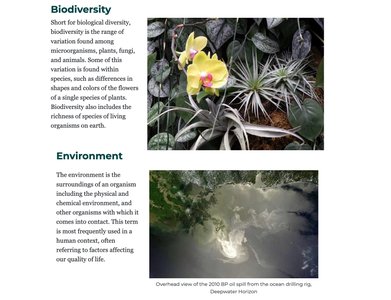
Biodiversity refers to the range of variation among living organisms, while the environment encompasses all physical and chemical surroundings.
Biodiversity: Includes genetic, species, and ecosystem diversity.
Environment: Physical and chemical surroundings affecting organisms.
Levels of Ecological Organization
Organism, Population, Community, Ecosystem
Ecology is studied at multiple levels, each focusing on different aspects of biological interactions and environmental influences.
Organism: Individual living being and its adaptations to the environment.
Population: Group of individuals of the same species in a specific area.
Community: All populations of different species interacting in a location.
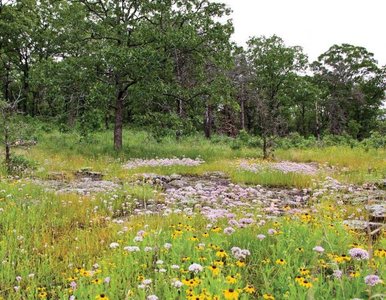
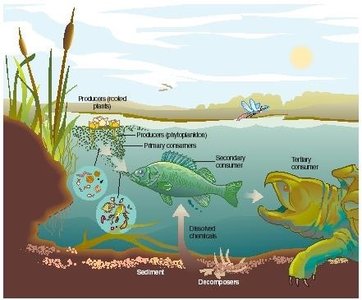
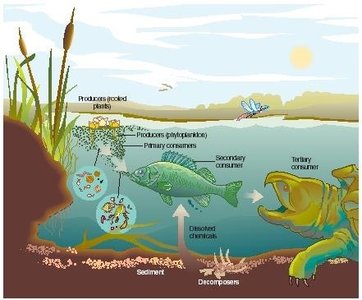
Ecosystem: Communities interacting with abiotic factors, involving energy flow and nutrient cycling.

Ecological Interactions
Types of Species Interactions
Species interact in various ways, influencing their fitness, population size, and evolutionary trajectories. The four main types of interactions are competition, commensalism, consumption, and mutualism.
Competition (-/-): Both species are negatively affected as they vie for the same resources.
Commensalism (+/0): One species benefits, the other is unaffected.
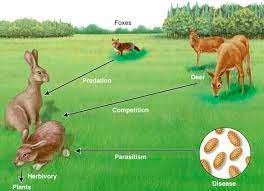
Consumption (+/-): One species benefits by consuming another (includes predation, herbivory, parasitism).
Mutualism (+/+): Both species benefit from the interaction.
Competition
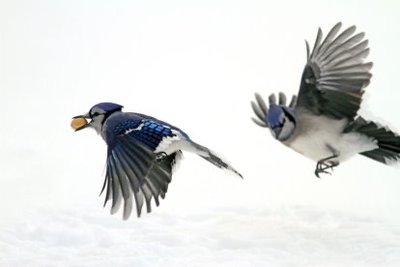
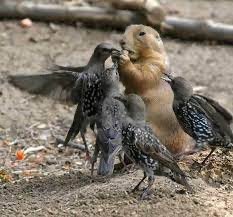
Competition occurs when organisms vie for the same resources. It can be intraspecific (within a species) or interspecific (between species). The competitive exclusion principle states that two species cannot occupy the same niche indefinitely.
Intraspecific Competition: Competition among individuals of the same species.
Interspecific Competition: Competition between individuals of different species.
Competitive Exclusion Principle: No two species can occupy the exact same niche in a habitat.
Niche and Habitat
The habitat is where an organism lives, while the niche describes how it lives and interacts with its environment. Niche differentiation (resource partitioning) allows similar species to coexist by occupying different niches.
Habitat: The physical location where an organism lives.
Niche: The role and position of an organism, including its interactions and resource use.
Niche Differentiation: Evolution of differences in resource use to minimize competition.
Commensalism
Commensalism is a relationship where one species benefits and the other is unaffected. Examples include birds following grazing animals to feed on insects stirred up by their movement.
Example: Egrets feeding on insects disturbed by buffalo.
Example: Vultures feeding on scraps left by lions.
Consumption
Consumption includes predation, herbivory, and parasitism. These interactions drive the evolution of defense mechanisms in prey species.
Predation: One organism kills and eats another.
Herbivory: An organism eats plants.
Parasitism: One organism lives on or in another, causing harm.
Defense Mechanisms: Structural, chemical, behavioral, and protective coloration adaptations.
Mutualism
Mutualism is an interaction where both species benefit. This relationship is often stable and maintained over time, sometimes leading to co-evolution.
Example: Ants protecting acacia trees in exchange for nectar.
Example: Pollinators and flowering plants.
Summary Table: Types of Species Interactions
Type of Interaction | Fitness Effect | Short-term Impact | Long-term Impact |
|---|---|---|---|
Competition | Reduces fitness of both species | Population size decreases; weaker competitor may retreat or go extinct | Niche differentiation via selection |
Commensalism | One benefits, other unaffected | Population size and range of commensal depend on host | Strong selection on commensal; none on host |
Consumption | Consumer benefits, prey harmed | Impact depends on prey density and defenses | Coevolutionary arms race |
Mutualism | Both benefit | Population size and range depend on each other | Strong selection to maximize benefits |
Levels of Ecological Study
Organismal, Population, Community, Ecosystem
Ecologists study life at different levels, each with unique questions and methods:
Organismal Level: Focuses on adaptations that increase fitness in specific environments.
Population Level: Examines changes in number and distribution of individuals over time.
Community Level: Studies interactions among populations of different species.
Ecosystem Level: Investigates energy flow and biogeochemical cycles.
Key Equations in Population Ecology
Population Change Formula
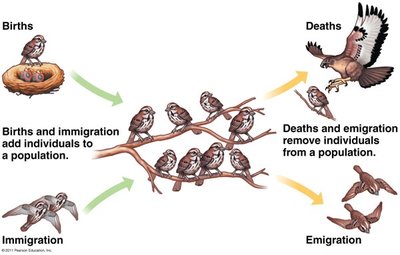
Population size changes due to births, deaths, immigration, and emigration:
Population Change Equation:
Where \Delta N is the change in population size, B is births, I is immigration, D is deaths, and E is emigration.
Conclusion
Ecology provides a framework for understanding the complex interactions that shape the natural world. By studying organisms, populations, communities, and ecosystems, ecologists reveal the processes that sustain life and inform efforts to conserve biodiversity and manage resources.
