 Back
Introduction to Evolution and Biodiversity: Mechanisms, Evidence, and Phylogenetic Trees
Study Guide - Smart Notes
 Tailored notes based on your materials, expanded with key definitions, examples, and context.
Evolution and Biodiversity
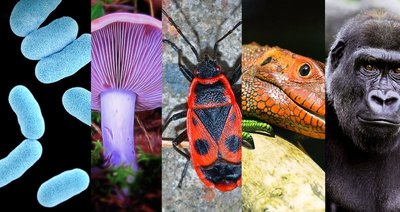
Introduction to Biodiversity
Biodiversity refers to the variety of all life forms on Earth, encompassing the diversity within species, between species, and of ecosystems. It is a foundational concept in biology, as it reflects the complexity and interconnectedness of life.
Biodiversity: The total variety of life, including all species of plants, animals, fungi, and microorganisms, the genetic differences within these species, and the ecosystems they form.
Importance: Biodiversity supports ecosystem productivity, resilience, and provides resources such as food, medicine, and ecosystem services.
Measurement: Biodiversity can be measured at genetic, species, and ecosystem levels.
Example: Tropical rainforests and coral reefs are among the most biodiverse ecosystems on Earth.
Defining Evolution
Evolution is a central theory in biology that explains how species change over time through inherited modifications. It provides the framework for understanding the diversity of life and the relationships among organisms.
Evolution (biological definition): Descent with inherited modification; the process by which populations of organisms change over generations through variations in traits that are inherited from ancestors.
Key Points:
All living organisms are descendants from prior ancestors.
Genetic traits are inherited and can be modified over time.
Evolution results in the diversity of life forms observed today.
Everyday vs. Biological Meaning: In everyday language, evolution means any change over time. In biology, it specifically refers to descent with modification.

Mechanisms of Evolution: Natural Selection
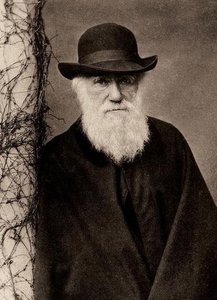
The theory of evolution by natural selection explains how new species arise from ancestral species. It was independently developed by Charles Darwin and Alfred Russel Wallace in the 19th century.
Natural Selection: The process by which heritable traits that enhance survival and reproduction become more common in successive generations of a population.
Four Main Ideas:
Variation: Individuals in a population vary in their traits.
Inheritance: Traits are passed from parents to offspring.
Survival and Reproduction: Individuals with advantageous traits are more likely to survive and reproduce.
Change Across Generations: Beneficial traits become more common in the population over time.
Example: Darwin's finches on the Galapagos Islands, where beak shape and size evolved in response to different food sources.
Phylogenetic Trees and Evolutionary Relationships
Understanding Phylogenetic Trees
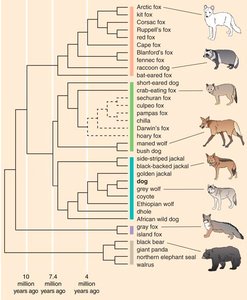
Phylogenetic trees are diagrams that represent the evolutionary relationships among various species or groups. They help visualize how species are related through common ancestry and how traits have evolved over time.
Phylogenetic Tree: A branching diagram showing the inferred evolutionary relationships among species based on similarities and differences in genetic or physical traits.
Family Tree vs. Phylogenetic Tree:
Family trees (pedigrees) show direct lineage among individuals within a family.
Phylogenetic trees show relationships among species or higher taxa, tracing back to common ancestors.
Applications: Used to trace evolutionary history, study trait evolution, and classify organisms.
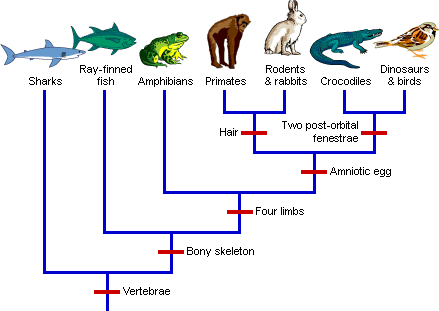
Examples of Phylogenetic Trees
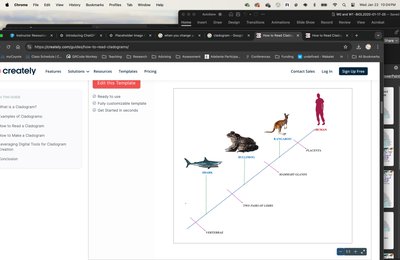
Cladograms: Show branching patterns of evolution without indicating time.
Phylograms: Branch lengths are proportional to evolutionary change.
Example: The evolutionary tree of vertebrates, showing the origin of key traits such as vertebrae, bony skeleton, four limbs, and amniotic egg.
Evidence for Evolution: Darwin’s Observations
Darwin’s Voyage and the Galapagos Finches
Charles Darwin’s observations during his voyage on the HMS Beagle, especially in the Galapagos Islands, provided key evidence for the theory of evolution by natural selection.
Galapagos Finches: Darwin observed that finches on different islands had different beak shapes and sizes, adapted to specific food sources.
Beak Structure and Function:
Cactus Finch: Long, pointed beak for extracting seeds from cactus fruit.
Warbler Finch: Thin, pointed beak for catching insects.
Large Ground Finch: Large, stout beak for cracking hard seeds.
Evolutionary Advantage: Specialized beak shapes allowed finches to exploit different ecological niches, reducing competition and increasing survival.
Science, Religion, and Evolution
Understanding Different Perspectives
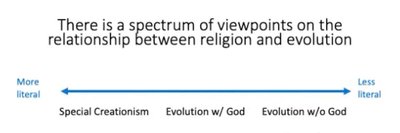
There is a spectrum of viewpoints regarding the relationship between religion and evolution, ranging from literal interpretations of creation to acceptance of evolution with or without the involvement of a deity. Science and religion address different types of questions: science focuses on natural explanations, while religion often addresses purpose and meaning.
Science: Seeks natural explanations for natural phenomena (how, when, where).
Religion: Addresses questions of purpose, existence, and morality.
Key Point: These perspectives can inform and complement each other, and are not necessarily in conflict.
Summary Table: Key Concepts in Evolution and Biodiversity
Concept | Definition | Example |
|---|---|---|
Biodiversity | Variety of all life forms on Earth | Tropical rainforest species diversity |
Evolution | Descent with inherited modification | Darwin's finches |
Natural Selection | Process where advantageous traits become more common | Beak size in finches adapting to food sources |
Phylogenetic Tree | Diagram showing evolutionary relationships | Tree of vertebrate evolution |
Key Takeaways
Evolution explains the diversity of life through descent with modification.
Biodiversity is the result of evolutionary processes over time.
Natural selection is a key mechanism driving evolution.
Phylogenetic trees help visualize evolutionary relationships among species.
Science and religion address different questions and can coexist without conflict.
