 Back
BackIntroduction to Evolution and Natural Selection: Key Concepts and Phylogenetic Thinking
Study Guide - Smart Notes
 Tailored notes based on your materials, expanded with key definitions, examples, and context.
Introduction to Evolution and Natural Selection
Defining Evolution and Natural Selection
Evolution and natural selection are foundational concepts in biology that explain the diversity of life and how organisms adapt to their environments over time.
Evolution: The change in the genetic composition of a population over successive generations, often resulting in the development of new species.
Natural Selection: The process by which individuals with advantageous traits are more likely to survive and reproduce, passing those traits to the next generation.
Fitness: The likelihood that an individual contributes offspring to the next generation. Fitness is not just about survival, but also about successful reproduction.
Adaptation: A trait that makes an organism well-suited to its environment, increasing its fitness.
Relationship: Natural selection is the primary mechanism by which evolution occurs. Over time, natural selection leads to adaptation and evolutionary change within populations.
Examples: Distinguishing Evolution and Natural Selection
A camouflaged caterpillar is more likely to reproduce because it avoids predation (Natural Selection).
Birds and reptiles share many traits due to common ancestry (Evolution).
Fossil evidence shows horse ancestors increased in size over time (Evolution).
Attracting mates is a component of fitness, not just survival (Natural Selection).
Dandelions with seeds that travel farther spread their offspring more widely (Natural Selection).
Practice: Key Concepts
Natural selection is an explanation for how evolution happens.
Highest fitness: The organism that produces the most offspring, regardless of size or lifespan, has the highest evolutionary fitness.
Common descent: Many similarities between species exist because they were inherited from the same ancestor.
Typological vs. Population Thinking
Understanding Variation in Species
Biologists use different frameworks to describe species and their variation:
Typological Thinking: Assumes a single ideal type for each species; variation is considered a deviation from this ideal.
Population Thinking: Recognizes the importance of variation among individuals within a population; the average or typical traits depend on the population and can change over time.
Modern biology emphasizes population thinking, as it is essential for understanding evolution and natural selection.
Examples: Typological vs. Population Thinking
"Normal height for a human female is 5 ft 5 in" (Typological).
"The mean length of a birch tree leaf is 7±2.5 cm" (Population).
"A jaguar with abnormally dark coloration is called a 'black panther'" (Population).
Practice: Dog Breeds and Population Thinking
Dog breed standards use an idealized form to which dogs are compared; this reflects typological thinking.
Population thinking is important because it requires scientists to consider the full variation present in nature.
Ladder vs. Tree Thinking
Historical and Modern Views of Species Relationships
There are two main ways to conceptualize the relationships among species:
Ladder Thinking (Great Chain of Being): Species are arranged in a hierarchy from low to high complexity, with humans at the top. This view, rooted in Aristotle's philosophy, sees species as fixed and unchanging.
Tree Thinking: Species are related through common descent, and evolutionary relationships are depicted as branches on a tree. All populations have been evolving for the same amount of time, and variation is explained by different evolutionary histories.

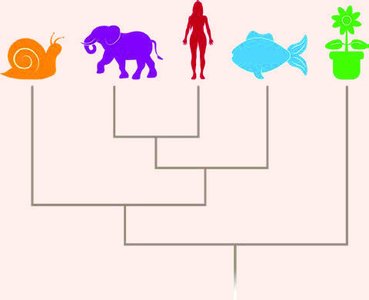
Practice: Ladder vs. Tree Thinking
The Latin term Scala Naturae reflects Aristotle’s argument that organisms can be arranged hierarchically by complexity (Ladder Thinking).
In tree thinking, species are organized based on evolutionary relationships, not by complexity.
Reading Phylogenetic Trees
Understanding Phylogenetic Trees
Phylogenetic trees are diagrams that represent evolutionary relationships among species based on common descent.
Branches: Represent evolutionary lineages over time.
Nodes: Represent common ancestors where lineages diverge.
Relatedness: Determined by how recently two species share a common ancestor (node).
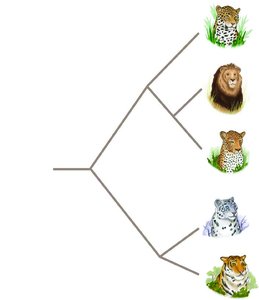
Practice: Interpreting Trees
To determine which species are most closely related, find the most recent common node (ancestor) they share.
All descendants of a node share a common ancestor at that point.
Examples: Bird Phylogeny
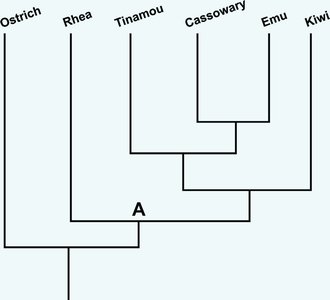
The Emu is most closely related to the Cassowary.
The Tinamou is more closely related to the Kiwi than to the Rhea.
The Ostrich is most closely related to the Rhea.
The Tinamou shares the most traits with the Kiwi.
Examples: Plant Phylogeny
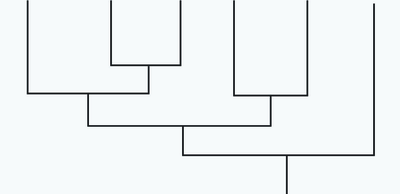
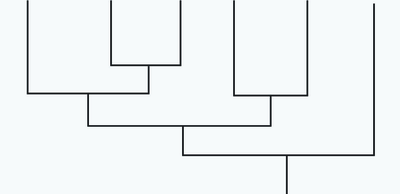
The most recent common ancestor between the pear and the cucumber is at node B.
The cucumber is equally related to the apple and the pear.
The cucumber and the California poppy share a common ancestor at node E.
The most recent common ancestor between the apple and the orange is also the most recent common ancestor of the apple and the California poppy.
The pear and the cucumber are more closely related than the pear and the orange.
Summary Table: Key Differences in Thinking
Type of Thinking | Description | View on Variation | Species Change? |
|---|---|---|---|
Typological | Ideal type; deviations are imperfections | Ignored | No |
Population | Variation among individuals is important | Emphasized | Yes |
Ladder | Hierarchy from simple to complex | Seen as imperfection | No |
Tree | Branching evolutionary relationships | Explained by ancestry | Yes |
Additional info: Phylogenetic trees are essential tools in modern biology for understanding evolutionary relationships, tracing the origin of traits, and classifying organisms based on shared ancestry rather than superficial similarities.
