 Back
Introduction to Human Biology: Life, Classification, and the Scientific Method
Study Guide - Smart Notes
 Tailored notes based on your materials, expanded with key definitions, examples, and context.
Chapter 1: Human Biology, Science, and Society
Characteristics of Life
All living organisms share a set of fundamental characteristics that distinguish them from nonliving matter. Understanding these traits is essential for recognizing life and its processes.
Unique Molecules: Living things contain molecules (such as DNA, proteins, and lipids) that are distinct from those found in nonliving things.
Energy and Materials: Organisms require energy and raw materials to maintain their structure and function.
Cellular Organization: All living things are composed of one or more cells, the basic units of life.
Homeostasis: The ability to maintain a stable internal environment despite external changes.
Response to Environment: Organisms can sense and respond to stimuli in their environment.
Growth and Reproduction: Living things grow and reproduce, passing genetic information to their offspring.
Evolution: Populations of living organisms change over time through the process of evolution.
How Living Things Are Grouped
The Three Domains of Life
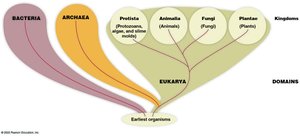
All life forms are classified into three major domains based on cellular structure and genetics. The domain system reflects evolutionary relationships among organisms.
Domain Bacteria: Prokaryotic, unicellular organisms without a membrane-bound nucleus.
Domain Archaea: Prokaryotic, unicellular organisms, often found in extreme environments, also lacking a membrane-bound nucleus.
Domain Eukarya: Organisms with cells that contain a membrane-bound nucleus; includes four kingdoms: Protista, Animalia, Fungi, and Plantae.
Main Classification Criteria
Presence of a Nucleus: Eukaryotes have a membrane-bound nucleus; prokaryotes (Bacteria and Archaea) do not.
Number of Cells: Organisms may be unicellular or multicellular.
Type of Metabolism: Organisms differ in how they obtain and use energy.
The Four Kingdoms of Eukarya
Protista: Mostly unicellular or simple multicellular organisms (e.g., protozoa, algae, slime molds).
Plantae: Multicellular organisms that produce food via photosynthesis.
Animalia: Multicellular organisms that obtain food by consuming other organisms.
Fungi: Eukaryotic decomposers (e.g., molds, yeasts, mushrooms).
Classification of Humans (Homo sapiens)
Humans are classified within the domain Eukarya and the kingdom Animalia. The full taxonomic hierarchy is as follows:
Domain: Eukarya
Kingdom: Animalia
Phylum: Chordata
Class: Mammalia
Order: Primates
Family: Hominidae
Genus: Homo
Species: sapiens
Genus and Species
Species: The smallest classification group; organisms that can interbreed and produce fertile offspring.
Genus: A group of closely related species.
All humans belong to the same genus and species: Homo sapiens.
Unique Human Features
Bipedalism: Ability to stand upright and walk on two legs.
Large Brain: Relative to body size, humans have a large and complex brain.
Complex Language: Use of spoken and written language for communication.
Opposable Thumbs: Ability to grasp objects with thumb and fingers.
Levels of Biological Organization
Biological systems are organized into a hierarchy, from the smallest chemical units to the entire biosphere.
Atom
Molecule
Cell
Tissue
Organ
Organ system
Organism
Population
Community
Ecosystem
Biosphere
Table: Issues at Different Levels of Human Biology
This table summarizes key issues and controversies at each level of biological organization.
Level of Organization | Issues and Controversies |
|---|---|
Atom and molecule | Disposing of radioactive wastes; keeping drinking water free of toxic chemicals; role of free radicals in cancer and aging |
Cell | Cloning organisms from a single cell |
Tissue | Use of human fetal tissues in research |
Organ | Organ transplantation; directing stem cells to form new organs |
Organ system | Enhancing performance with drugs or genetic modification |
Organism | Testing for heritable diseases; abortion; healthcare costs for behavior-related illnesses |
Population | Rationing medical care; organ allocation; mandatory vaccinations |
Community | Impact on other species; genetic modification; animal testing |
Ecosystem | Environmental pollution; ecosystem destruction |
Biosphere | Global warming; climate change; ozone layer destruction |
Science: Knowledge and Process
The Nature of Science
Science is both a body of knowledge about the natural world and a systematic process for acquiring that knowledge. The scientific method is the foundation of scientific inquiry.
The Scientific Method
The scientific method is a logical approach to solving problems and answering questions about the natural world.
Observe and Generalize: Use inductive reasoning to form general ideas from specific observations.
Formulate a Hypothesis: Propose a possible explanation that can be tested.
Make a Testable Prediction: Use deductive reasoning to make specific predictions, often in "if...then" format.
Experiment or Observe: Test predictions through controlled experiments or further observation.
Revise Hypothesis and Repeat: Modify the hypothesis if predictions are not supported; repeat the process as needed.
Designing and Conducting Experiments
Independent Variable: The factor that is changed or manipulated by the researcher.
Dependent Variable: The outcome or response measured in the experiment.
Control Group: A group that does not receive the experimental treatment, used for comparison.
Experimental Group: The group that receives the treatment or variable being tested.
Example: Testing whether Drug X reduces blood pressure by comparing an experimental group (receives Drug X) and a control group (receives placebo), ensuring all other factors are balanced.
Sharing and Evaluating Scientific Findings
Results are published in peer-reviewed journals for validation by other experts.
Scientific findings are most reliable when published in peer-reviewed sources.
Clear records allow replication and further testing by other scientists.
Theories in Science
A theory is a broad, extensively tested, and reliable explanation for a range of phenomena (e.g., evolution, cell theory).
Theories can be revised or disproved if new evidence emerges.
Evaluating Scientific Information
Sources of Scientific Information
Reliable sources: Peer-reviewed journals, science magazines, nonfiction books, reputable news outlets.
Less reliable sources: Social media platforms (e.g., Facebook, Twitter, Instagram), though quality may vary.
Assessing Internet Sources
Check the author's credentials and expertise.
Determine the website's purpose (informational vs. promotional).
Ensure the information is current and sources are cited.
Critical Thinking in Science
Question claims and evaluate evidence.
Interpret graphs and understand statistics.
Distinguish between anecdotal stories and scientific evidence.
Separate facts from conclusions.
Recognize the difference between correlation and causation.
The Role of Science in Society
Science drives technological advances and improves quality of life.
Science has limitations and cannot answer all questions.
Scientific understanding helps individuals make informed decisions.
