 Back
BackIntroduction to Invertebrates: Diversity, Classification, and Major Phyla
Study Guide - Smart Notes
 Tailored notes based on your materials, expanded with key definitions, examples, and context.
Introduction to Invertebrates
Overview of Invertebrate Diversity
Invertebrates are animals that lack a backbone and represent the vast majority of animal diversity on Earth. They occupy nearly every habitat and display a remarkable range of body forms, life cycles, and adaptations. Understanding their classification and evolutionary relationships helps clarify the origins and diversification of animal life.
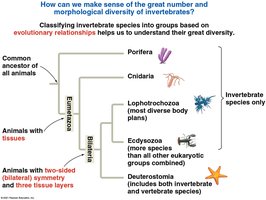
Invertebrates include all animals except those in the subphylum Vertebrata.
Major groups are classified based on body plan, symmetry, tissue organization, and molecular data.
Key clades include Porifera, Cnidaria, Lophotrochozoa, Ecdysozoa, and Deuterostomia.
Porifera (Sponges)
Structure and Function
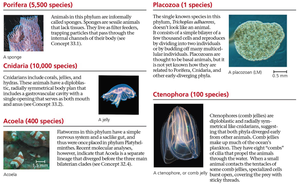
Sponges are among the simplest multicellular animals. They are sedentary, mostly marine, and filter feeders with bodies full of pores and channels allowing water to circulate through them.
Body Plan: Sac-like structure with pores (ostia) leading to a central cavity (spongocoel) and an opening (osculum).
Feeding: Filter feeders; water carries food particles into the body, which are captured by specialized cells called choanocytes.
Tissues: Lack true tissues and organs.
Cnidaria
Body Plan and Diversity
Cnidarians include corals, hydras, and jellies. They are diploblastic (two tissue layers) and exhibit radial symmetry. Their basic body plan is a sac with a single opening functioning as both mouth and anus, leading to a gastrovascular cavity.
Body Forms: Two main forms: sessile polyp and motile medusa.
Feeding: Predators using tentacles armed with cnidocytes (stinging cells) containing nematocysts.
Nervous System: Noncentralized nerve net coordinates movement and response to stimuli.
Major Clades: Medusozoa (jellyfish, box jellies) and Anthozoa (sea anemones, corals).
Major Invertebrate Phyla and Their Characteristics
Summary Table of Major Invertebrate Groups
The following table summarizes the main invertebrate phyla, their species diversity, and key characteristics.
Phylum | Species (approx.) | Key Features |
|---|---|---|
Porifera | 5,500 | Sessile filter feeders, lack true tissues |
Cnidaria | 10,000 | Radial symmetry, diploblastic, stinging cells |
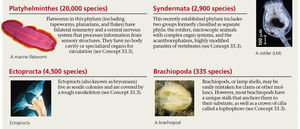
Platyhelminthes | 20,000 | Flatworms, acoelomate, simple nervous system |
Syndermata (Rotifera + Acanthocephala) | 2,900 | Microscopic, pseudocoelomate, specialized organs |
Ectoprocta | 4,500 | Colonial, lophophore for feeding |
Brachiopoda | 335 | Marine, lophophore, two shells |
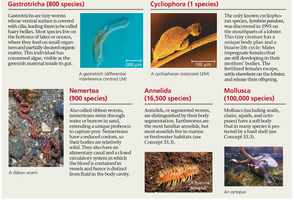
Mollusca | 100,000 | Soft-bodied, often with shell, diverse forms |
Annelida | 16,500 | Segmented worms, coelomate |
Nematoda | 25,000 | Roundworms, pseudocoelomate, cuticle |
Arthropoda | 1,000,000+ | Segmented body, exoskeleton, jointed appendages |
Echinodermata | 7,000 | Radial symmetry (adults), water vascular system |
Chordata | 60,000 | Notochord, dorsal nerve cord, pharyngeal slits |
Lophotrochozoa
Defining Features and Major Groups
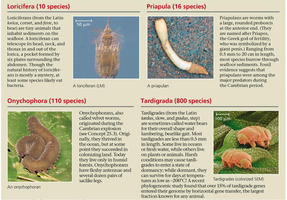
Lophotrochozoa is a diverse clade identified by molecular data, including animals with a lophophore (feeding structure), trochophore larval stage, or neither. Major phyla include flatworms, rotifers, ectoprocts, brachiopods, molluscs, and annelids.
Flatworms (Platyhelminthes): Acoelomate, simple body plan, many are parasitic.
Rotifers (Syndermata): Microscopic, pseudocoelomate, specialized organs, some reproduce by parthenogenesis.
Ectoprocts and Brachiopods: Possess a lophophore, U-shaped alimentary canal, coelomate.
Molluscs: Soft-bodied, often with a shell, diverse forms (snails, clams, octopuses).
Annelids: Segmented worms, coelomate, important for soil health.
Ecdysozoa
Defining Features and Major Groups
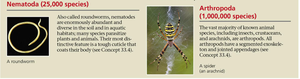
Ecdysozoans are animals that grow by molting (ecdysis) their cuticle. The two largest phyla are nematodes and arthropods.
Nematoda (Roundworms): Cylindrical, pseudocoelomate, covered by a tough cuticle, many are free-living or parasitic.
Arthropoda: Most diverse animal phylum, segmented body, exoskeleton of chitin, jointed appendages, includes insects, arachnids, crustaceans, and more.
Deuterostomia
Defining Features and Major Groups
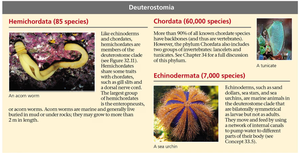
Deuterostomes are defined by their embryonic development (blastopore becomes anus) and include both invertebrate and vertebrate species. Major invertebrate groups are echinoderms and hemichordates.
Echinodermata: Sea stars, sea urchins, and relatives; radial symmetry as adults, water vascular system, endoskeleton.
Hemichordata: Acorn worms, share some features with chordates and echinoderms.
Chordata: Includes all vertebrates and two groups of invertebrates (lancelets and tunicates).
Conclusion
Invertebrates represent the majority of animal diversity and are classified into major groups based on body plan, developmental patterns, and molecular data. Understanding their classification provides insight into the evolutionary history and ecological roles of animals.
