 Back
Introduction to Metabolism: Energy, Enzymes, and Cellular Reactions
Study Guide - Smart Notes
 Tailored notes based on your materials, expanded with key definitions, examples, and context.
Energy and Metabolism
Overview of Metabolism
Metabolism encompasses all chemical reactions occurring within living organisms, enabling them to grow, reproduce, and maintain their structures. These reactions are organized into metabolic pathways, each catalyzed by specific enzymes.
Anabolic pathways: Build complex molecules from simpler ones, requiring energy input.
Catabolic pathways: Break down complex molecules into simpler ones, releasing energy.
ATP (Adenosine Triphosphate): The primary energy currency of the cell, used to drive endergonic reactions.
Types of Energy
Energy is the capacity to do work. Biological systems utilize various forms of energy:
Kinetic energy: Energy associated with motion.
Potential energy: Stored energy, such as that in chemical bonds.
Chemical energy: A form of potential energy stored in molecules.
Thermodynamics in Biology
Biological systems obey the laws of thermodynamics:
First Law of Thermodynamics: Energy cannot be created or destroyed, only transformed.
Second Law of Thermodynamics: Every energy transfer increases the entropy (disorder) of the universe.
Example: Cellular respiration transforms chemical energy in glucose into ATP and heat, increasing entropy. 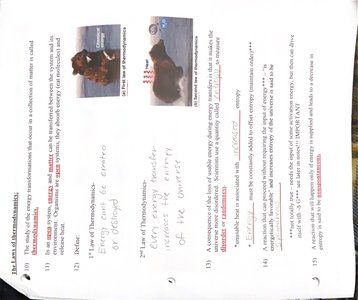
Free Energy and Cellular Work
Gibbs Free Energy (ΔG)
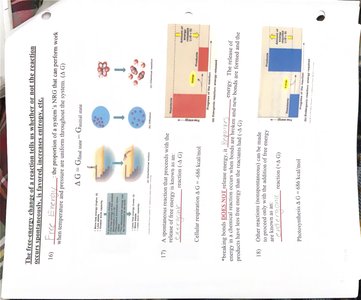
Gibbs free energy determines whether a reaction can occur spontaneously.
ΔG < 0: Spontaneous (exergonic) reaction; releases energy.
ΔG > 0: Non-spontaneous (endergonic) reaction; requires energy input.
Equation:
ΔH: Change in enthalpy (heat content)
T: Temperature in Kelvin
ΔS: Change in entropy
ATP: The Energy Currency
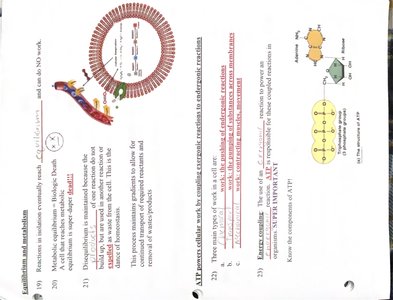
ATP powers cellular work by coupling exergonic and endergonic reactions.
Hydrolysis of ATP releases energy:
ATP regeneration occurs via cellular respiration.
Enzymes and Catalysis
Enzyme Structure and Function
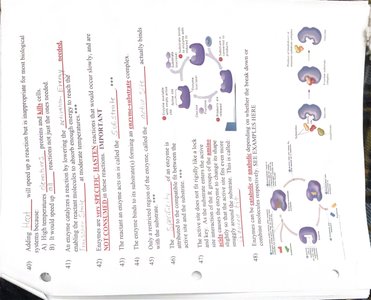
Enzymes are biological catalysts that speed up reactions by lowering activation energy.
Active site: Region on the enzyme where substrate binds.
Substrate: The reactant acted upon by the enzyme.
Induced fit: Enzyme changes shape to better fit the substrate.
Factors Affecting Enzyme Activity
Several factors influence enzyme function:
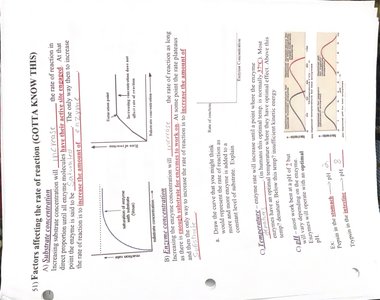
Temperature: Each enzyme has an optimal temperature.
pH: Each enzyme has an optimal pH range.
Substrate concentration: Higher concentration increases reaction rate up to a saturation point.
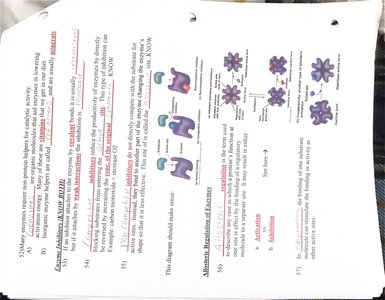
Inhibitors: Molecules that decrease enzyme activity (competitive and noncompetitive).
Enzyme Regulation
Enzyme activity is regulated by:
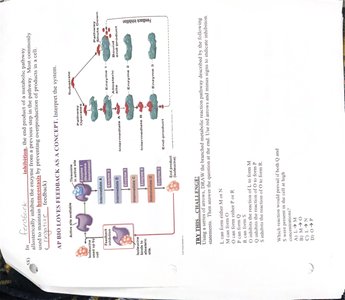
Allosteric regulation: Binding of regulators at sites other than the active site.
Feedback inhibition: End product of a pathway inhibits an earlier step.
Activation Energy and Reaction Rates
Activation Energy
Activation energy is the energy required to initiate a chemical reaction. Enzymes lower this barrier, allowing reactions to proceed faster. 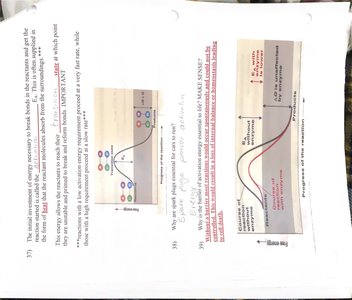
Reaction Rate Influences
Enzyme concentration
Substrate concentration
Presence of inhibitors or activators
Summary Table: Types of Metabolic Reactions
Type | Description | Energy Change |
|---|---|---|
Anabolic | Builds complex molecules | Requires energy (endergonic) |
Catabolic | Breaks down molecules | Releases energy (exergonic) |
Key Concepts to Remember
Metabolism is the sum of all chemical reactions in a cell.
ATP is regenerated through cellular respiration.
Enzymes lower activation energy and are highly specific.
Regulation of enzymes is essential for metabolic control.
Example: Feedback inhibition prevents overproduction of amino acids in cells. Additional info: Academic context was added to clarify definitions, examples, and mechanisms based on standard General Biology curriculum.
