 Back
Introduction to Metabolism: Energy, Thermodynamics, and Enzymatic Catalysis
Study Guide - Smart Notes
 Tailored notes based on your materials, expanded with key definitions, examples, and context.
Introduction to Metabolism
Definition and Overview
Metabolism is the sum total of an organism’s chemical reactions, encompassing both the management of material and
energy resources within a cell. It involves the making and breaking of macromolecules and is central to bioenergetics,
which describes how organisms manage their energy resources.
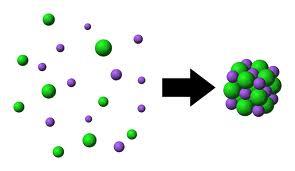
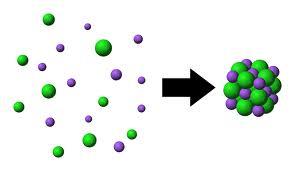
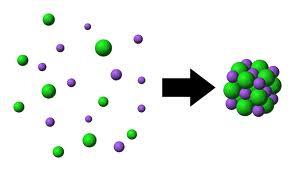
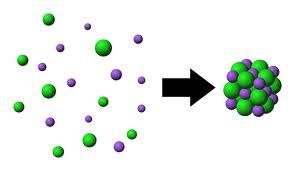
Anabolic Pathways: Consume energy to build large molecules from smaller ones
(e.g., dehydration reactions, photosynthesis).
Catabolic Pathways: Release energy by breaking down large molecules into smaller ones
(e.g., hydrolysis reactions, cellular respiration).
Bioenergetics: The study of how organisms manage energy resources.
Anabolic vs. Catabolic Pathways
Anabolic and catabolic pathways are fundamental to cellular metabolism, with each playing distinct roles in energy transformation.
Anabolic Pathways:
Build complex molecules (e.g., formation of glucose from CO2 and H2O).
Require energy input.
Example: Photosynthesis – CO2 + H2O (+ energy) → C6H12O6 + O2
Catabolic Pathways:
Break down complex molecules (e.g., breakdown of glucose).
Release energy.
Example: Cellular Respiration – C6H12O6 + O2 → CO2 + H2O (+ energy)
Energy and Its Forms
Kinetic and Potential Energy
Energy is the ability to do work, and it exists in two primary forms: kinetic and potential energy.
Kinetic Energy (KE): Energy due to motion; includes heat, movement, and transport.
Potential Energy (PE): Stored energy due to position; includes chemical bonds and concentration gradients.
Chemical Energy: A form of potential energy available for release in chemical reactions.
Energy Coupling
Cells constantly perform both anabolic and catabolic reactions. Energy coupling is the process by which energy released from catabolic pathways is used to drive anabolic pathways.
Energy Coupling: Links exergonic (energy-releasing) and endergonic (energy-consuming) reactions.
ATP: The primary molecule mediating energy coupling in cells.

Thermodynamics in Biological Reactions
Laws of Thermodynamics
Biological systems obey the laws of thermodynamics, which govern energy transformations.
First Law: Energy cannot be created or destroyed, only transformed.
Second Law: Entropy (disorder) of the universe is always increasing; spontaneous reactions increase entropy.
Key Definitions
Heat (H): Total energy (KE + PE).
Calorie (cal): Unit of energy; 1 cal heats 1 g of water by 1°C.
Temperature (T): Average kinetic energy.
Entropy (S): Measure of disorder; increased S means decreased order.
Gibbs Free Energy
Concept and Equation
Gibbs Free Energy (G) is the energy available to do work in a system. It is a function of total energy (H), entropy (S), and temperature (T).
Direct Relationship: G increases with H.
Inverse Relationship: G decreases with S.
Equation:
Change in Free Energy:
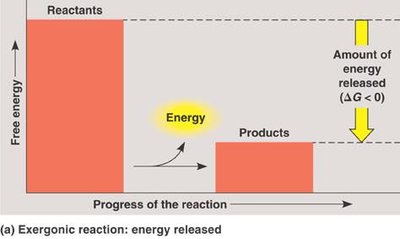
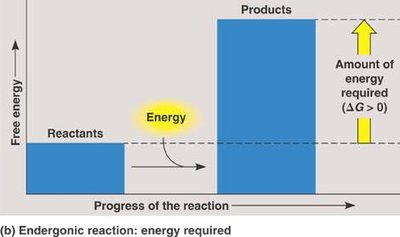
Exergonic vs. Endergonic Reactions
Exergonic Reactions:
Negative
Release energy
Increase entropy (S)
Spontaneous
Endergonic Reactions:
Positive
Require energy input
Decrease entropy (S)
Non-spontaneous
Equilibrium
In a chemical reaction, equilibrium is achieved when the forward and reverse reactions proceed at the same rate.
At equilibrium, and no work is performed.
System is most stable at equilibrium.
Cells must avoid metabolic equilibrium to remain alive.
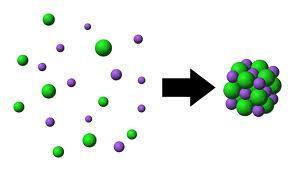
ATP and Energy Coupling
ATP Structure and Function
Adenosine Triphosphate (ATP) is the primary energy currency of the cell. Its hydrolysis releases energy,
which is used to drive endergonic reactions.
ATP Hydrolysis: (exergonic)
ATP Cycle: Energy from catabolism generates ATP (from ADP and Pi), which then drives anabolism (consuming ATP).
Energy Coupling: Endergonic reactions are coupled to ATP hydrolysis.
Enzymatic Catalysis
Role of Enzymes
Enzymes are biological catalysts that increase the rate of chemical reactions without being consumed.
They lower the activation energy (Ea) required for reactions to proceed.
Activation Energy (Ea): The energy barrier that must be overcome for a reaction to occur.
Transition State (TS*): The point of highest free energy during a reaction.
Enzyme Mechanism: Enzymes stabilize the transition state, lowering Ea and speeding up reactions.
Enzyme Regulation
Inhibitors:
Irreversible: Bind permanently to the enzyme.
Reversible: Bind transiently.
Competitive: Bind to the active site, competing with the substrate.
Noncompetitive (Allosteric): Bind elsewhere, changing the shape of the active site.
Activators: Enhance enzyme activity, often through allosteric regulation.
Feedback Inhibition: The final product of a pathway inhibits enzymes earlier in the pathway, regulating metabolic activity.
Enzyme Activity Factors
Cofactors: Non-protein molecules required for enzyme activity (e.g., Zn2+, Mg2+).
Coenzymes: Organic cofactors (often vitamins).
Optimal Conditions: Enzymes function best at specific temperatures and pH levels.
Summary Table: Metabolic Reactions
This table summarizes the properties of key metabolic reactions.
Reaction | Energy Required or Released | (+ or -) | (+ or -) | (+ or -) | Spontaneous or Nonspontaneous |
|---|---|---|---|---|---|
Anabolic reaction | Required | + | - | + | Nonspontaneous |
Catabolic reaction | Released | - | + | - | Spontaneous |
Photosynthesis | Required | + | - | + | Nonspontaneous |
Respiration | Released | - | + | - | Spontaneous |
Dehydration | Required | + | - | + | Nonspontaneous |
Hydrolysis | Released | - | + | - | Spontaneous |
Practice Questions
What is the difference between anabolic and catabolic pathways?
How does ATP mediate energy coupling in cells?
Explain the significance of Gibbs Free Energy in biological reactions.
Describe the role of enzymes in catalyzing metabolic reactions.
What is feedback inhibition and why is it important?
Conclusion
Metabolism is a complex network of chemical reactions that manage energy and material resources in cells. Understanding the principles of energy transformation, thermodynamics, and enzymatic catalysis is essential for comprehending how cells function and maintain life.
