 Back
BackIntroduction to Molecular and Cellular Biology: Study Guide 1
Study Guide - Smart Notes
 Tailored notes based on your materials, expanded with key definitions, examples, and context.
Introduction to Biology and Scientific Inquiry
Key Terms and Concepts
This section introduces foundational terminology and concepts essential for understanding molecular and cellular biology. Mastery of these terms is crucial for further study in the biological sciences.
Biology: The scientific study of living organisms and their interactions with each other and their environments.
Emergent Property: Properties that arise from the arrangement and interaction of parts within a system, increasing in complexity as new levels of organization are reached.
Reductionism: An approach that breaks down complex systems into simpler components for study and understanding.
Systems Biology: The comprehensive study of interactions among components of biological systems, often using computational and mathematical modeling.
Cell: The smallest unit of life capable of performing all life processes.
Eukaryotic Cell: A cell containing membrane-bound organelles, including a nucleus.
Prokaryotic Cell: A cell lacking a nucleus and other membrane-bound organelles; generally smaller than eukaryotic cells.
Bioinformatics: The application of computational tools to process and analyze large sets of biological data.
Energy: The capacity to do work; exists as kinetic or potential energy.
Matter: The substance of which all living and nonliving things are composed.
Chemical Energy: Potential energy stored in the bonds of molecules.
Work: The processes cells perform to maintain life.
Molecule: The smallest unit of a chemical compound, composed of two or more atoms bonded together.
Organelle: Specialized structures within cells that perform distinct functions.
Community: A collection of populations of different species living and interacting in a particular area.
Ecosystem: A community of living organisms and their physical environment, interacting as a system.
Biosphere: The global ecosystem, encompassing all life on Earth and the environments in which life exists.
Genome: The complete set of genetic material in an organism.
Gene: A discrete unit of hereditary information consisting of a specific nucleotide sequence in DNA (or RNA in some viruses).
Gene Expression: The process by which information from a gene is used to synthesize functional gene products (proteins or RNAs).
Proteome: The entire set of proteins expressed by a cell, tissue, or organism.
Tissue: Groups of similar cells working together to perform specific functions.
Organ: A structure composed of multiple tissues that performs a specific function.
Organism: An individual living entity.
Population: All individuals of a species in a given area.
Hypothesis: A testable explanation for a set of observations, narrower in scope than a theory.
Prediction: A specific expected outcome if the hypothesis is correct.
Control: The part of an experiment used for comparison, not receiving the experimental treatment.
Variable: Any factor that can change in an experiment.
Independent Variable: The factor intentionally changed in an experiment.
Dependent Variable: The factor measured in response to changes in the independent variable.
Theory: A well-supported explanation for natural phenomena, based on a large body of evidence.
Properties of Living Things
Cellular and Molecular Examples
Living organisms share several key properties, each of which can be illustrated at the cellular or molecular level.
Order (Organization): Living things exhibit complex, organized structures. Example: Cells contain organized organelles such as nuclei and mitochondria, each with specific functions.
Energy Processing (Metabolism): Organisms obtain and use energy to power life processes. Example: Mitochondria convert glucose into ATP via cellular respiration.
Growth: Increase in size or number of cells. Example: Bacterial binary fission increases population size.
Development: Predictable changes in form or function over the life cycle. Example: Stem cells differentiate into specialized cells.
Response to Environment: Ability to detect and respond to stimuli. Example: Bacteria move toward nutrients (chemotaxis).
Regulation: Maintenance of stable internal conditions. Example: Cells regulate internal pH; humans maintain body temperature.
Reproduction: Production of new individuals, passing on genetic information. Example: DNA replication and mitosis in eukaryotic cells.
Adaptation: Evolution of traits that enhance survival and reproduction. Example: Bacteria develop antibiotic resistance through gene mutations.
Levels of Biological Organization
From Molecules to Biosphere
Biological organization is hierarchical, with each level building upon the previous one. Understanding these levels is essential for grasping the complexity of life.
Molecules: Chemical structures such as DNA, proteins, lipids, and carbohydrates.
Organelles: Specialized structures within cells (e.g., mitochondria, nucleus).
Cells: The fundamental units of life, capable of all vital functions.
Tissues: Groups of similar cells performing specific functions.
Organs: Structures made of multiple tissues with specific functions.
Organ Systems: Groups of organs working together for major functions.
Organisms: Individual living beings.
Populations: All individuals of a species in a given area.
Communities: All populations of different species in an area.
Ecosystems: Communities interacting with their physical environment.
Biosphere: All life on Earth and the environments where life exists.
Top-down: Biosphere → Ecosystem → Community → Population → Organism → Organ System → Organ → Tissue → Cell → Organelle → Molecule Bottom-up: Molecule → Organelle → Cell → Tissue → Organ → Organ System → Organism → Population → Community → Ecosystem → Biosphere
Structure and Function in Biology
Relationship Examples
Biological structures are closely related to their functions. This relationship is a central theme in biology.
Red Blood Cells: Their biconcave shape increases surface area and flexibility, optimizing gas exchange.
Plant Leaves: Broad and thin structure maximizes sunlight capture and gas diffusion, supporting photosynthesis.
Cell Types: Eukaryotic vs. Prokaryotic
Basic Cell Diagrams and Features
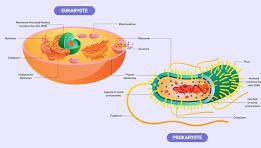
Eukaryotic and prokaryotic cells differ in structure and complexity. Eukaryotes have membrane-bound organelles, while prokaryotes do not.
Eukaryotic Cells: Contain nucleus and organelles (e.g., mitochondria, endoplasmic reticulum).
Prokaryotic Cells: Lack nucleus and membrane-bound organelles; generally smaller and simpler.
Genetic Information: Expression and Transmission
Key Steps
Expression:
DNA replication
Transcription
RNA processing
Translation
Protein folding and modification
Transmission:
DNA replication
Mitosis
Meiosis
Fertilization
Inheritance
Energy Flow and Chemical Cycling in Ecosystems
Producers, Consumers, and Decomposers
Energy flows one way through ecosystems, while chemicals are recycled.
Energy Flow: Sun → Producers (plants) → Consumers (animals) → Decomposers; energy is lost as heat at each step.
Chemical Cycling: Matter cycles between living and nonliving components, reused continuously.
Producers capture energy and convert it to chemical energy. Consumers obtain energy by eating producers or other consumers. Decomposers break down dead matter, returning nutrients to the environment.
Feedback Regulation
Example: Blood Glucose Levels
Feedback regulation maintains internal stability (homeostasis). For example, when blood glucose rises, the pancreas releases insulin, prompting cells to absorb glucose and lower blood sugar. When glucose drops, glucagon is released, causing glucose to be released into the blood. This negative feedback loop restores balance.
The Scientific Process
Steps of Scientific Inquiry
Observation of the natural world
Formulation of a question
Development of a hypothesis (testable explanation)
Deductive reasoning to make predictions
Testing predictions through experiments or further observation
Data collection and analysis
Revision or rejection of the hypothesis based on results
Scientific inquiry is iterative and flexible, allowing for continuous refinement of ideas.
Hypothesis vs. Theory
Scientific Explanations
Hypothesis: A specific, testable explanation for a particular observation or question.
Theory: A broad, well-supported explanation for a wide range of phenomena, supported by extensive evidence and repeated testing.
