 Back
BackIntroduction to Neurobiology: Structure and Function of Nervous Systems
Study Guide - Smart Notes
 Tailored notes based on your materials, expanded with key definitions, examples, and context.
An Introduction to Neurobiology
Overview of Nervous System Functions
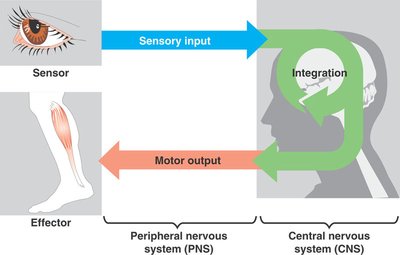
The nervous system is a complex network responsible for perceiving stimuli, reacting to the environment, communicating information, enabling thought, learning, memory, and consciousness. It is composed of specialized cells that form intricate circuits and networks to process and transmit information throughout the body.
Perception: Detection of environmental changes via sensory receptors.
Reaction: Initiation of appropriate motor responses.
Communication: Transmission of signals between different body regions.
Integration: Processing and interpretation of sensory input to generate responses.
Learning and Memory: Storage and retrieval of information.
Consciousness: Emergent property of complex neural networks.
I. Nerve Cells and Functions
A. Nervous Systems as Networks & Circuits
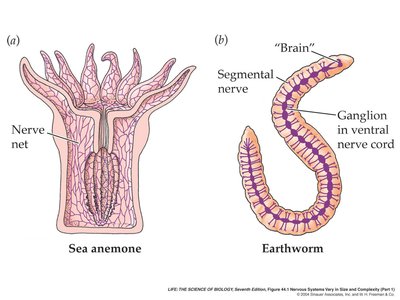
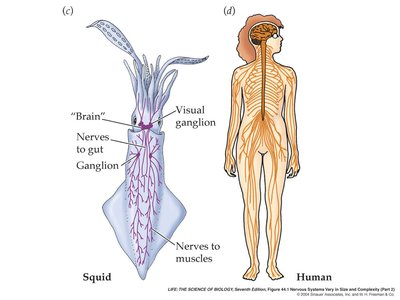
Nervous systems range from simple nerve nets in invertebrates to highly organized central and peripheral systems in vertebrates. The central nervous system (CNS) includes the brain and spinal cord, while the peripheral nervous system (PNS) connects the CNS to the rest of the body.
Nerve Net: Simplest form, seen in cnidarians (e.g., sea anemones).
Ganglia: Clusters of neurons that process information in more complex invertebrates (e.g., earthworms, squid).
CNS and PNS: In vertebrates, the CNS is the main processing center, and the PNS relays information to and from the CNS.
B. Neurons
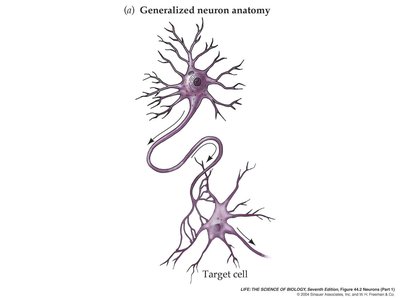
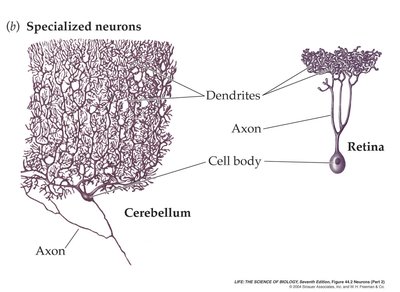
Neurons are excitable cells specialized for the generation and conduction of electrical signals. They are the fundamental units of the nervous system and come in various morphologies adapted for specific functions.
Sensory Neurons: Transmit sensory information to the CNS.
Interneurons: Integrate information within the CNS.
Motor Neurons: Convey commands from the CNS to effectors (muscles/glands).
C. Glia
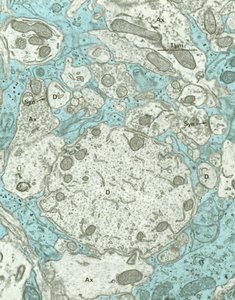
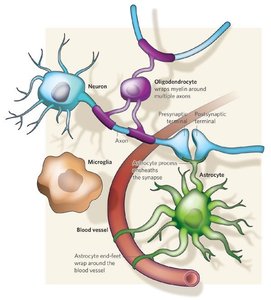
Glial cells provide structural and metabolic support to neurons, maintain homeostasis, form myelin, and participate in signal transmission. Types include astrocytes, oligodendrocytes, Schwann cells, and microglia.
Astrocytes: Support neurons, regulate the blood-brain barrier, and maintain ion balance.
Oligodendrocytes (CNS) and Schwann Cells (PNS): Produce myelin sheaths for insulation.
Microglia: Immune defense in the CNS.
II. Neurons: Generating and Conducting Nerve Impulses
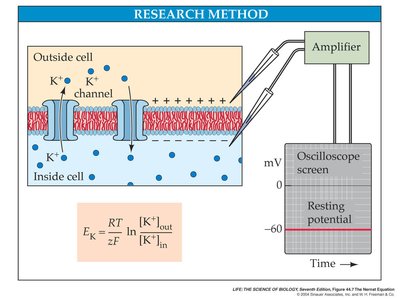
A. Resting Membrane Potential (Vm)
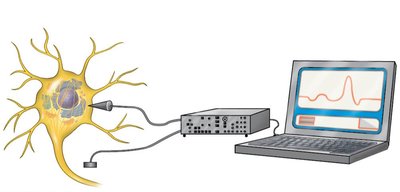
The resting membrane potential is the voltage difference across the neuronal membrane when the cell is not transmitting a signal. It is primarily established by:
Ion Concentration Gradients: Differences in the concentration of ions (Na+, K+, Cl-) across the membrane.
Selective Membrane Permeability: The membrane is more permeable to K+ than to Na+ or Cl-.
The equilibrium potential for each ion can be calculated using the Nernst equation:
R: Gas constant
T: Temperature (Kelvin)
z: Charge of the ion
F: Faraday's constant
B. Electrical Signaling: Action Potentials
Action potentials are rapid, transient changes in membrane potential that propagate along axons. They are generated by the opening and closing of voltage-gated ion channels.
Phases: Depolarization (Na+ influx), repolarization (K+ efflux), and hyperpolarization.
All-or-None Principle: Action potentials occur fully or not at all.
Propagation: Action potentials travel unidirectionally due to refractory periods.
Velocity: Increased by larger axon diameter and myelination (saltatory conduction).
III. Neurons, Synapses, and Communication
A. Types of Synapses and Neurotransmitters
Neurons communicate at synapses, which can be electrical (via gap junctions) or chemical (via neurotransmitter release). Chemical synapses are more common and allow for modulation and integration of signals.
Excitatory Neurotransmitters: Acetylcholine (ACh), glutamate, dopamine, norepinephrine.
Inhibitory Neurotransmitters: GABA, glycine, serotonin (generally inhibitory).
B. Synaptic Integration and Signal Termination
Postsynaptic potentials (EPSPs and IPSPs) are integrated at the axon hillock. If the threshold is reached, an action potential is triggered. Signals are terminated by neurotransmitter degradation, diffusion, or reuptake.
EPSP: Excitatory postsynaptic potential (depolarization).
IPSP: Inhibitory postsynaptic potential (hyperpolarization).
Summation: Spatial and temporal summation of inputs determines neuronal output.
Example: At the neuromuscular junction, ACh release causes muscle contraction. In the CNS, integration of multiple synaptic inputs determines neuronal firing.
IV. Learning, Memory, and Neural Complexity
A. Synaptic Plasticity and Memory
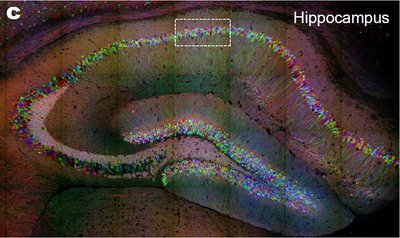
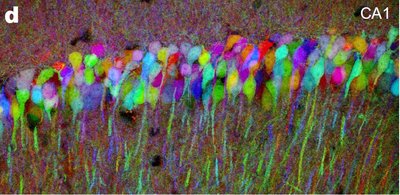
Learning and memory are associated with changes in synaptic strength and number. The hippocampus is a key brain region involved in these processes, with distinct neuronal cell types and circuits.
B. Neural Circuit Complexity
The human brain contains approximately 100 billion neurons and 100 trillion synapses, enabling complex behaviors, cognition, and consciousness. Each neuron integrates thousands of synaptic inputs, functioning as a computational unit.
V. Historical Perspectives and Experimental Foundations
A. Biological Electricity
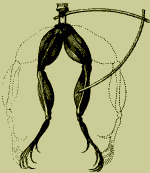
Early experiments by Luigi Galvani demonstrated that electrical signals are fundamental to nerve and muscle function, leading to the concept of "animal electricity." This discovery laid the groundwork for modern neurobiology.

B. Cultural Impact
The idea of electricity as a "vital force" influenced literature, such as Mary Shelley's Frankenstein, reflecting society's fascination with the power of biological electricity.


Summary Table: Types of Nervous System Cells
Cell Type | Main Function | Location |
|---|---|---|
Neuron | Signal transmission | CNS & PNS |
Astrocyte | Support, BBB, ion balance | CNS |
Oligodendrocyte | Myelin formation | CNS |
Schwann cell | Myelin formation | PNS |
Microglia | Immune defense | CNS |
Key Equations
Nernst Equation:
Resting Membrane Potential (Goldman-Hodgkin-Katz):
Additional info: The notes above integrate foundational neurobiology concepts with relevant images and equations, providing a comprehensive overview suitable for college-level biology students.
