 Back
Introduction to Oncology: Medical Terminology and Concepts
Study Guide - Smart Notes
 Tailored notes based on your materials, expanded with key definitions, examples, and context.
Oncology: The Study of Cancer
Overview of Oncology
Oncology is the branch of medicine focused on the study, diagnosis, treatment, and prevention of cancer. Cancer is characterized by uncontrolled cell division, leading to the formation of abnormal tissue masses known as neoplasms or tumors. Understanding oncology requires familiarity with specialized medical terminology, including word parts, general terms, and classification systems used to describe cancer and its progression.
Medical Terminology in Oncology
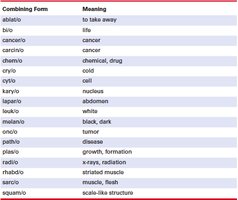
Combining Forms
Combining forms are root words with a vowel added, used to construct medical terms related to oncology. These forms often describe the tissue, process, or condition involved.
Combining Form | Meaning |
|---|---|
ablato | to take away |
bio | life |
carcino | cancer |
chemo | chemical, drug |
cyto | cell |
karyo | nucleus |
laparo | abdomen |
leuko | white |
melano | black, dark |
onco | tumor |
patho | disease |
plaso | growth, formation |
radio | x-ray, radiation |
rhabdo | striated muscle |
sarco | muscle, flesh |
squamo | scale-like structure |
Prefixes
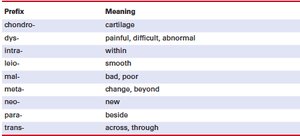
Prefixes modify the meaning of root words, often indicating location, number, or quality.
Prefix | Meaning |
|---|---|
chondro- | cartilage |
dys- | painful, difficult, abnormal |
intra- | within |
leio- | smooth |
mal- | bad, poor |
meta- | change, beyond |
neo- | new |
para- | beside |
trans- | across, through |
Suffixes
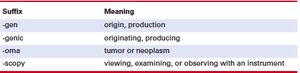
Suffixes are added to the end of root words to indicate procedures, conditions, or diseases.
Suffix | Meaning |
|---|---|
-gen | origin, production |
-genic | originating, producing |
-oma | tumor or neoplasm |
-scopy | viewing, examining, or observing with an instrument |
General Terms Related to Oncology
Key Oncology Terms and Definitions
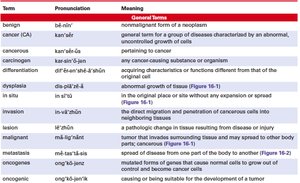
Understanding cancer requires knowledge of specific terms that describe tumor characteristics, behavior, and progression.
Term | Pronunciation | Meaning |
|---|---|---|
benign | bĕ-nīn′ | nonmalignant form of a neoplasm |
cancer (CA) | kan′ser | general term for a group of diseases characterized by abnormal, uncontrolled growth of cells |
carcinoma | kar′si-nō′ma | pertaining to cancer |
carcinogenic | kar′si-nō-jen′ik | any cancer-causing substance or organism |
differentiation | dif′er-en-shē-ā′shun | acquiring characteristics or functions different from that of the original cell |
dysplasia | dis-plā′zh(ē-)a | abnormal growth of tissue |
in situ | in sī′tū | in the original place or site without any expansion or spread |
invasion | in-vā′zhun | the spreading and penetration of cancerous cells into adjacent tissue |
lesion | lē′zhun | a pathologic change in tissue resulting from disease or injury |
malignant | mă-lig′nant | tumor that invades surrounding tissue and may spread to other body sites (shows metastasis) |
metastasis | mĕ-tas′tă-sis | spread of cancer cells from one part of the body to another |
oncogenesis | ong′kō-jen′e-sis | formation of tumors from normal cells |
oncogenic | ong′kō-jen′ik | causing or being suitable for the development of a tumor |
Cellular Changes in Cancer
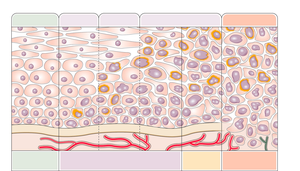
Cancer development involves a series of cellular changes, including abnormal cell growth, loss of differentiation, and invasion of surrounding tissues. These changes can be observed microscopically and are used to diagnose and classify tumors.
Additional Oncology Terms
Other important terms describe the course and management of cancer.
Term | Pronunciation | Meaning |
|---|---|---|
recurrence | rē-kur′ens | the return of cancer or disease |
remission | rē-mish′un | lessening in severity of disease symptoms; period when cancer is improving or under control |
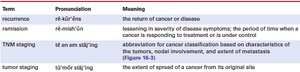
TNM staging | tē en em stāj′ing | abbreviation for cancer classification based on tumor size, nodal involvement, and extent of metastasis |
tumor staging | tū′mor stāj′ing | the extent of spread of a cancer from its original site |
Types and Classification of Tumors
Adenocarcinoma
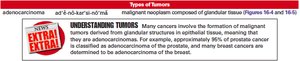
Adenocarcinoma is a malignant neoplasm composed of glandular tissue. Many cancers, such as those of the prostate and breast, are classified as adenocarcinomas due to their origin in glandular structures within epithelial tissue.
Microscopic Appearance of Adenocarcinoma
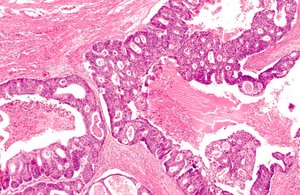
Under the microscope, adenocarcinomas display glandular patterns and may show varying degrees of differentiation. The degree of differentiation helps determine the tumor's aggressiveness and prognosis.
Cancer Staging and Progression
Metastasis and Stage IV Cancer
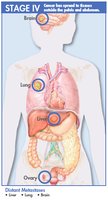
Metastasis refers to the spread of cancer cells from the original (primary) site to distant organs, such as the liver, lungs, or brain. Stage IV cancer is characterized by the presence of distant metastases, indicating advanced disease and often requiring systemic therapy.
TNM Staging System
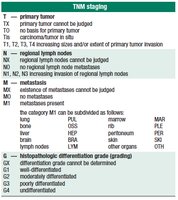
The TNM staging system is a standardized method for classifying the extent of cancer spread. It evaluates three components:
T (Tumor): Size and extent of the primary tumor
N (Nodes): Involvement of regional lymph nodes
M (Metastasis): Presence of distant metastases
Each component is assigned a number or letter to indicate severity or presence. The system also includes grading based on histologic differentiation.
Summary
Oncology is a critical field in medicine, focusing on the study and management of cancer. Mastery of oncology terminology—including word parts, general terms, and classification systems—is essential for understanding cancer diagnosis, progression, and treatment. The TNM system and microscopic evaluation of tumors are key tools in staging and guiding therapy.
