 Back
BackIntroduction to Plants and Nonvascular Plants (Bryophytes)
Study Guide - Smart Notes
 Tailored notes based on your materials, expanded with key definitions, examples, and context.
Introduction to Plants
General Characteristics of Plants
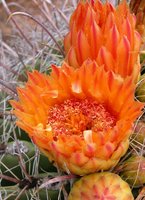
Plants are a diverse group of multicellular, primarily photoautotrophic eukaryotes that play a crucial role in Earth's ecosystems. They exhibit a wide range of structural complexity and have evolved various adaptations to terrestrial life over at least one billion years.
Multicellular Eukaryotes: Plants are composed of multiple cells with membrane-bound organelles.
Photoautotrophs: Most plants use sunlight to synthesize organic compounds via photosynthesis. A few are saprobes or parasites.
Structural Complexity: Plant bodies can be sessile (fixed in one place) or floating, and range from simple to highly complex forms.
Diversity: There is tremendous diversity among plant species, both in form and function.
Evolutionary History: Fossil evidence suggests that plants have been evolving for at least one billion years.
Major Groups of Plants
Phylogenetic Relationships
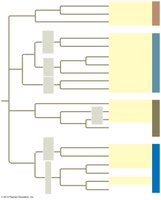
Plants are part of the Archaeplastida supergroup, which also includes green algae and red algae. The evolutionary history of plants is marked by several key innovations, including the development of vascular tissue and seeds.
Green Algae: The closest relatives to land plants, divided into chlorophytes and charophytes.
Land Plants: Evolved from ancestral green algae, with major groups including nonvascular plants (bryophytes), seedless vascular plants, and seed plants (gymnosperms and angiosperms).
Classification of Plants
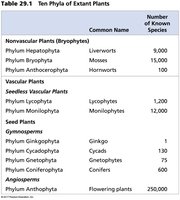
Plants are classified into several phyla based on the presence or absence of vascular tissue and seeds. The table below summarizes the ten major phyla of extant plants, their common names, and the approximate number of known species.
Group | Phylum | Common Name | Number of Known Species |
|---|---|---|---|
Nonvascular Plants (Bryophytes) | Hepatophyta | Liverworts | 9,000 |
Bryophyta | Mosses | 15,000 | |
Anthocerophyta | Hornworts | 100 | |
Seedless Vascular Plants | Lycophyta | Lycophytes | 1,200 |
Monilophyta | Monilophytes | 12,000 | |
Seed Plants (Gymnosperms) | Ginkgophyta | Ginkgo | 1 |
Cycadophyta | Cycads | 130 | |
Gnetophyta | Gnetophytes | 75 | |
Coniferophyta | Conifers | 600 | |
Seed Plants (Angiosperms) | Anthophyta | Flowering plants | 250,000 |
Evolutionary History of Plants
Major Evolutionary Events
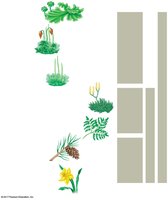
The evolution of plants is marked by the origin of nonvascular plants, the development of vascular tissue, and the emergence of seeds. These innovations allowed plants to colonize new terrestrial environments and diversify extensively.
Origin of Nonvascular Plants: About 470 million years ago, the first land plants (bryophytes) evolved from ancestral green algae.
Origin of Vascular Plants: Vascular tissue (xylem and phloem) evolved around 425 million years ago, enabling greater size and complexity.
Origin of Seed Plants: Seeds evolved approximately 360 million years ago, providing new reproductive advantages.
Alternation of Generations
Life Cycle Overview
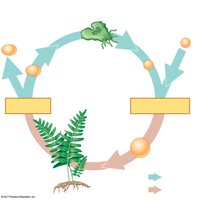
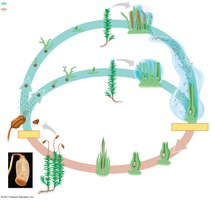
All plants exhibit an alternation of generations life cycle, alternating between a multicellular haploid gametophyte and a multicellular diploid sporophyte.
Gametophyte (n): Produces gametes (sperm and eggs) by mitosis.
Sporophyte (2n): Develops from the fertilized egg (zygote) and produces haploid spores by meiosis.
Spore: A haploid cell that can develop into a new gametophyte.
Fertilization: Fusion of gametes produces a diploid zygote, beginning the sporophyte generation.
Key Terminology
Gametangium: Structure that produces gametes.
Antheridium: Sperm-producing gametangium.
Archegonium: Egg-producing gametangium.
Sporangium: Structure where meiosis and spore formation occur.
Sporangiophore: Structure supporting the sporangium.
Sorus/Strobilus: Dense cluster of sporangia.
Mega- and Micro- Prefixes: Refer to female (egg-producing) and male (sperm-producing) structures, respectively.
The Bryophytes (Nonvascular Plants)
Major Groups of Bryophytes
Bryophytes are the earliest diverging group of land plants and lack vascular tissue. They include three main phyla:
Bryophyta: Mosses
Hepatophyta: Liverworts
Anthocerophyta: Hornworts

Mosses (Phylum Bryophyta)
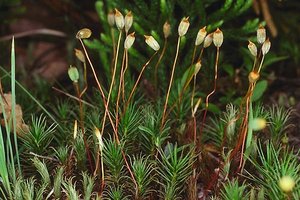
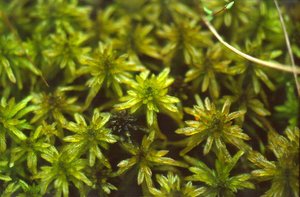
Mosses are small, nonvascular plants that are commonly found in moist environments. They have a dominant gametophyte generation and reproduce via spores.
Gametophyte: The dominant, photosynthetic stage of the moss life cycle.
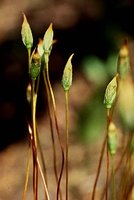
Sporophyte: Dependent on the gametophyte, consisting of a seta (stalk) and capsule (sporangium).
Reproduction: Mosses require water for sperm motility and fertilization.
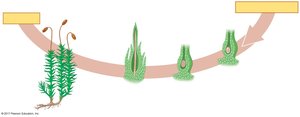
Moss Life Cycle
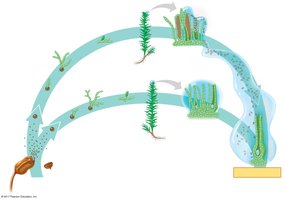
The moss life cycle illustrates the alternation of generations, with a dominant gametophyte and a dependent sporophyte.
Protonema: Early, filamentous stage of the gametophyte.
Gametophore: Structure bearing the sex organs (antheridia and archegonia).
Fertilization: Occurs within the archegonium, producing a diploid zygote.
Sporophyte: Develops from the zygote, remains attached to the gametophyte, and produces spores by meiosis.



Moss Reproductive Structures
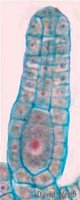
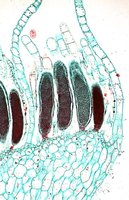
Antheridia: Male gametangia producing sperm.
Archegonia: Female gametangia producing eggs.
Capsule (Sporangium): Structure where spores are produced and released.
Liverworts (Phylum Hepatophyta)
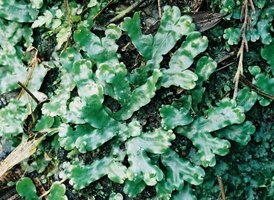
Liverworts are nonvascular plants with a flattened, thalloid gametophyte. They can reproduce both sexually and asexually.
Thallus: The main body of the liverwort gametophyte.
Archegoniophores and Antheridiophores: Structures that bear archegonia and antheridia, respectively.
Asexual Reproduction: Occurs via gemmae, small multicellular bodies that can develop into new plants.
Hornworts (Phylum Anthocerophyta)
Hornworts are a small group of nonvascular plants characterized by their elongated, horn-like sporophytes. They share many features with both liverworts and mosses but are distinguished by their unique sporophyte structure.
Additional info: The above notes integrate and expand upon the provided lecture content, including definitions, examples, and academic context for clarity and completeness. Images were included only when directly relevant to the adjacent text.
