 Back
Invertebrate Anatomy and Physiology: Arthropods and Mollusks
Study Guide - Smart Notes
 Tailored notes based on your materials, expanded with key definitions, examples, and context.
Overview of Invertebrate Anatomy
This study guide covers the anatomical and physiological features of major invertebrate groups, focusing on arthropods (insects, arachnids, crustaceans) and mollusks. These phyla are essential for understanding animal diversity, structure, and function in General Biology.
Arthropods
General Body Plan
Arthropods possess a segmented body covered by a hard exoskeleton made of chitin. The body is typically divided into regions such as the head, thorax, and abdomen, with specialized appendages for feeding, locomotion, and sensory perception.
Exoskeleton: Provides protection and support; must be periodically shed for growth (molting).
Segmentation: Allows for specialization of body regions and appendages.
Jointed Appendages: Enable complex movement and manipulation of the environment.
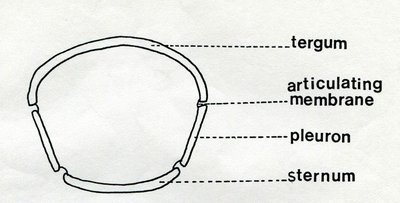
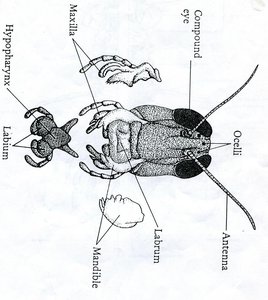
Insect Anatomy
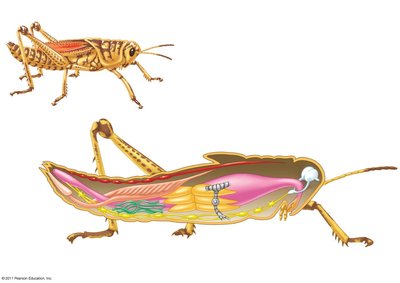
Insects are the most diverse group of arthropods. Their body is divided into three main regions: head, thorax, and abdomen. Each region contains specialized structures for different functions.
Head: Contains sensory organs (compound eyes, antennae) and mouthparts for feeding.
Thorax: Bears legs and wings (if present).
Abdomen: Houses digestive, excretory, and reproductive organs.
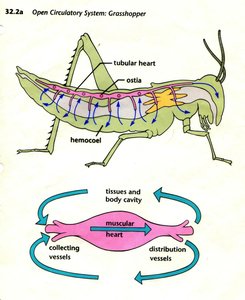
Open Circulatory System in Insects
Insects have an open circulatory system, where hemolymph (insect blood) is pumped by a tubular heart through the body cavity (hemocoel), bathing organs directly.
Tubular Heart: Pumps hemolymph forward through the dorsal vessel.
Ostia: Openings in the heart that allow hemolymph to enter.
Hemocoel: Main body cavity where hemolymph circulates.
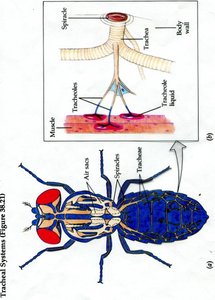
Respiratory System: Tracheal System
Insects breathe through a network of tubes called tracheae, which deliver oxygen directly to tissues. Air enters through spiracles and diffuses through tracheoles to reach cells.
Spiracles: External openings for gas exchange.
Tracheae: Large tubes branching into smaller tracheoles.
Tracheoles: Fine tubes that deliver oxygen directly to cells.
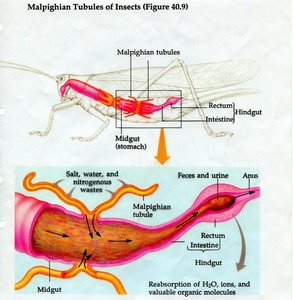
Excretory System: Malpighian Tubules
Insects excrete nitrogenous wastes using Malpighian tubules, which remove wastes from hemolymph and empty them into the gut for elimination.
Malpighian Tubules: Thin tubes that filter wastes from hemolymph.
Rectum: Reabsorbs water and valuable ions before waste is expelled.
Excretion: Produces a mixture of feces and uric acid, conserving water.
Other Arthropod Groups
Arachnids (Spiders and Scorpions)
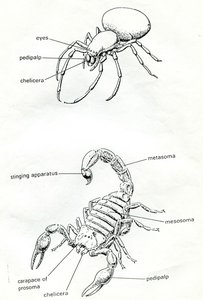
Arachnids have two main body regions: the prosoma (cephalothorax) and opisthosoma (abdomen). They possess specialized appendages such as chelicerae (fangs) and pedipalps.
Spiders: Use chelicerae to inject venom and pedipalps for sensory and reproductive functions.
Scorpions: Have a segmented tail (metasoma) ending in a stinger, and large pedipalps for grasping prey.
Crustaceans (e.g., Crayfish)
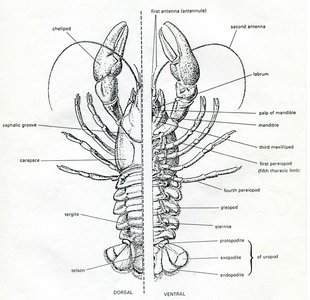
Crustaceans have a hard exoskeleton, two pairs of antennae, and specialized appendages for feeding and locomotion. Their body is divided into the cephalothorax and abdomen.
Cephalothorax: Fused head and thorax, covered by a carapace.
Abdomen: Segmented, often with swimmerets.
Appendages: Include chelipeds (claws), walking legs, and mouthparts.
Mollusks
General Body Plan
Mollusks are soft-bodied animals, often protected by a hard shell. Their body plan includes a muscular foot, a visceral mass containing organs, and a mantle that secretes the shell.
Foot: Used for locomotion.
Visceral Mass: Contains internal organs.
Mantle: Secretes the shell and forms a cavity for respiration and excretion.
Bivalve Anatomy
Bivalves (e.g., clams) have two shells joined by a hinge. They are filter feeders, drawing water in through an incurrent siphon, passing it over gills for food and gas exchange, and expelling it through an excurrent siphon.
Shell: Two-part, hinged at the dorsal side.
Gills: Used for respiration and feeding.
Adductor Muscles: Close the shell tightly.
Mantle Cavity: Space between mantle and visceral mass.
Structure | Function |
|---|---|
Incurrent siphon | Brings water into mantle cavity |
Excurrent siphon | Expels water and waste |
Gills | Filter food, gas exchange |
Adductor muscle | Closes shell |
Chitons
Chitons are marine mollusks with eight overlapping shell plates and a broad, muscular foot. Their mantle cavity contains gills for respiration.
Shell Plates: Provide protection and flexibility.
Foot: Used for movement and attachment to rocks.
Mantle Cavity: Houses gills for gas exchange.
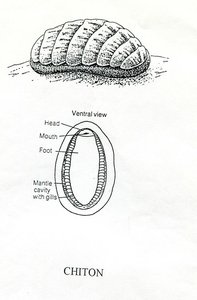
Radula
The radula is a unique feeding organ found in most mollusks (except bivalves). It is a ribbon-like structure covered with tiny teeth, used to scrape or cut food before ingestion.
Odontophore: Cartilaginous structure supporting the radula.
Function: Scrapes algae or plant material from surfaces.
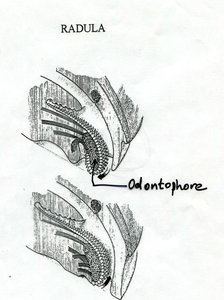
Summary Table: Key Features of Arthropods and Mollusks
Phylum | Body Plan | Respiratory System | Circulatory System | Excretory System |
|---|---|---|---|---|
Arthropoda | Segmented, exoskeleton, jointed appendages | Tracheae (insects), book lungs (arachnids), gills (crustaceans) | Open | Malpighian tubules (insects), green glands (crustaceans) |
Mollusca | Muscular foot, visceral mass, mantle | Gills, lungs (in some) | Open (except cephalopods) | Nephridia |
Additional info: This guide integrates and expands upon the provided diagrams and terms, offering a comprehensive overview suitable for General Biology students studying invertebrate anatomy and physiology.
