 Back
Invertebrates: Diversity, Structure, and Evolution
Study Guide - Smart Notes
 Tailored notes based on your materials, expanded with key definitions, examples, and context.
Invertebrates: An Overview
Definition and Diversity
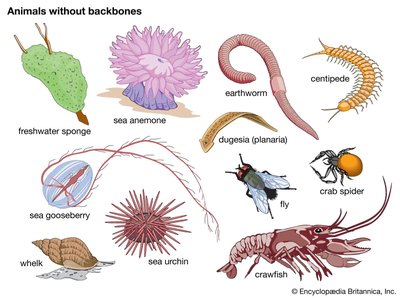
Invertebrates are animals that lack a backbone and represent the vast majority of animal diversity on Earth. They occupy nearly every habitat and display a remarkable range of body forms and adaptations.
Kingdom Animalia contains approximately 1.3 million described species, with estimates of total species ranging up to 10–20 million.
Invertebrates account for over 95% of known animal species.
They are found in marine, freshwater, and terrestrial environments.
Major Invertebrate Clades
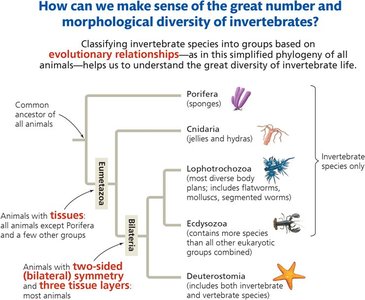
Invertebrates are classified into several major clades based on evolutionary relationships and body plan characteristics.
Porifera (sponges)
Cnidaria (jellies, hydras, corals)
Lophotrochozoa (flatworms, molluscs, annelids, etc.)
Ecdysozoa (nematodes, arthropods)
Deuterostomia (echinoderms, chordates)
Porifera: Sponges
Characteristics and Body Plan
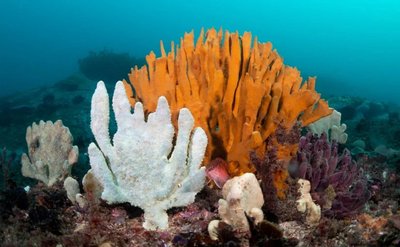
Sponges are basal animals that lack true tissues but possess specialized cells. They are primarily marine, sessile filter feeders with a simple body plan.
Body is a sac perforated with pores, allowing water flow for filter feeding.
Specialized cells include choanocytes (collar cells), amoebocytes (totipotent cells), and others.
Sponges are hermaphroditic, often exhibiting sequential hermaphroditism.
Feeding and Structure
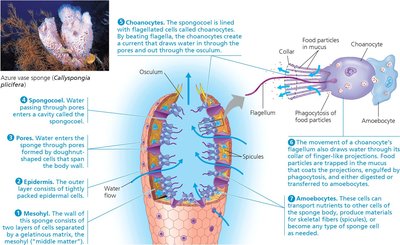
Sponges feed by drawing water into the spongocoel and out through the osculum, filtering food particles from the water.
Choanocytes use flagella to create water currents and capture food by phagocytosis.
Mesohyl is a gelatinous matrix between cell layers, containing amoebocytes for digestion and skeletal support.
Cnidaria: Ancient Eumetazoans
General Features
Cnidarians are among the oldest eumetazoans (animals with true tissues). They include corals, sea anemones, hydras, and jellies, and are characterized by radial symmetry and a diploblastic body plan.
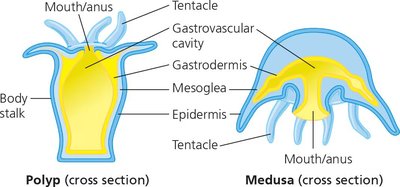
Basic body plan: a sac with a gastrovascular cavity (central digestive compartment).
Single opening serves as both mouth and anus.
Two main body forms: polyp (sessile) and medusa (motile).
Feeding and Nervous System
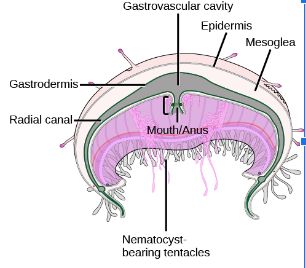
Cnidarians are predators that use tentacles armed with cnidocytes (stinging cells) containing nematocysts for prey capture and defense. They possess a simple nerve net and contractile tissues.
Cnidocytes: Specialized cells for stinging and capturing prey.
Nematocysts: Organelles within cnidocytes that eject a stinging thread.
Non-centralized nerve net coordinates movement and response to stimuli.
Major Clades: Medusozoa and Anthozoa
Cnidaria is divided into two major clades:
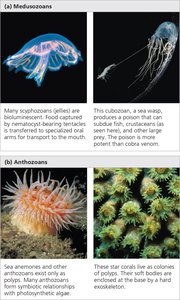
Medusozoa: Includes jellies (Scyphozoa), box jellies (Cubozoa), and hydrozoans. Most alternate between polyp and medusa forms.
Anthozoa: Includes sea anemones and corals, which exist only as polyps and often form symbiotic relationships with algae.
Lophotrochozoa: Diversity of Body Forms
General Features
Lophotrochozoans are a diverse clade of bilaterians, identified by molecular data. Most have bilateral symmetry, triploblastic development, and a coelom.
Named for the presence of a lophophore (ciliated feeding structure) or a trochophore larval stage in some members.
Includes flatworms, rotifers, ectoprocts, brachiopods, molluscs, and annelids.

Flatworms (Phylum Platyhelminthes)
Flatworms are dorsoventrally flattened, triploblastic acoelomates with a branched gastrovascular cavity. Many are free-living, while others are parasitic.
Gas exchange and nitrogenous waste elimination occur by diffusion across the body surface.
Simple excretory system: protonephridia with flame bulbs.
Parasitic groups include trematodes (flukes) and tapeworms.
Molluscs
Molluscs are soft-bodied animals, often protected by a calcium carbonate shell. They have a body plan with a muscular foot, visceral mass, and mantle.
Major clades: Polyplacophora (chitons), Gastropoda (snails, slugs), Bivalvia (clams, oysters), Cephalopoda (squids, octopuses).
Most have open circulatory systems, except cephalopods (closed system).
Annelids
Annelids are segmented worms with a true coelom. They include earthworms, leeches, and marine polychaetes.
Segmentation allows for specialization of body regions and efficient movement.
Two main clades: Errantia (mobile, mostly marine) and Sedentaria (less mobile, includes earthworms and leeches).
Ecdysozoa: The Most Species-Rich Animal Group
General Features
Ecdysozoans are defined by their ability to molt a tough external cuticle, a process called ecdysis. The two largest phyla are nematodes and arthropods.
Nematodes: Roundworms with a pseudocoelom, unsegmented bodies, and no circulatory system.
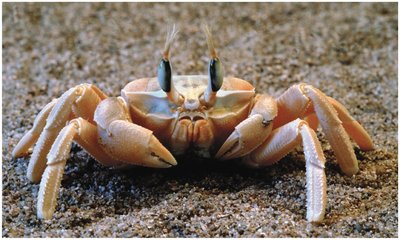
Arthropods: Segmented bodies, jointed appendages, and a chitinous exoskeleton. Includes insects, spiders, crustaceans, and more.
Deuterostomia: Echinoderms and Chordates
Developmental Features
Deuterostomes are characterized by radial cleavage and the formation of the anus from the blastopore during embryonic development.
Echinoderms: Marine animals with a water vascular system and often pentaradial symmetry as adults (e.g., sea stars, sea urchins).
Chordates: Includes all vertebrates and two groups of invertebrates (lancelets and tunicates).
Symmetry in Animal Body Plans
Radial vs. Bilateral Symmetry
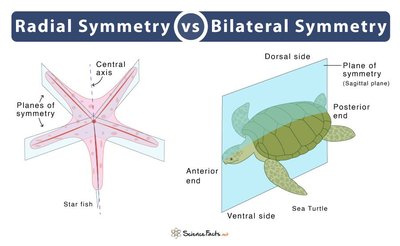
Animal body plans can be classified based on symmetry:
Radial symmetry: Body parts arranged around a central axis (e.g., cnidarians, adult echinoderms).
Bilateral symmetry: Body has left and right sides, with a distinct anterior and posterior end (e.g., most other animals).
Summary Table: Major Invertebrate Clades
Clade | Key Features | Examples |
|---|---|---|
Porifera | Lack true tissues, filter feeders | Sponges |
Cnidaria | Diploblastic, radial symmetry, stinging cells | Jellies, corals, hydras |
Lophotrochozoa | Bilateral symmetry, triploblastic, diverse body forms | Flatworms, molluscs, annelids |
Ecdysozoa | Molting of cuticle, largest animal group | Nematodes, arthropods |
Deuterostomia | Radial cleavage, anus forms first | Echinoderms, chordates |
