 Back
BackIsomer Types in Sugar Molecules
Study Guide - Smart Notes
 Tailored notes based on your materials, expanded with key definitions, examples, and context.
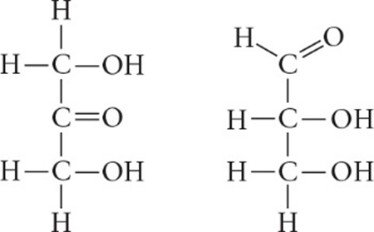
Q16. Choose the term that correctly describes the relationship between these two sugar molecules.
Background
Topic: Isomerism in Organic Molecules
This question is testing your understanding of the different types of isomers, specifically how structural differences in sugar molecules can lead to different isomer classifications.
Key Terms:
Isomers: Molecules with the same molecular formula but different structural arrangements.
Structural Isomers: Isomers that differ in the connectivity of their atoms.
Cis-trans Isomers: Isomers that differ in the spatial arrangement around a double bond or ring structure.
Enantiomers: Isomers that are mirror images of each other and not superimposable.
Step-by-Step Guidance
Examine the molecular formulas of both sugar molecules. Are they the same? This is the first requirement for isomerism.
Look closely at the arrangement of atoms and functional groups in each molecule. Are the atoms connected in the same way, or is the connectivity different?
Consider whether the molecules are mirror images of each other (enantiomers), or if they differ in the arrangement around a double bond (cis-trans isomers), or if they simply have different connectivity (structural isomers).
Identify which type of isomerism is present based on your observations. Focus on whether the difference is in the structure (connectivity) or in spatial arrangement.
Try solving on your own before revealing the answer!
Final Answer: structural isomers
The two sugar molecules have the same molecular formula but differ in the connectivity of their atoms, making them structural isomers.
This is a classic example of structural isomerism in carbohydrates, where the arrangement of functional groups changes the molecule's properties.
