Back
Key Terms in Biomolecules and Molecular Biology
Study Guide - Smart Notes
 Tailored notes based on your materials, expanded with key definitions, examples, and context.
Biomolecules and Molecular Biology
Overview
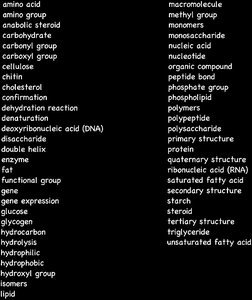
This section introduces essential vocabulary related to biomolecules, their structure, and function in living organisms. Understanding these terms is foundational for topics such as cell components, gene expression, and metabolism in General Biology.
Key Terms and Definitions
Amino Acid: Organic molecules that are the building blocks of proteins. Each contains an amino group, a carboxyl group, and a unique side chain.
Carbohydrate: Molecules composed of carbon, hydrogen, and oxygen; serve as energy sources and structural components. Examples include glucose, starch, and cellulose.
Lipid: Hydrophobic molecules including fats, oils, and steroids; important for energy storage and membrane structure.
Protein: Polymers of amino acids with diverse functions such as catalysis (enzymes), structure, and signaling.
Nucleic Acid: Polymers of nucleotides; DNA and RNA store and transmit genetic information.
Monomer: A single molecular unit that can join with others to form polymers (e.g., amino acids, monosaccharides).
Polymer: Large molecules made from repeating monomer units (e.g., proteins, polysaccharides).
Enzyme: Proteins that catalyze biochemical reactions, increasing reaction rates without being consumed.
Gene: A segment of DNA that encodes a functional product, usually a protein.
Double Helix: The structure of DNA, consisting of two intertwined strands.
Phospholipid: Major component of cell membranes, consisting of a hydrophilic head and hydrophobic tails.
Hydrophobic: Describes molecules or parts of molecules that repel water.
Hydrophilic: Describes molecules or parts of molecules that interact well with water.
Starch: A polysaccharide used by plants for energy storage.
Cellulose: A structural polysaccharide in plant cell walls.
Triglyceride: A lipid formed from glycerol and three fatty acids; main form of stored fat in animals.
Macromolecule: Large, complex molecules such as proteins, nucleic acids, carbohydrates, and lipids.
Organic Compound: Molecules containing carbon, typically found in living organisms.
Denaturation: Loss of normal protein structure due to environmental changes (e.g., heat, pH).
Primary Structure: The sequence of amino acids in a protein.
Secondary Structure: Local folding patterns in proteins (e.g., alpha helix, beta sheet).
Tertiary Structure: Overall three-dimensional shape of a protein.
Quaternary Structure: Arrangement of multiple protein subunits.
Gene Expression: The process by which information from a gene is used to synthesize a functional product.
Phosphate Group: Functional group important in nucleic acids and energy transfer (e.g., ATP).
Hydroxyl Group: Functional group (-OH) found in alcohols and carbohydrates.
Methyl Group: Functional group (-CH3) affecting molecular function and gene expression.
Fatty Acid: Building block of lipids; can be saturated or unsaturated.
Saturated Fatty Acid: Fatty acid with no double bonds; typically solid at room temperature.
Unsaturated Fatty Acid: Fatty acid with one or more double bonds; typically liquid at room temperature.
Polysaccharide: Large carbohydrate molecule composed of many monosaccharides (e.g., starch, cellulose).
Monosaccharide: Simple sugar molecule (e.g., glucose, fructose).
Disaccharide: Carbohydrate formed from two monosaccharides (e.g., sucrose, lactose).
Peptide Bond: Covalent bond joining amino acids in proteins.
Chitin: Structural polysaccharide in fungal cell walls and arthropod exoskeletons.
Steroid: Lipid molecule with four fused rings; includes hormones like cholesterol.
Glycogen: Storage polysaccharide in animals.
Organic Compound: Molecule containing carbon, found in living things.
RNA (Ribonucleic Acid): Nucleic acid involved in protein synthesis and gene regulation.
DNA (Deoxyribonucleic Acid): Nucleic acid storing genetic information.
Example Table: Types of Biomolecules
Biomolecule | Monomer | Function | Example |
|---|---|---|---|
Protein | Amino Acid | Catalysis, structure, signaling | Enzyme, collagen |
Carbohydrate | Monosaccharide | Energy, structure | Glucose, cellulose |
Lipid | Fatty Acid, Glycerol | Energy storage, membrane structure | Triglyceride, phospholipid |
Nucleic Acid | Nucleotide | Genetic information | DNA, RNA |
Additional info:
These terms are foundational for understanding chapters such as Biomolecules, Cell Components, Gene Expression, and Energy and Metabolism. Mastery of this vocabulary is essential for success in General Biology.