 Back
Keystone Species, Succession, and Energy Flow in Ecosystems
Study Guide - Smart Notes
 Tailored notes based on your materials, expanded with key definitions, examples, and context.
Keystone Species
Definition and Importance
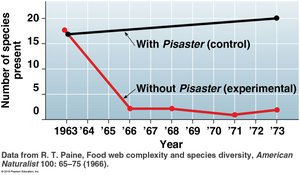
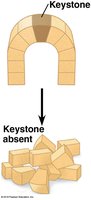
Keystone species are organisms that have a disproportionately large effect on the structure and diversity of their ecosystem relative to their abundance. The removal of a keystone species can lead to significant changes in ecosystem composition and may cause the collapse of ecological communities.
Key Point 1: Keystone species maintain species diversity by controlling populations of other species, often preventing any one species from dominating the ecosystem.
Key Point 2: The loss of a keystone species can result in a dramatic reduction in biodiversity and ecosystem stability.
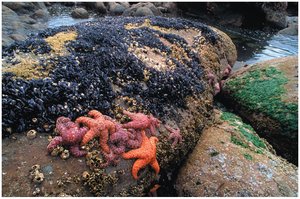
Example: The sea star Pisaster is a classic example of a keystone species in intertidal communities. Its removal leads to a sharp decline in species diversity.
Ecological Succession
Primary and Secondary Succession
Ecological succession is the process by which the structure of a biological community evolves over time. There are two main types: primary succession, which occurs in lifeless areas, and secondary succession, which occurs in areas where a disturbance has destroyed a community but left the soil intact.
Key Point 1: Primary succession begins on bare rock or sand, where no soil exists. Pioneer species such as lichens and mosses are the first to colonize.
Key Point 2: Secondary succession occurs after disturbances like fire or farming, where soil remains and the recovery is faster due to the presence of seed banks and nutrients.
Example: Forest regrowth after a fire is an example of secondary succession.
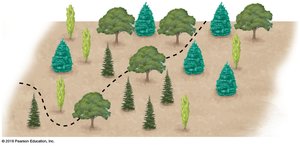
Biodiversity: Species Richness and Evenness
Measuring Biodiversity
Biodiversity in an ecosystem is commonly measured by two components: species richness (the number of different species present) and species evenness (the relative abundance of each species).
Key Point 1: Species richness refers to the total number of species in a community.
Key Point 2: Species evenness describes how evenly individuals are distributed among the species present.
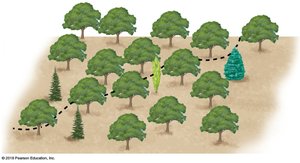
Example: Two woodlots may have the same number of species (richness), but if one is dominated by a single species, it has lower evenness.
Species | Relative Abundance in Woodlot A (%) | Relative Abundance in Woodlot B (%) |
|---|---|---|
| 80 | 25 |
10 | 25 | |
5 | 25 | |
5 | 25 |
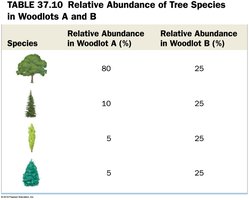
Additional info: Table 37.10 compares the relative abundance of tree species in two woodlots, illustrating the concept of species evenness.
Energy Flow in Ecosystems
Food Chains and Trophic Levels
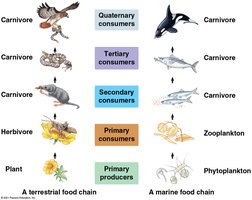
Energy flows through ecosystems in a one-way stream, from primary producers to various levels of consumers. Each step in this transfer is known as a trophic level.
Key Point 1: Primary producers (autotrophs) capture energy from sunlight or chemicals and convert it into organic molecules.
Key Point 2: Consumers (heterotrophs) obtain energy by eating other organisms. They are classified as primary, secondary, tertiary, or quaternary consumers based on their position in the food chain.
Example: In a terrestrial food chain: plants → herbivores → carnivores.
Primary Production
Primary production is the amount of light energy converted to chemical energy (organic compounds) by autotrophs in an ecosystem. It sets the energy budget for the entire ecosystem.
Key Point 1: Gross Primary Production (GPP): The total amount of photosynthetic production of organic compounds in an ecosystem.
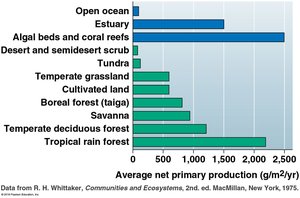
Key Point 2: Net Primary Production (NPP): The energy that remains after autotrophs have met their own energetic needs through respiration. It represents the energy available to consumers.
Formula:
Example: Tropical rain forests and algal beds have high NPP, while deserts have low NPP.
Energy Transfer and Trophic Efficiency
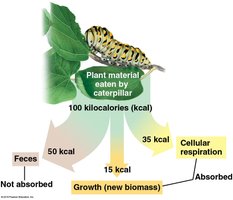
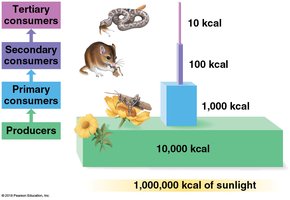
Energy transfer between trophic levels is inefficient, with only about 10% of the energy at one level being passed to the next. The rest is lost as heat, used for metabolism, or excreted as waste.
Key Point 1: Trophic efficiency limits the length of food chains and the biomass of higher trophic levels.
Key Point 2: Energy pyramids visually represent the diminishing energy available at each trophic level.
Example: If 1,000,000 kcal of sunlight is captured by producers, only about 10 kcal is available to tertiary consumers.
Chemical Cycling in Ecosystems
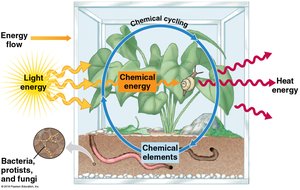
While energy flows through ecosystems and is eventually lost as heat, chemical elements such as carbon, nitrogen, and phosphorus are recycled. Decomposers play a crucial role in breaking down organic matter and returning nutrients to the environment.
Key Point 1: Energy flow is linear and non-cyclic, while chemical cycling is circular and essential for ecosystem sustainability.
Key Point 2: Decomposers (bacteria, fungi, protists) are vital for nutrient recycling.
Summary Table: Key Concepts
Concept | Definition | Example |
|---|---|---|
Keystone Species | Species with a large impact on community structure | Pisaster sea star |
Succession | Orderly change in community composition over time | Forest regrowth after fire |
Species Richness | Number of species in a community | 10 tree species in a woodlot |
Species Evenness | Relative abundance of species | All species equally abundant |
Primary Production | Energy captured by autotrophs | Photosynthesis in plants |
Net Primary Production | GPP minus energy used by producers | Biomass available to herbivores |
