 Back
BackLab Exam 2 Study Guide: Non-seed Plants, Seed Plants, Invertebrates, and Mammalian Anatomy
Study Guide - Smart Notes
 Tailored notes based on your materials, expanded with key definitions, examples, and context.
Non-seed and Seedless Vascular Plants
Dominant Generation in Plant Groups
Plants exhibit alternation of generations, alternating between multicellular haploid (gametophyte) and diploid (sporophyte) stages. The dominant generation varies among plant groups.
Nonvascular Plants (Bryophytes): Dominant generation is the gametophyte.
Vascular Seedless Plants (e.g., ferns): Dominant generation is the sporophyte.
Antheridia and archegonia are structures where gametes (sperm and eggs, respectively) are produced in gametophyte plants.
The first vascular plants to have stems, roots, and leaves were the ferns and their relatives.
Sporangia are spore-producing structures found in many plant and fungal groups.
Annulus, frond, and prothallus are all terms associated with ferns.
Both gymnosperms and angiosperms produce seeds, an evolutionary adaptation for terrestrial life.
Vascular tissue provides support and transports water and nutrients throughout the plant.
Land plants have a two-generation life cycle called alternation of generations.
Seed Plants
General Features and Evolution
Seed plants include gymnosperms and angiosperms. They are characterized by the production of seeds, which protect and nourish the developing embryo.
The dominant generation in seed plants is the sporophyte (2n).
Seed plants share a common ancestor with other land plants (embryophytes).
Both gymnosperms and angiosperms produce seeds, a key adaptation for survival on land.
Gymnosperm means "naked seed" (seeds not enclosed in fruit), while angiosperm means "enclosed seed" (seeds within a fruit).
Angiosperms are the most dominant group of seed plants today.
The four groups of gymnosperms are: Cycads, Ginkgo, Conifers, and Gnetophytes.
Monocots vs. Eudicots
Angiosperms are divided into two major groups based on seed, leaf, and floral characteristics.
Feature | Monocots | Eudicots |
|---|---|---|
Number of cotyledons | 1 | 2 |
Leaf venation | Parallel | Net-like |
Flower parts | Multiples of 3 | Multiples of 4 or 5 |
Vascular bundles | Scattered | Arranged in a ring |
Flower Structure
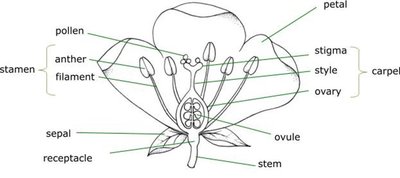
Flowers are the reproductive organs of angiosperms. Understanding their structure is essential for identifying plant reproductive strategies.
Stamen: Male part, consists of anther (produces pollen) and filament.
Carpel (Pistil): Female part, consists of stigma (receives pollen), style, and ovary (contains ovules).
Petal: Often colorful, attracts pollinators.
Sepal: Protects the flower bud.
Receptacle: Base of the flower.
Ovule: Develops into seed after fertilization.
Invertebrates
Protostomes vs. Deuterostomes
These terms describe two major developmental pathways in animal embryology.
Protostomes: The mouth develops from the first opening (blastopore).
Deuterostomes: The anus develops from the first opening; the mouth forms secondarily.
Types of Symmetry
Bilateral symmetry: Body can be divided into mirror-image halves (e.g., planarians, earthworms, squid, crayfish).
Radial symmetry: Body parts arranged around a central axis (e.g., hydras, sea stars).
Asymmetry: No symmetry (e.g., sponges).
Major Invertebrate Groups and Their Phyla
Sponges: Phylum Porifera
Hydras: Phylum Cnidaria
Planarians: Phylum Platyhelminthes
Ascaris (roundworms): Phylum Nematoda
Rotifers: Phylum Rotifera
Tapeworms: Phylum Platyhelminthes
Earthworm: Phylum Annelida
Crayfish: Phylum Arthropoda
Sea star: Phylum Echinodermata
Squid: Phylum Mollusca
Defense Mechanisms
Sponges: Produce toxic chemicals to deter predators.
Hydras: Use specialized stinging cells (nematocysts) for defense.
Other Key Features
Main organ of absorption in squid: The cecum.
Number of aortic arches in earthworm: Five pairs (total of ten).
Symmetry in invertebrates: See above for group-specific symmetry.
Virtual Pig Lab: Mammalian Anatomy
Major Organs and Functions
Liver: Produces bile, detoxifies blood, stores glycogen, metabolizes nutrients.
Organ producing bile: Liver.
Number of lobes in fetal pig liver: Five.
Organ storing bile: Gallbladder.
Structure holding organs in place: Mesentery.
Number of heart chambers in mammals: Four (two atria, two ventricles).
Egg production in female pig: Ovaries.
Alveoli: Tiny air sacs in the lungs where gas exchange occurs.
Urine transport: Urine moves from the kidney to the bladder via the ureter.
Thymus sections: Cervical and thoracic.
Testosterone effects: Promotes development of male secondary sexual characteristics and reproductive organs.
Controller of the endocrine system: Pituitary gland.
