 Back
Land Plant Diversity and Evolution: Seedless and Seed Plants
Study Guide - Smart Notes
 Tailored notes based on your materials, expanded with key definitions, examples, and context.
Land Plant Diversity and Evolution
Overview of Land Plant Diversity
Land plants are a diverse group that evolved from green algal ancestors and have adapted to terrestrial environments through a series of derived traits. The major groups include nonvascular plants, seedless vascular plants, and seed plants (gymnosperms and angiosperms).
Nonvascular plants (mosses, liverworts, hornworts): Lack specialized vascular tissues; gametophyte is dominant.
Seedless vascular plants (lycophytes, monilophytes): Have vascular tissues; sporophyte is dominant.
Seed plants (gymnosperms, angiosperms): Possess seeds, pollen, and reduced gametophytes.
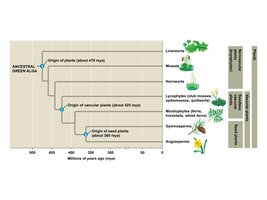
Additional info: The evolutionary tree shows the origin of land plants, vascular plants, and seed plants, highlighting major transitions in plant evolution.
Evolutionary Relationships Among Land Plants
Land plants (embryophytes) are part of the Viridiplantae clade, which also includes green algae. The closest relatives are charophytes, sharing several key traits.
Chlorophylls a and b: Present in both charophytes and land plants.
Cellulose-synthesizing complexes: Rings of proteins in the plasma membrane.
Phragmoplast formation: Structure during cell division.
Sporopollenin: Protective polymer in spores and pollen.
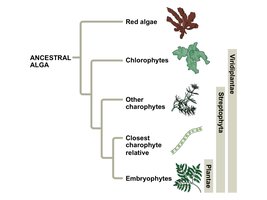
Additional info: The phylogenetic tree illustrates the evolutionary relationships among red algae, chlorophytes, charophytes, and embryophytes.
Seedless Land Plants
Nonvascular Plants (Bryophytes)
Nonvascular plants include mosses, liverworts, and hornworts. They lack vascular tissues and rely on water for fertilization. The gametophyte stage is dominant, and sporophytes are small and dependent.
Dominant gametophyte: The main photosynthetic stage.
Dependent sporophyte: Grows on the gametophyte and relies on it for nutrients.
Water-dependent fertilization: Sperm swim to eggs in water.
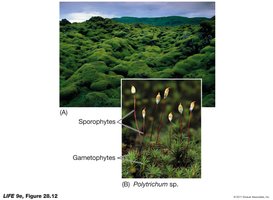
Additional info: The image shows mosses with labeled gametophyte and sporophyte stages, illustrating their life cycle.
Seedless Vascular Plants
Seedless vascular plants, such as ferns, lycophytes, and horsetails, possess vascular tissues (xylem and phloem) and have a dominant sporophyte stage. They reproduce via spores and require water for fertilization.
Vascular tissues: Allow transport of water and nutrients.
Dominant sporophyte: Larger and independent of gametophyte.
Spore production: Homosporous (one type of spore) or heterosporous (two types).
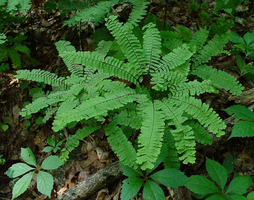
Additional info: Ferns are a classic example of seedless vascular plants, with large, branching sporophytes.
Vascular Plant Traits
Vascular plants evolved several key traits:
Alternation of generations: Large, branching, independent sporophyte.
Vascular system: Xylem and phloem.
Roots and leaves: Microphylls and megaphylls.
Sporophylls: Sporangia-bearing leaves.
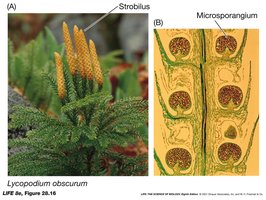
Additional info: The image shows a lycophyte with strobili (cone-like structures) and microsporangia, highlighting reproductive adaptations.
Seed Plants: Gymnosperms
Gymnosperms: "Naked-Seeded" Plants
Gymnosperms are seed plants that do not form flowers. Their seeds are exposed on sporophylls, usually arranged in cones. They include conifers, cycads, gnetophytes, and ginkgos.
Exposed ovules/seeds: Not enclosed by additional tissue.
Four main clades: Conifers, cycads, gnetophytes, ginkgos.
Dominant during Mesozoic: Conifers still dominate many forests.
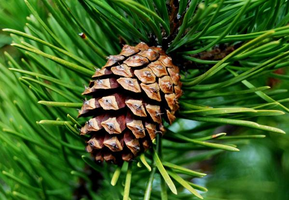
Additional info: The pine cone is a typical gymnosperm reproductive structure, bearing seeds on woody scales.
Conifer Life Cycle
Conifers illustrate the gymnosperm life cycle, with separate male and female cones. Wind carries pollen from male cones to female cones, where fertilization occurs and seeds develop.
Male cones (microstrobili): Produce pollen grains.
Female cones (megastrobili): Bear ovules and seeds.
Pollination: Pollen tube delivers sperm to egg.
Seed structure: Seed coat (parent sporophyte), nutrient tissue (female gametophyte), embryo (new sporophyte).
Key Terms and Concepts
Ovule: Structure containing the megasporangium, megaspore, and integument.
Integument: Protective layer around the ovule.
Pollination: Transfer of pollen to the ovule.
Pollen grain: Microgametophyte covered in sporopollenin.
Pollen tube: Delivers sperm to the egg.
Seed: Contains embryo, seed coat, and nutrient tissue.
Embryo: Young sporophyte within the seed.
Seed coat: Protective outer layer.
Conifer: Gymnosperm group with cones.
Gnetophyte: Diverse gymnosperm group.
Cycad: Palm-like gymnosperm.
Homo/heterosporous: Producing one or two types of spores.
Mega/microspore: Female/male spores.
Mega/microgametophyte: Female/male gametophytes.
Lycophyte: Seedless vascular plant.
Monilophyte: Ferns and relatives.
Strobilus/strobili: Cone-like reproductive structures.
Ferns, horsetails, whisk ferns: Seedless vascular plants.
Sorus/sori: Cluster of sporangia in ferns.
Elater: Spore dispersal structure.
Gymnosperm: Seed plant with exposed seeds.
Ginkgo: Unique gymnosperm species.
Megastrobilus: Female cone.
Megasporocyte: Cell that produces megaspores.
Microstrobilus: Male cone.
Microsporocyte: Cell that produces microspores.
Micropyle: Pore in ovule for pollen tube entry.
Cone: Reproductive structure in gymnosperms.
Study Questions
Describe the characteristics and lifecycles of seedless vascular plants.
Describe the evolutionary trend towards reduction of the gametophyte generation in land plants.
Describe the formation of a megaspore and its fate in a seed plant like a gymnosperm.
Describe the formation of a microspore and its fate in a seed plant like a gymnosperm.
Describe the process of pollination in a seed plant.
Describe the structure of a gymnosperm seed, understanding where all of its components come from.
Explain a conifer life cycle.
List the different gymnosperm groups and their different characteristics.
