 Back
Land Plants: Evolution, Adaptations, and Ecological Roles
Study Guide - Smart Notes
 Tailored notes based on your materials, expanded with key definitions, examples, and context.
Land Plants: Evolution, Adaptations, and Ecological Roles
Overview of Land Plants
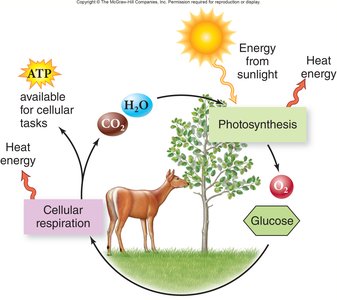
Land plants are multicellular eukaryotes and photoautotrophs, meaning they generate organic molecules through photosynthesis. They play a crucial role as primary producers in terrestrial ecosystems, supporting life by providing food, oxygen, and other resources.
Photosynthesis Reaction:
Cellular Respiration Reaction:
Plants: Producers (chloroplasts), also have mitochondria
Animals: Consumers (mitochondria)
Transition from Water to Land
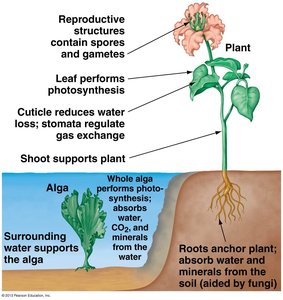
The transition from aquatic to terrestrial environments provided plants with new opportunities and challenges. Land plants evolved adaptations to thrive with their tissues exposed to air, unlike their aquatic ancestors.
Pros: More nutrients, better support
Cons: Increased competition, risk of consumption
Importance of Land Plants
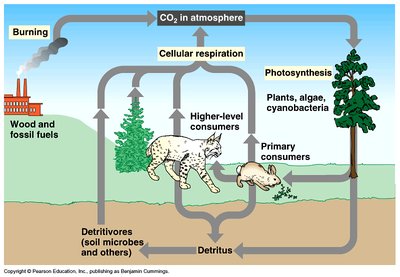
Land plants are foundational to terrestrial life, providing food, fuel, fibers, building materials, and pharmaceuticals. They are also essential for oxygen production and carbon sequestration, supporting agriculture, forestry, and horticulture.
Plants provide ecosystem services such as oxygen production, soil formation, water retention, and climate moderation.
Some plants are considered weeds, while others are invasive species that can degrade natural areas.
Major Groups of Land Plants
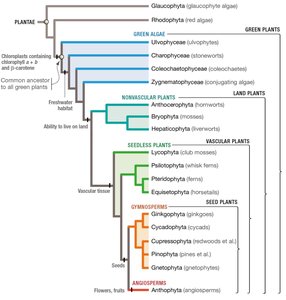
Land plants are classified into four main groups based on their evolutionary traits and adaptations:
Green Algae: Important photosynthetic organisms in freshwater habitats.
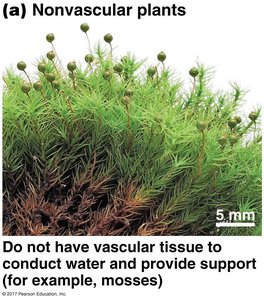
Nonvascular Plants: Lack vascular tissue; include mosses; reproduce via spores.
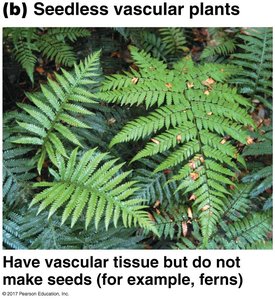
Seedless Vascular Plants: Have vascular tissue but do not produce seeds; include ferns.
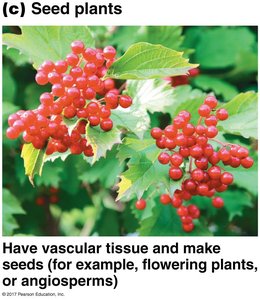
Seed Plants: Have vascular tissue and produce seeds; include gymnosperms and angiosperms.

Major Morphological Differences Among Land Plants
Land plants differ in their structural adaptations, which are linked to their evolutionary history and ecological roles.
Nonvascular Plants: Lack vascular tissue; rely on spores for reproduction.
Seedless Vascular Plants: Possess vascular tissue; reproduce via spores.
Seed Plants: Have vascular tissue and produce seeds, which consist of an embryo, nutritive tissue, and a protective coat.
Adaptations to Dry Conditions and Intense Sunlight
Early land plants evolved several key adaptations to survive in terrestrial environments:
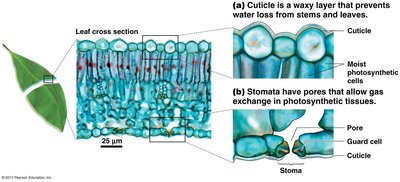
Minimizing Water Loss: Sporopollenin (on spores), cuticle, and stomata (on leaves)
Protection from UV Radiation: Flavonoids (secondary compounds protecting DNA)
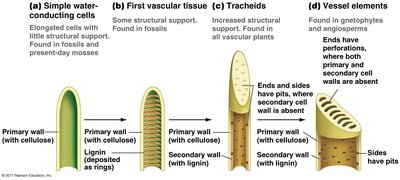
Efficient Water Transport: Vascular tissue and lignin
Reproduction in Dry Conditions
Three innovations were essential for efficient plant reproduction on land:
Spores: Resistant to drying due to tough coats
Multicellular Gametangia: Gametes produced in complex structures
Embryo Retention: Embryos nourished by parent plant
Alternation of Generations
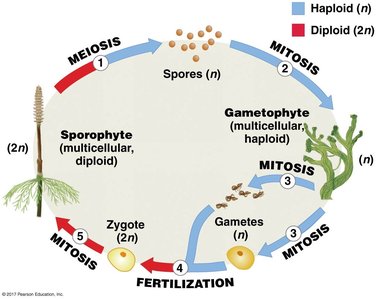
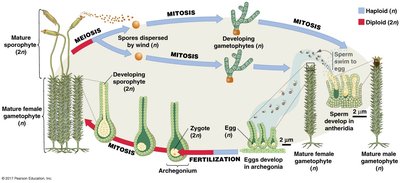
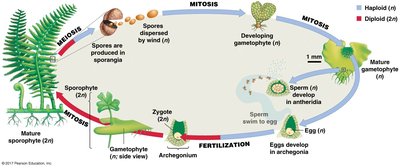
All land plants undergo alternation of generations, featuring both multicellular haploid (gametophyte) and diploid (sporophyte) phases. The two phases are connected by gametes and spores.
Gametophyte (n): Produces gametes by mitosis
Sporophyte (2n): Produces spores by meiosis
Life Cycle Sequence:
Sporophyte produces haploid spores by meiosis
Spores germinate and develop into gametophytes
Gametophytes produce gametes by mitosis
Gametes unite to form a diploid zygote
Zygote develops into a sporophyte
Gametophyte-Dominant vs. Sporophyte-Dominant Life Cycles
The dominance of gametophyte or sporophyte phases has shifted over evolutionary time:
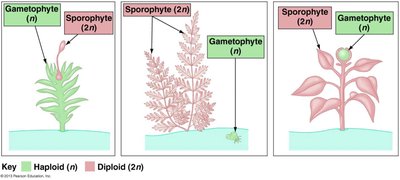
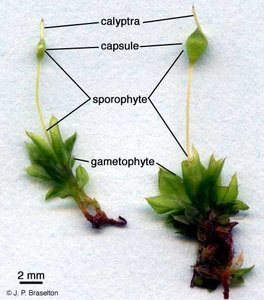
Gametophyte-Dominant: Nonvascular plants (e.g., mosses); sporophyte is small and dependent on gametophyte
Sporophyte-Dominant: Vascular plants (e.g., ferns, seed plants); sporophyte is larger and longer-lived
Gametophytes of gymnosperms and angiosperms are microscopic
Advantages of Sporophyte-Dominant Life Cycles
Sporophyte-dominated life cycles are advantageous because diploid cells can respond to environmental changes more efficiently, especially if heterozygous at many genes.
Homosporous vs. Heterosporous Plants
Plants differ in their spore production:
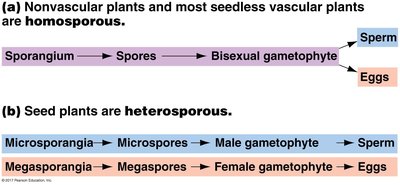
Homosporous: Nonvascular and most seedless vascular plants produce one type of spore
Heterosporous: Seed plants produce two types of spores (microspores and megaspores)
Adaptations of Angiosperm Plants to Reproduction in Dry Conditions
Angiosperms evolved several adaptations for efficient reproduction and dispersal:
Pollen: Male gametophytes surrounded by sporopollenin; can be transported by wind or animals
Seeds: Embryo and nutritive tissue surrounded by a protective coat; portable and can disperse to new locations
Flowers: Reproductive organs; coevolved with animal pollinators
Fruits: Derived from ovary; enclose seeds and aid in dispersal
Comparing Gymnosperms and Angiosperms
Trait | Gymnosperms | Angiosperms |
|---|---|---|
Pollen | Wind | Wind + Flower (pollination) |
Ovule | Present | Present + Fruit (dispersal) |
Seed | Present | Present + food |
Species Richness | ~850 species | ~250,000 species |
The Angiosperm Radiation
Angiosperms underwent adaptive radiation, producing a large number of descendant species adapted to diverse habitats. Their diversification is associated with three key adaptations:
Water-conducting vessels
Flowers
Fruits
These adaptations allow angiosperms to transport water, pollen, and seeds efficiently, contributing to their ecological success and species richness.
Diversity of Plants
Plant diversity includes green algae, nonvascular plants (e.g., mosses), seedless vascular plants (e.g., ferns), and seed plants (gymnosperms and angiosperms). Each group exhibits unique adaptations and ecological roles.
Ecological Roles of Terrestrial Plants
Terrestrial plants are vital in communities and ecosystems, providing food, oxygen, habitat, and regulating climate and nutrient cycles. Their presence enables the diversity and complexity of terrestrial life.
Additional info: Academic context was added to clarify evolutionary transitions, reproductive adaptations, and ecological roles. Images were included only when directly relevant to the explanation of each paragraph.
