 Back
BackLife Processes: Nutrition and Maintenance in Living Organisms
Study Guide - Smart Notes
 Tailored notes based on your materials, expanded with key definitions, examples, and context.
Life Processes
Introduction to Life Processes
Life processes are the essential functions that distinguish living organisms from non-living things. These processes ensure the maintenance, growth, and survival of organisms. Even when an organism appears inactive, internal processes continue to sustain life.
Definition: Life processes are the series of activities performed by living organisms to maintain and sustain life.
Examples: Nutrition, respiration, transportation, excretion.
Importance: These processes are necessary for growth, repair, energy production, and adaptation to the environment.
Maintenance Functions in Living Organisms
Maintenance functions include processes that prevent damage and ensure the proper functioning of the body. These involve the transfer of substances, energy production, and removal of waste.
Nutrition: Intake and processing of food to obtain energy and materials for growth.
Respiration: Breakdown of food to release energy.
Transportation: Movement of substances within the body.
Excretion: Removal of waste products.
Nutrition
What is Nutrition?
Nutrition is the process by which living organisms obtain and utilize food for energy, growth, and maintenance. It is a fundamental life process required for survival.
Energy Requirement: Energy is needed for all activities, including movement and cellular functions.
Food as Energy Source: Food provides the necessary energy and materials for the body.
How Do Living Things Get Their Food?
Organisms obtain food through different modes of nutrition, which can be classified as autotrophic or heterotrophic.
Autotrophic Nutrition: Organisms synthesize their own food from simple inorganic substances (e.g., plants).
Heterotrophic Nutrition: Organisms obtain food by consuming other organisms (e.g., animals, fungi).
Autotrophic Nutrition
Autotrophic nutrition is the process by which organisms, such as green plants, produce their own food using sunlight, carbon dioxide, and water through photosynthesis.
Photosynthesis: The process by which green plants convert light energy into chemical energy.
Key Equation:
Steps in Photosynthesis:
Absorption of light energy by chlorophyll
Conversion of light energy to chemical energy
Splitting of water molecules to release oxygen
Reduction of carbon dioxide to form glucose
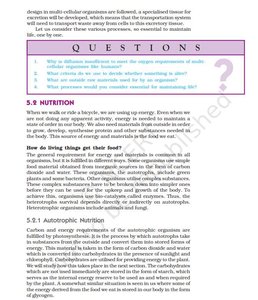
How Plants Obtain Carbon Dioxide
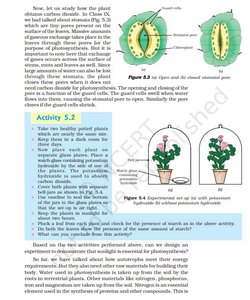
Plants obtain carbon dioxide from the atmosphere through specialized structures called stomata. The opening and closing of stomatal pores regulate gas exchange.
Stomata: Small pores on the leaf surface that allow the exchange of gases.
Guard Cells: Cells that control the opening and closing of stomata.
Heterotrophic Nutrition
Heterotrophic nutrition involves obtaining food from other organisms. The mode of nutrition depends on the organism's environment and food availability.
Types:
Herbivores: Eat plants
Carnivores: Eat other animals
Omnivores: Eat both plants and animals
Adaptations: Organisms have specialized structures and strategies for obtaining and digesting food.
How Do Organisms Obtain Their Nutrition?
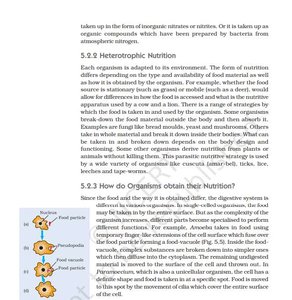
The method of food intake varies among organisms. In unicellular organisms, food is taken in through the cell surface. In multicellular organisms, specialized organs and systems are involved.
Example: Amoeba engulfs food particles by forming pseudopodia.
Summary Table: Modes of Nutrition
Mode | Definition | Example Organisms |
|---|---|---|
Autotrophic | Self-synthesis of food from inorganic substances | Plants, algae |
Heterotrophic | Obtaining food from other organisms | Animals, fungi, some bacteria |
Additional info:
These notes cover the fundamental concepts of life processes, focusing on nutrition and maintenance in living organisms. The diagrams included reinforce the understanding of photosynthesis, stomatal function, and food intake in unicellular organisms.
