 Back
Lipids and Proteins: Structure, Function, and Biological Importance
Study Guide - Smart Notes
 Tailored notes based on your materials, expanded with key definitions, examples, and context.
Lipids
Overview of Lipids
Lipids are a diverse group of hydrophobic molecules that play crucial roles in biological systems. The three major types of biologically important lipids are triglycerides, phospholipids, and steroids. All lipids share the common feature of being largely insoluble in water due to their nonpolar nature.
Triglycerides (fats and oils): Main energy storage molecules.
Phospholipids: Major components of cell membranes.
Steroids: Include hormones and cholesterol, important for signaling and membrane structure.
Structure of Fats (Triglycerides)
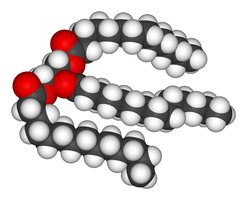
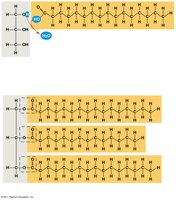
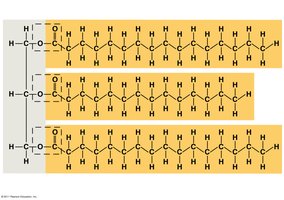
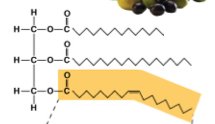
Fats are composed of two main components: glycerol and fatty acids. These are joined by ester linkages formed through dehydration synthesis reactions, where water is removed as the bond forms.
Glycerol: A three-carbon alcohol with a hydroxyl group attached to each carbon.
Fatty acids: Long hydrocarbon chains with a carboxyl group at one end.
One fat molecule (triacylglycerol) consists of one glycerol and three fatty acids.
Variation in Fats: Saturated vs. Unsaturated
Fats vary in the types of fatty acids they contain. The two main types are saturated and unsaturated fats, which differ in their chemical structure and physical properties.
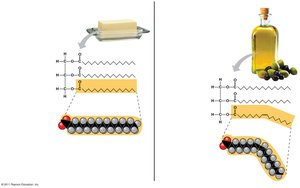
Saturated fats: Have no double bonds between carbon atoms; fatty acid chains are straight and pack tightly, making them solid at room temperature (e.g., butter, lard).
Unsaturated fats: Have one or more double bonds, causing kinks in the chain; these cannot pack tightly, making them liquid at room temperature (e.g., plant oils, fish oils).
The presence of cis double bonds in unsaturated fats causes bending, preventing tight packing.


Biological Functions of Fats
Fats serve several essential functions in living organisms:
Energy storage: Fats store more energy per gram than carbohydrates due to their high number of carbon-hydrogen bonds.
Insulation and protection: Adipose tissue cushions organs and insulates the body.
ATP production: Fats can be broken down to generate ATP, the energy currency of the cell.
Fats are used as an energy "bank" because they allow organisms to store large amounts of energy in a compact form.
Emergent Properties of Unsaturated Fats
The presence of double bonds in unsaturated fatty acids introduces kinks, which prevent tight packing. As a result, unsaturated fats remain liquid at lower temperatures compared to saturated fats. This property is crucial for maintaining membrane fluidity and function in living cells.
At lower temperatures, saturated fats solidify more readily than unsaturated fats.
Unsaturated fats are common in plants and fish, helping them maintain membrane fluidity in cooler environments.
Phospholipids
Phospholipids are a major component of cell membranes. They consist of a glycerol backbone, two fatty acid tails (hydrophobic), and a phosphate group (hydrophilic head). This amphipathic nature allows them to form bilayers in aqueous environments, creating the structural basis of biological membranes.
Hydrophilic head: Interacts with water.
Hydrophobic tails: Avoid water, orienting inward.
Phospholipid bilayers form spontaneously in water, creating a selective barrier for cells.
Steroids
Steroids are lipids characterized by a carbon skeleton with four fused rings. Cholesterol is a key steroid in animal cell membranes, regulating membrane fluidity. Many hormones, such as estrogen and testosterone, are also steroids and function as signaling molecules.
Cholesterol: Maintains membrane fluidity and stability.
Steroid hormones: Regulate various physiological processes.
Proteins
Structure of Amino Acids
Proteins are polymers of amino acids. Each amino acid has a central carbon (alpha carbon) bonded to an amino group, a carboxyl group, a hydrogen atom, and a variable side chain (R group). The R group determines the properties and identity of each amino acid.
Amino group: Basic, can accept a proton.
Carboxyl group: Acidic, can donate a proton.
R group: Varies among amino acids, conferring unique properties.
Peptide Bond Formation
Amino acids are linked by peptide bonds, which are covalent bonds formed between the carboxyl group of one amino acid and the amino group of another through a dehydration reaction (releasing water).
The resulting chain is called a polypeptide.
Polypeptides have an N-terminus (amino end) and a C-terminus (carboxyl end).
Levels of Protein Structure
Protein structure is organized into four hierarchical levels:
Primary structure: The unique sequence of amino acids in a polypeptide chain.
Secondary structure: Local folding into alpha helices and beta pleated sheets, stabilized by hydrogen bonds.
Tertiary structure: Overall 3D shape of a polypeptide, stabilized by interactions between R groups (hydrogen bonds, ionic bonds, disulfide bridges, hydrophobic interactions).
Quaternary structure: Association of multiple polypeptide subunits to form a functional protein (e.g., hemoglobin).
Importance of Protein Structure
The function of a protein is directly related to its structure. Even a single amino acid change can disrupt protein function, as seen in diseases like sickle-cell anemia. Protein shape is essential for enzyme activity, transport, immune response, and more.
Enzymes: Catalyze biochemical reactions with high specificity.
Transport proteins: Move substances across membranes.
Antibodies: Recognize and bind specific foreign molecules.
Protein Denaturation
Proteins can lose their functional shape (denature) when exposed to extreme heat, pH, or high salt concentrations. Denaturation disrupts non-covalent bonds, causing loss of function. Some proteins can refold and regain function, but many cannot.
Summary Table: Types of Lipids
Lipid Type | Structure | Main Function | Example |
|---|---|---|---|
Triglyceride | Glycerol + 3 fatty acids | Energy storage | Butter, vegetable oil |
Phospholipid | Glycerol + 2 fatty acids + phosphate group | Membrane structure | Cell membrane |
Steroid | Four fused carbon rings | Signaling, membrane fluidity | Cholesterol, hormones |
Summary Table: Levels of Protein Structure
Level | Description | Stabilizing Bonds | Example |
|---|---|---|---|
Primary | Sequence of amino acids | Covalent (peptide bonds) | Insulin sequence |
Secondary | Alpha helix, beta sheet | Hydrogen bonds | Keratin, silk |
Tertiary | 3D folding of polypeptide | Hydrogen, ionic, disulfide, hydrophobic | Myoglobin |
Quaternary | Association of multiple polypeptides | Same as tertiary | Hemoglobin |
Key Equations
Dehydration synthesis (formation of a peptide bond):
General formula for a fatty acid:
Additional info: The notes above expand on the original lecture content by providing definitions, examples, and summary tables for clarity and completeness. The images included are only those that directly illustrate the molecular structure and differences between types of fats, as well as the process of fat synthesis.
