 Back
Lipids, Membranes, and Cell Permeability: Study Notes for General Biology
Study Guide - Smart Notes
 Tailored notes based on your materials, expanded with key definitions, examples, and context.
Lipids and Membranes
Overview of Biological Macromolecules
Four classes of macromolecules are essential for life: polysaccharides, proteins, nucleic acids, and lipids. Each class is built from specific monomers: monosaccharides for polysaccharides, amino acids for proteins, nucleotides for nucleic acids, and fatty acids/isoprenoids for lipids. Lipids are unique in that they are not polymers and their interactions with water govern their structure and function.
Structure of Lipids
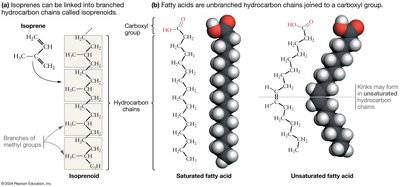
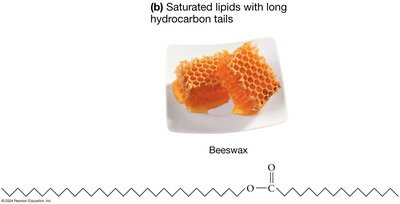
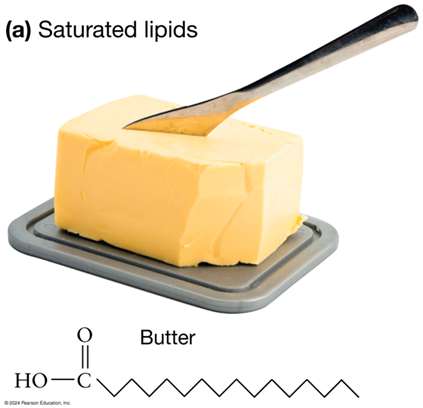
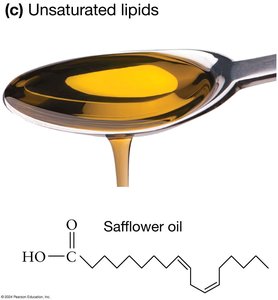
Lipids are hydrophobic molecules, primarily composed of long hydrocarbon chains or rings. They include fatty acids, triglycerides, phospholipids, and steroids. Fatty acids can be saturated (no double bonds, straight chains) or unsaturated (one or more double bonds, kinked chains). Saturated lipids are typically solid at room temperature, while unsaturated lipids are liquid.
Saturated fatty acids: Straight hydrocarbon chains, pack tightly, solid at room temperature.
Unsaturated fatty acids: Kinked chains due to double bonds, pack loosely, liquid at room temperature.
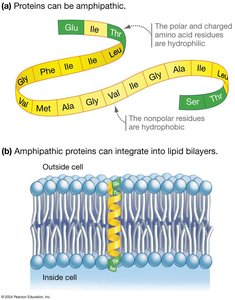
Phospholipids: Amphipathic molecules with hydrophilic heads and hydrophobic tails, forming the basis of cell membranes.
Amphipathic Nature of Phospholipids
Phospholipids are amphipathic, meaning they have both hydrophilic (polar) heads and hydrophobic (nonpolar) tails. This property allows them to form bilayers in aqueous environments, with the hydrophobic tails facing inward and the hydrophilic heads facing outward.
Cell Membrane Structure and Function
Phospholipid Bilayer
The cell membrane is primarily composed of a phospholipid bilayer. This bilayer acts as a selective barrier, regulating the movement of molecules into and out of the cell. The arrangement of phospholipids creates a semi-permeable membrane, allowing certain molecules to pass while restricting others.
Fluid Mosaic Model
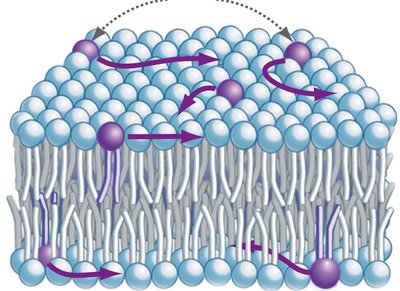
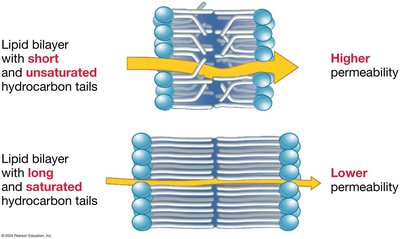
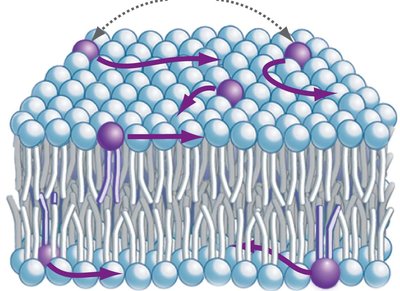
The fluid mosaic model describes the cell membrane as a dynamic structure where lipids and proteins move laterally within the layer. Membrane fluidity is influenced by the type and length of fatty acid tails, presence of cholesterol, and temperature.
Short, unsaturated tails: Increase fluidity and permeability.
Long, saturated tails: Decrease fluidity and permeability.
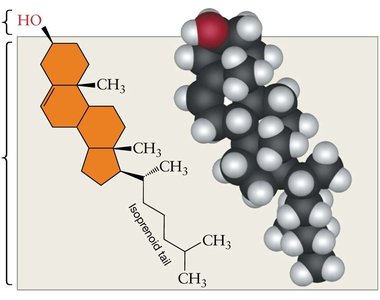
Cholesterol: Packs tightly with phospholipid tails, reducing fluidity at high temperatures and increasing stability at low temperatures.
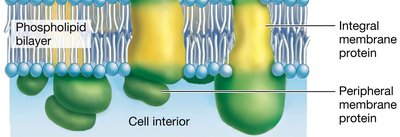
Proteins: Integral and peripheral proteins contribute to membrane function and structure.
Van der Waals Forces in Membranes
Non-polar tails of phospholipids are held together by van der Waals forces. These weak interactions are crucial for maintaining membrane integrity and flexibility. The strength of these forces depends on the tail structure and packing density.
Temperature Effects on Membrane Permeability
Temperature affects membrane fluidity and permeability. Lower temperatures cause phospholipid tails to pack tightly, increasing van der Waals forces and decreasing permeability. Higher temperatures increase tail movement, loosening packing and increasing permeability.
Membrane Permeability and Transport
Diffusion Across Lipid Bilayers
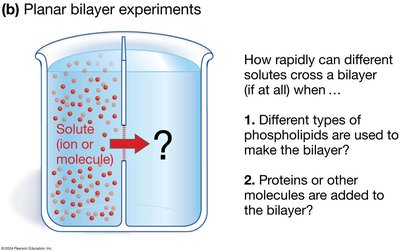
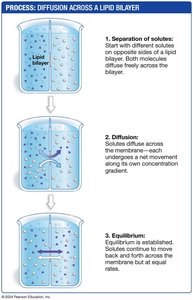
Diffusion is the passive movement of molecules from areas of high concentration to low concentration. The permeability of the membrane depends on the size, polarity, and charge of the molecules.
Small, nonpolar molecules: High permeability (e.g., O2, CO2).
Small, uncharged polar molecules: Moderate permeability (e.g., H2O, glycerol).
Large, uncharged polar molecules: Low permeability (e.g., glucose).
Ions: Very low permeability due to charge.
Osmosis and Tonicity
Osmosis is the diffusion of water across a semi-permeable membrane. Tonicity describes the relative concentration of solutes on either side of the membrane:
Hypertonic: Higher solute, lower water concentration.
Hypotonic: Lower solute, higher water concentration.
Isotonic: Equal solute and water concentration.
Facilitated Diffusion
Some molecules require assistance to cross the membrane. Facilitated diffusion involves channel proteins (e.g., aquaporins for water) and carrier proteins, allowing ions and polar molecules to move down their concentration gradients without energy input.
Summary Table: Membrane Permeability
Type of Molecule | Permeability | Example |
|---|---|---|
Small, nonpolar | High | O2, CO2 |
Small, uncharged polar | Moderate | H2O, glycerol |
Large, uncharged polar | Low | Glucose |
Ions | Very low | Na+, Cl- |
Key Equations
Diffusion rate across a membrane can be described by Fick's Law:
Where: J = flux (rate of diffusion) D = diffusion coefficient \frac{dC}{dx} = concentration gradient
Conclusion
The structure and composition of the cell membrane are critical for its function as a selective barrier. Lipids, proteins, and cholesterol interact to regulate membrane fluidity, permeability, and transport processes, ensuring proper cellular function.
