 Back
Lipids, Membranes, and Membrane Permeability
Study Guide - Smart Notes
 Tailored notes based on your materials, expanded with key definitions, examples, and context.
Lipids and Membranes
Introduction to Biological Membranes
The plasma membrane is a dynamic structure that regulates the movement of molecules into and out of the cell. Its composition and physical state are critical for cellular function, influencing permeability, fluidity, and the ability to respond to environmental changes.
Selective Permeability: The membrane allows certain molecules to pass while restricting others, maintaining homeostasis.
Regulation: Membrane proteins and lipids contribute to the regulation of transport, signaling, and cell recognition.
Influence of Composition and Temperature: The types of lipids, presence of cholesterol, and temperature all affect membrane fluidity and permeability.
Macromolecules of Life
Classes and Building Blocks
Four major classes of macromolecules are essential for life: polysaccharides, proteins, nucleic acids, and lipids. Their interactions with water determine their structure and function.
Polysaccharides: Polymers of monosaccharides (sugars).
Proteins: Polymers of amino acids.
Nucleic Acids: Polymers of nucleotides.
Lipids: Not true polymers; composed of hydrophobic molecules such as fatty acids and glycerol.
Lipids: Structure and Types
Fatty Acids and Lipid Diversity
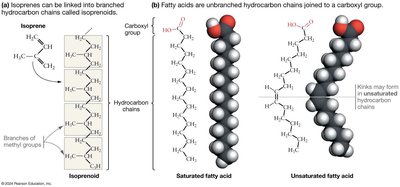
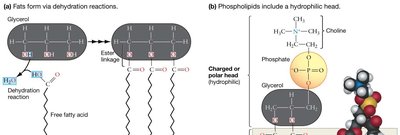
Lipids are hydrophobic molecules that include fats, phospholipids, and steroids. Fatty acids can be saturated (no double bonds) or unsaturated (one or more double bonds), affecting their physical properties and biological roles.
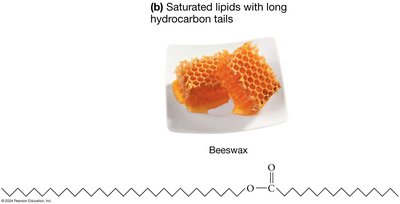
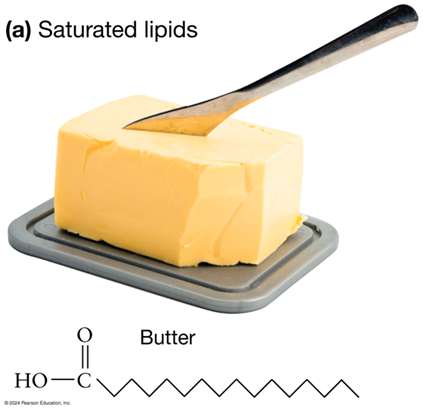
Saturated Fatty Acids: No double bonds; straight chains; pack tightly; solid at room temperature (e.g., butter, beeswax).
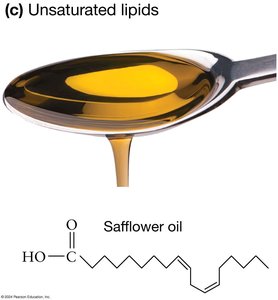
Unsaturated Fatty Acids: One or more double bonds; kinks in chains; less tightly packed; liquid at room temperature (e.g., safflower oil).
Phospholipids and Amphipathic Nature
Phospholipids are amphipathic molecules with hydrophilic (polar) heads and hydrophobic (nonpolar) tails. This dual nature drives the formation of biological membranes.
Amphipathic: Molecules with both hydrophilic and hydrophobic regions.
Bilayer Formation: In aqueous environments, phospholipids spontaneously form bilayers, with tails inward and heads outward.
Membrane Structure and Fluidity
Van der Waals Forces and Membrane Packing
Non-polar tails of phospholipids are held together by van der Waals forces, which are weak attractions between molecules. The strength of these forces depends on the length and saturation of the hydrocarbon tails.
Van der Waals Forces: Weak, transient attractions that stabilize the membrane structure.
Effect of Tail Structure: Kinked (unsaturated) tails reduce packing and increase fluidity; straight (saturated) tails increase packing and decrease fluidity.
Role of Cholesterol
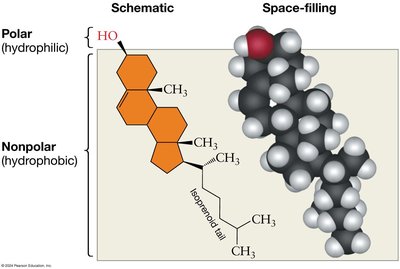
Cholesterol is an amphipathic molecule that modulates membrane fluidity. It fits between phospholipid tails, affecting their packing and the overall permeability of the membrane.
At Low Temperatures: Cholesterol prevents tight packing, maintaining fluidity.
At High Temperatures: Cholesterol stabilizes the membrane and reduces fluidity.
Fluid Mosaic Model
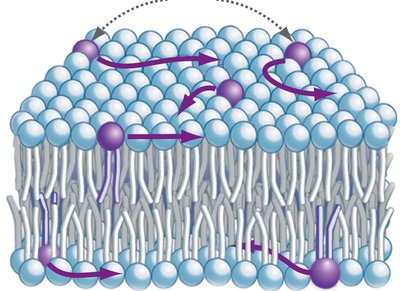
The cell membrane is described by the fluid mosaic model, where lipids and proteins move laterally within the layer, creating a dynamic and flexible structure.
Components: Phospholipids, cholesterol, proteins, and carbohydrates.
Fluidity: Influenced by lipid composition, cholesterol content, and temperature.
Membrane Permeability and Transport
Diffusion and Brownian Motion
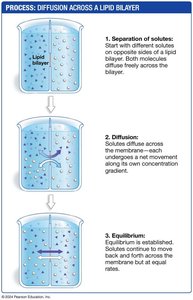
Diffusion is the passive movement of molecules from areas of high concentration to low concentration, driven by Brownian motion. This process is fundamental to the movement of substances across membranes.
Brownian Motion: Random movement of particles in solution.
Equilibrium: Achieved when molecules are evenly distributed, with no net movement.
Permeability of the Lipid Bilayer
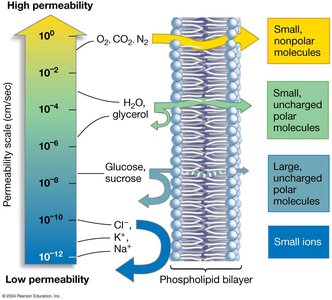
The permeability of the membrane depends on the size, polarity, and charge of molecules, as well as the composition of the bilayer.
High Permeability: Small, nonpolar molecules (e.g., O2, CO2).
Moderate Permeability: Small, uncharged polar molecules (e.g., H2O, glycerol).
Low Permeability: Large, uncharged polar molecules (e.g., glucose) and ions (e.g., Na+, Cl-).
Effect of Tail Structure on Permeability
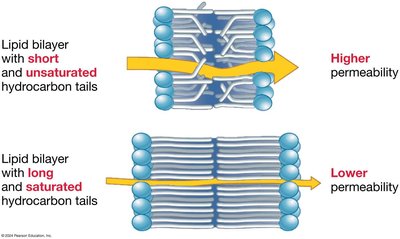
Bilayers with short and unsaturated hydrocarbon tails have higher permeability, while those with long and saturated tails have lower permeability.
Role of Proteins in Membrane Structure
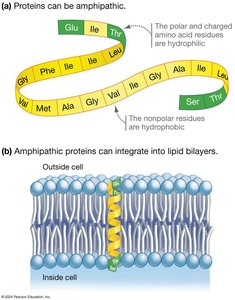
Proteins can be amphipathic and integrate into the lipid bilayer, contributing to membrane structure and function. Integral proteins span the membrane, while peripheral proteins are attached to the surface.
Integral Proteins: Span the membrane and are involved in transport and signaling.
Peripheral Proteins: Attached to the membrane surface; involved in signaling and maintaining cell shape.
Osmosis and Tonicity
Osmosis
Osmosis is the diffusion of water across a selectively permeable membrane. The direction of water movement depends on the relative solute concentrations on either side of the membrane.
Hypertonic Solution: Higher solute concentration outside the cell; water moves out.
Hypotonic Solution: Lower solute concentration outside the cell; water moves in.
Isotonic Solution: Equal solute concentration; no net water movement.
Facilitated Diffusion and Membrane Proteins
Facilitated Diffusion
Some molecules and ions cannot diffuse freely across the lipid bilayer and require the assistance of membrane proteins. Facilitated diffusion is a passive process that does not require energy.
Aquaporins: Channel proteins that facilitate water movement.
Ion Channels: Allow specific ions to pass through the membrane down their electrochemical gradients.
Summary Table: Factors Affecting Membrane Fluidity and Permeability
Factor | Effect on Fluidity | Effect on Permeability |
|---|---|---|
Short, unsaturated tails | Increase | Increase |
Long, saturated tails | Decrease | Decrease |
Cholesterol (low temp) | Increase | Increase |
Cholesterol (high temp) | Decrease | Decrease |
High temperature | Increase | Increase |
Low temperature | Decrease | Decrease |
Additional info: The notes above integrate foundational concepts from the chapters "Biomolecules," "The Membrane," and "Energy and Metabolism," as well as relevant experimental and structural details for General Biology students.
