 Back
Lipids, Membranes, and Membrane Transport: Structure, Function, and Mechanisms
Study Guide - Smart Notes
 Tailored notes based on your materials, expanded with key definitions, examples, and context.
Lipids, Membranes, and Membrane Transport
6.1 Lipid Structure and Function
Lipids are a diverse group of hydrophobic, mostly hydrocarbon molecules that play critical roles in cellular structure and function. Unlike proteins, nucleic acids, and carbohydrates, lipids are not polymers because they are not composed of repeating monomeric units.
Hydrocarbons: Molecules consisting entirely of carbon and hydrogen. Their structure can be linear, branched, or ring-shaped.
Hydrophobicity: Lipids are largely nonpolar and insoluble in water due to their hydrocarbon content.
Not Polymers: Lipids are not built from repeating monomers.
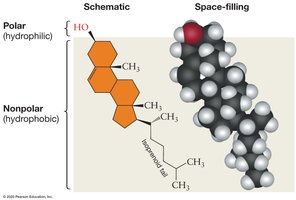
Types of Lipids in Cells
There are three major types of lipids found in cells, each with distinct structures and functions:
Steroids: Characterized by a four-ring hydrocarbon structure with an isoprenoid tail and a hydroxyl group. Examples include cholesterol (a membrane component) and hormones such as estrogen and testosterone.
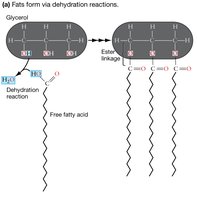
Fats (Triglycerides): Composed of a glycerol molecule bonded to three fatty acid chains. Their primary role is energy storage.
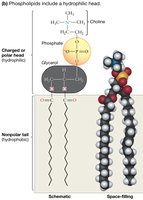
Phospholipids: Consist of a glycerol backbone, two fatty acid tails, and a phosphate-containing polar head group. They are amphipathic, with both hydrophilic and hydrophobic regions, making them essential for membrane structure.
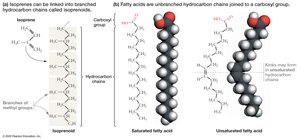
Saturated vs. Unsaturated Fatty Acids
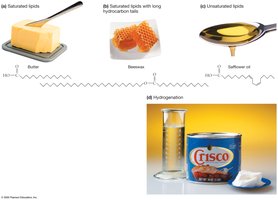
Saturated fatty acids: Have no double bonds between carbon atoms; their hydrocarbon chains are straight, allowing tight packing (solid at room temperature).
Unsaturated fatty acids: Contain one or more double bonds, introducing kinks that prevent tight packing (liquid at room temperature).
6.2 Phospholipid Bilayers
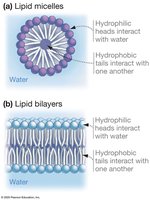
Phospholipids spontaneously form organized structures in aqueous environments due to their amphipathic nature. The hydrophilic heads interact with water, while the hydrophobic tails avoid water, leading to the formation of micelles and bilayers.
Micelles: Spherical structures with hydrophilic heads facing outward and hydrophobic tails inward.
Bilayers: Double-layered sheets with hydrophobic tails sandwiched between hydrophilic heads facing the aqueous environment on both sides.
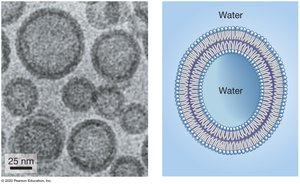
Artificial vesicles called liposomes can be formed from phospholipid bilayers, encapsulating water and solutes inside.
Selective Permeability of Phospholipid Bilayers
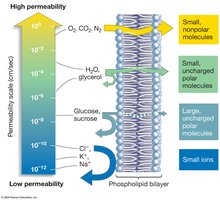
Phospholipid bilayers are selectively permeable, allowing some substances to cross more easily than others:
Small, nonpolar molecules (e.g., O2, CO2) move across quickly.
Small, uncharged polar molecules (e.g., H2O, glycerol) cross at moderate rates.
Large, uncharged polar molecules (e.g., glucose) and ions (e.g., Na+, Cl-) cross slowly or not at all.
Factors Affecting Membrane Permeability
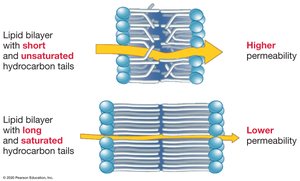
Hydrocarbon tail length: Shorter tails increase permeability; longer tails decrease it.
Saturation: Unsaturated tails (with double bonds) increase permeability; saturated tails decrease it.
Cholesterol: Presence of cholesterol decreases membrane permeability by packing phospholipids more tightly.
Membrane Fluidity
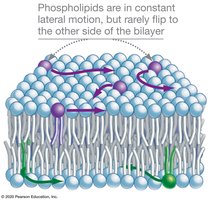
Phospholipids move laterally within the membrane, contributing to fluidity.
They rarely flip-flop between layers.
Increased temperature enhances membrane fluidity and permeability.
6.3 How Substances Move Across Lipid Bilayers: Diffusion and Osmosis
Substances move across membranes by passive or active processes. Passive processes do not require energy input.
Diffusion
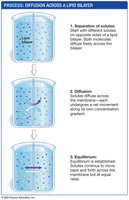
Diffusion: The spontaneous movement of molecules from regions of high concentration to low concentration, driven by the concentration gradient.
Equilibrium: Achieved when molecules are evenly distributed, but they continue to move randomly.
Osmosis
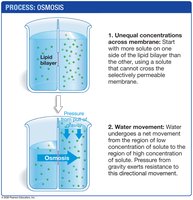
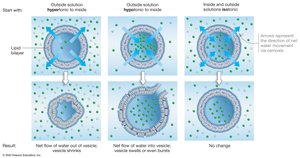
Osmosis: The diffusion of water across a selectively permeable membrane from regions of low solute concentration to high solute concentration.
Hypertonic solution: Higher solute concentration compared to another solution.
Hypotonic solution: Lower solute concentration compared to another solution.
Isotonic solutions: Equal solute concentrations on both sides of the membrane.
6.4 Proteins Alter Membrane Structure and Function
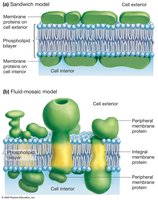
Biological membranes are composed of both lipids and proteins. Membrane proteins are amphipathic, allowing them to reside within the bilayer and perform various functions, including transport.
Fluid-Mosaic Model: Membranes are a mosaic of phospholipids and proteins, with some proteins spanning the bilayer (integral) and others attached to the surface (peripheral).
Transport Proteins
Transport proteins facilitate the movement of substances across membranes. There are three main types:
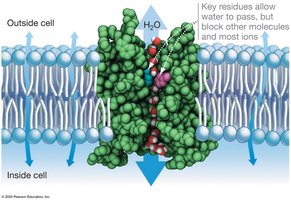
Channels: Allow specific ions or water to diffuse through the membrane with their electrochemical gradient (facilitated diffusion).
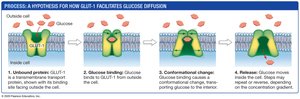
Carriers: Bind to specific molecules and undergo conformational changes to transport them across the membrane (facilitated diffusion).
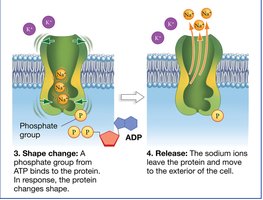
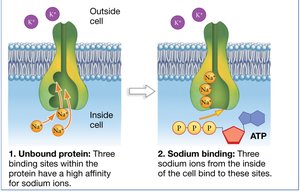
Pumps: Use energy (usually from ATP) to move substances against their concentration gradient (active transport).
Electrochemical Gradient
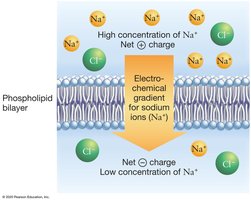
An electrochemical gradient combines the effects of a concentration gradient and an electrical (charge) gradient across a membrane.
Ion Channels
Highly selective membrane proteins that form pores for specific ions to cross the membrane with their electrochemical gradient.
Carrier Proteins
Bind to solutes and change shape to shuttle them across the membrane, moving substances down their concentration gradient.
Pumps and Active Transport
Move substances against their gradient, requiring energy input (usually from ATP hydrolysis).
The sodium-potassium pump is a classic example, exchanging Na+ and K+ ions across the plasma membrane.
Summary Table: Passive and Active Membrane Transport Mechanisms
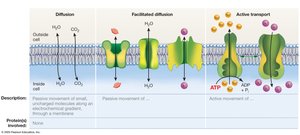
Type | Description | Proteins Involved | Energy Required? |
|---|---|---|---|
Diffusion | Passive movement of small, uncharged molecules along a concentration gradient | None | No |
Facilitated Diffusion | Passive movement of molecules via channel or carrier proteins | Channels, Carriers | No |
Active Transport | Movement of molecules against their gradient using energy | Pumps | Yes (ATP) |
Additional info: The sodium-potassium pump (Na+/K+-ATPase) is essential for maintaining the electrochemical gradients necessary for nerve impulse transmission and muscle contraction.
