 Back
Lipids, Membranes, and Membrane Transport: Study Notes for General Biology
Study Guide - Smart Notes
 Tailored notes based on your materials, expanded with key definitions, examples, and context.
Lipid Structure and Function
Definition and Properties of Lipids
Lipids are a diverse group of biological molecules primarily composed of hydrocarbons. They are characterized by their insolubility in water, making them largely nonpolar and hydrophobic. Unlike proteins, nucleic acids, and carbohydrates, lipids are not considered polymers because they are not built from repeating monomer units.
Hydrocarbons: Molecules containing only carbon and hydrogen, forming the backbone of most lipids.
Hydrophobicity: Lipids do not mix with water due to their nonpolar nature.
Non-polymeric: Lipids are not made from repeating monomers.
Types of Lipids in Cells
The three most important types of lipids found in cells are steroids, fats, and phospholipids. Each type has a distinct structure and function.
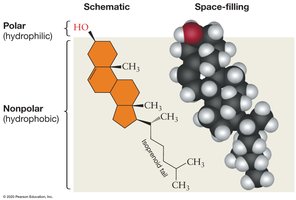
Steroids: Defined by a four-ring hydrocarbon structure with an isoprenoid tail and a polar hydroxyl group. Examples include cholesterol (a membrane component) and hormones (e.g., estrogen, testosterone).
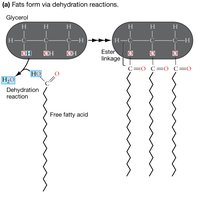
Fats: Serve as energy storage molecules, composed of glycerol and three fatty acid chains.
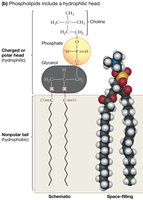
Phospholipids: Major components of biological membranes, consisting of glycerol, two fatty acid chains, and a polar phosphate-containing head group. They are amphipathic, with both hydrophilic and hydrophobic regions.
Saturated vs. Unsaturated Fatty Acids
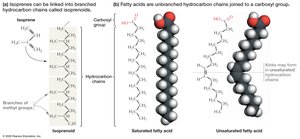
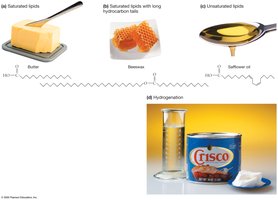
Fatty acids can be saturated (no double bonds, straight chains) or unsaturated (one or more double bonds, kinked chains). This affects the physical properties and fluidity of lipids.
Saturated fatty acids: Pack tightly, solid at room temperature (e.g., butter).
Unsaturated fatty acids: Have kinks, less tightly packed, liquid at room temperature (e.g., oils).
Phospholipid Bilayers
Formation and Structure
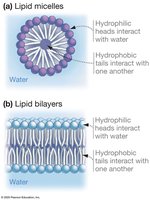
Phospholipids spontaneously form micelles and bilayers in aqueous environments due to their amphipathic nature.
Micelles: Spherical structures with hydrophilic heads facing water and hydrophobic tails inward.
Bilayers: Double-layered sheets with hydrophilic heads facing outward and hydrophobic tails facing inward.
Liposomes
Liposomes are artificial vesicles formed by phospholipid bilayers, used in research and medicine to mimic cell membranes. 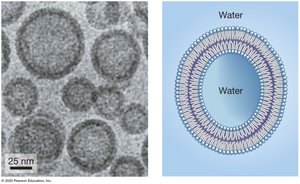
Selective Permeability of Bilayers
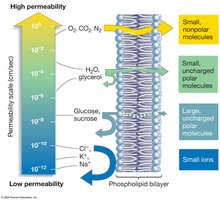
Phospholipid bilayers exhibit selective permeability, allowing certain molecules to pass while blocking others.
Small, nonpolar molecules: Pass quickly (e.g., O2, CO2).
Small, uncharged polar molecules: Pass slowly (e.g., H2O, glycerol).
Large, uncharged polar molecules: Pass very slowly or not at all (e.g., glucose).
Charged substances: Cannot pass through (e.g., ions).
Factors Affecting Membrane Permeability
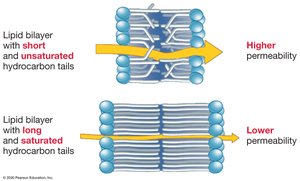
The permeability of membranes is influenced by the length and saturation of hydrocarbon tails and the presence of cholesterol.
Short, unsaturated tails: Increase permeability.
Long, saturated tails: Decrease permeability.
Cholesterol: Reduces permeability by packing tails tightly.
Membrane Fluidity
Phospholipids move laterally within the membrane, contributing to fluidity. Increased temperature enhances mobility and permeability. Phospholipids rarely flip to the other side of the bilayer. 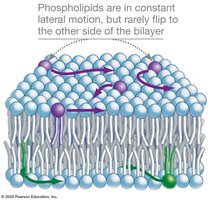
Diffusion and Osmosis Across Lipid Bilayers
Diffusion
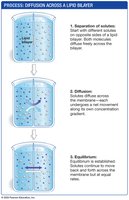
Diffusion is the spontaneous movement of molecules from regions of high concentration to low concentration, driven by a concentration gradient.
Equilibrium: Achieved when concentrations are equal on both sides of the membrane.
Osmosis
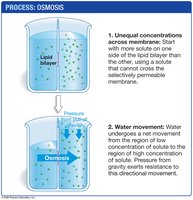
Osmosis is the diffusion of water across a selectively permeable membrane, moving from low solute concentration to high solute concentration.
Hypertonic: Higher solute concentration.
Hypotonic: Lower solute concentration.
Isotonic: Equal solute concentrations.
Effects of Osmosis on Cells
Osmosis can cause membrane-bound vesicles to shrink or burst depending on the surrounding solution's tonicity. 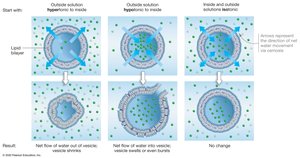
Proteins Alter Membrane Structure and Function
Membrane Proteins and the Fluid-Mosaic Model
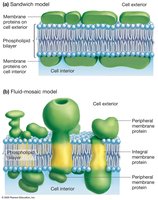
Biological membranes contain as much protein as phospholipids. Membrane proteins must be amphipathic to integrate into the bilayer. The fluid-mosaic model describes membranes as a mosaic of proteins embedded in a fluid phospholipid bilayer.
Integral proteins: Span the membrane.
Peripheral proteins: Attach to the membrane surface.
Transport Proteins
Transport proteins facilitate the movement of molecules across membranes.
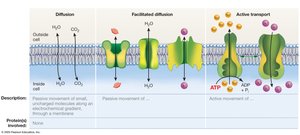
Facilitated diffusion: Movement with the concentration gradient via channels or carriers.
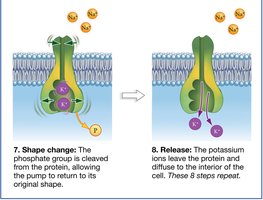
Active transport: Movement against the concentration gradient via pumps, requiring energy (usually ATP).
Types of Transport Proteins
Channels: Form pores for specific ions to diffuse with their electrochemical gradient.
Carriers: Bind and transport solutes across the membrane via conformational changes.
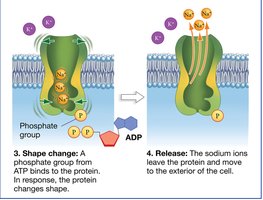
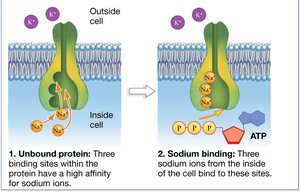
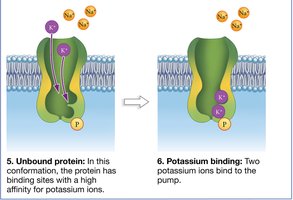
Pumps: Move substances against their gradient, powered by ATP.
Electrochemical Gradient
An electrochemical gradient combines concentration and electrical gradients across a membrane, influencing ion movement. 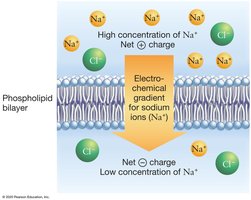
Ion Channels
Ion channels are highly selective membrane proteins that allow specific ions to cross the membrane with their electrochemical gradient. 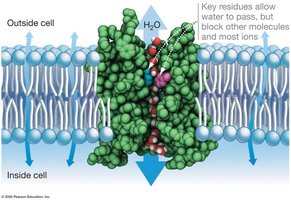
Carrier Proteins
Carrier proteins facilitate diffusion by binding to a solute and undergoing structural changes to transport it across the membrane. 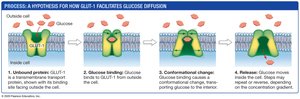
Pumps and Active Transport
Pumps perform active transport, moving substances against their gradient and requiring energy input, typically from ATP. The sodium-potassium pump is a classic example, maintaining cellular ion balance.
ATP hydrolysis: Provides energy for pump function.
Shape change: Phosphate transfer induces conformational changes in the pump.
Summary of Membrane Transport Mechanisms
Mechanism | Description | Proteins Involved |
|---|---|---|
Diffusion | Passive movement of small, uncharged molecules along concentration gradient | None |
Facilitated Diffusion | Passive movement of molecules via channels or carriers | Channels, Carriers |
Active Transport | Active movement of molecules against gradient, requires ATP | Pumps |
Key Equations
Diffusion Equation
The rate of diffusion is proportional to the concentration gradient:
Osmosis Equation
Osmotic pressure can be calculated as:
J: Flux
D: Diffusion coefficient
C: Concentration
x: Distance
\Pi: Osmotic pressure
i: van 't Hoff factor
M: Molarity
R: Gas constant
T: Temperature
Summary
Lipids are essential for energy storage, membrane structure, and signaling. Phospholipid bilayers form the basis of biological membranes, exhibiting selective permeability and fluidity. Membrane proteins enable transport of substances via diffusion, facilitated diffusion, and active transport, maintaining cellular homeostasis.
