 Back
BackLipids, Membranes, and the First Cells: Structure, Function, and Transport
Study Guide - Smart Notes
 Tailored notes based on your materials, expanded with key definitions, examples, and context.
Lipids, Membranes, and the First Cells
Introduction to Biological Membranes
The plasma membrane, also known as the cell membrane, is a fundamental structure that separates living cells from their external environment. It acts as a selective barrier, allowing essential materials to enter, excluding harmful substances, and facilitating the chemical reactions necessary for life by compartmentalizing reactants.
Selective Barrier: Controls the movement of substances in and out of the cell.
Chemical Compartmentalization: Enables efficient biochemical reactions by sequestering specific chemicals.
6.1 Lipid Structure and Function
Definition and Properties of Lipids
Lipids are carbon-containing compounds that are insoluble in water due to their high proportion of nonpolar bonds. The nonpolar nature arises from hydrocarbon chains, which are hydrophobic because electrons are shared equally between carbon and hydrogen atoms.
Hydrocarbons: Molecules containing only carbon and hydrogen; nonpolar and hydrophobic.
Bond Saturation and Hydrocarbon Structure
The physical properties of fatty acids depend on the saturation of their hydrocarbon chains:
Saturated Fatty Acids: Only single bonds between carbons; maximum number of hydrogen atoms; typically solid at room temperature.
Unsaturated Fatty Acids: One or more double bonds; fewer hydrogen atoms; double bonds create kinks; typically liquid at room temperature.
Polyunsaturated: Multiple double bonds present.
Foods with unsaturated lipids are generally considered healthier due to their liquid state at room temperature.
Major Types of Lipids in Cells
Lipids have diverse structures, but three main types are crucial in cells:
Steroids: Characterized by a bulky, four-ring structure; examples include cholesterol, estrogen, and testosterone.
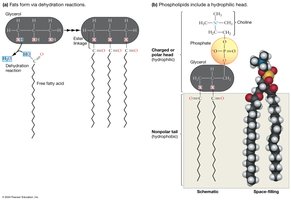
Fats (Triacylglycerols/Triglycerides): Composed of three fatty acids linked to glycerol; primary role is energy storage; formed by dehydration reactions creating ester linkages.
Phospholipids: Consist of glycerol, a phosphate group, and two hydrocarbon tails; major component of cell membranes.
6.2 Phospholipid Bilayers
Amphipathic Nature of Membrane Lipids
Phospholipids are amphipathic, meaning they contain both hydrophilic (water-attracting) and hydrophobic (water-repelling) regions. The hydrophilic head includes glycerol, a negatively charged phosphate group, and a charged or polar group, while the hydrophobic tail consists of nonpolar hydrocarbon chains.
Amphipathic Molecules: Responsible for the formation of biological membranes.
Formation of Micelles and Bilayers
In aqueous environments, amphipathic lipids spontaneously form structures:
Micelles: Spherical aggregates formed by free fatty acids.
Lipid Bilayers: Paired sheets of phospholipids; form the basis of cell membranes without energy input.
Selective Permeability of Lipid Bilayers
Phospholipid bilayers exhibit selective permeability:
Small or Nonpolar Molecules: Cross quickly (e.g., O2).
Large or Charged Molecules: Cross slowly or not at all (e.g., glucose).
Phospholipid Movement within Membranes
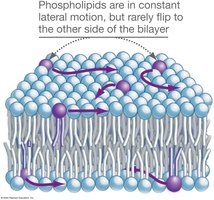
Phospholipids are dynamic, moving laterally within the membrane but rarely flipping between layers. This fluidity is essential for membrane function and flexibility.
6.3 How Substances Move Across Lipid Bilayers: Diffusion and Osmosis
Diffusion
Diffusion is the spontaneous movement of molecules from regions of high concentration to low concentration, driven by thermal energy. When equilibrium is reached, molecules are evenly distributed, but random movement continues. Passive transport occurs when substances diffuse across membranes without energy input.
Osmosis
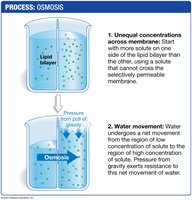
Osmosis is a special case of diffusion involving water movement across a selectively permeable membrane. Water moves from areas of low solute concentration to high solute concentration, diluting the solute and equalizing concentrations on both sides.
Hypertonic Solution: Higher solute concentration outside the cell; water exits the cell, causing shrinkage.
Hypotonic Solution: Lower solute concentration outside; water enters the cell, causing swelling.
Isotonic Solution: Equal solute concentrations; no net water movement.
Membranes and Chemical Evolution
Protocells and the Origin of Life
The first lipid bilayers likely provided containers for the earliest self-replicating molecules, such as RNA. Protocells are simple vesicle-like structures that may have been intermediates in the evolution of true cells, encapsulating nucleic acids and other biomolecules.
6.4 Proteins Alter Membrane Structure and Function
Role of Membrane Proteins
While phospholipids form the basic structure of membranes, proteins are essential for membrane function. Amphipathic proteins can insert into membranes, forming channels and passageways for specific molecules.
Integral (Transmembrane) Proteins: Span the membrane, with segments exposed on both sides.
Peripheral Proteins: Bind to membrane surfaces without crossing the bilayer.
Fluid-Mosaic Model
The fluid-mosaic model describes the membrane as a dynamic structure with proteins embedded in or associated with a fluid phospholipid bilayer. This model explains the diversity and mobility of membrane components.
Transport Proteins and Membrane Permeability
Membrane proteins facilitate the movement of ions and molecules across the bilayer:
Channel Proteins: Form selective pores for ions and small molecules; movement is passive and regulated by signals (gated channels).
Carrier Proteins: Undergo conformational changes to transport specific solutes (e.g., glucose transporter GLUT-1).
Aquaporins: Specialized channels for water transport.
Active and Passive Transport
Transport across membranes can be passive or active:
Passive Transport: Includes simple diffusion and facilitated diffusion; moves substances down their concentration gradients without energy input.
Active Transport: Moves substances against their gradients; requires energy, often from ATP (e.g., sodium–potassium pump).
Secondary active transport (cotransport) uses the energy stored in electrochemical gradients to move other substances against their gradients, without directly using ATP.
Summary Table: Types of Membrane Transport
Transport Type | Energy Requirement | Direction Relative to Gradient | Example |
|---|---|---|---|
Simple Diffusion | No | Down | O2 movement |
Facilitated Diffusion (Channel/Carrier) | No | Down | GLUT-1 (glucose) |
Active Transport (Pump) | Yes (ATP) | Against | Sodium–potassium pump |
Secondary Active Transport | Indirect (gradient) | Against (for one molecule) | Cotransporters |
